3 weeks ago
69
3 weeks ago
69
Lawrence Abu Hamdan has a double identity. He is an artist who, in 2019, jointly won the Turner prize; and one of his works is, for my money, among the most striking on show at this year’s Venice Biennale. But he is also the director of a young NGO, founded in 2023, called Earshot, which investigates human rights abuses using sound evidence. In less euphemistic language, that means, on occasion, investigating horrific killings. He and his team might analyse the direction and position of bullets Israeli soldiers have fired at emergency workers in Gaza, or build evidence that a sonic weapon was likely used to disperse a mass silent vigil in Belgrade.
The foundational work he did in this field was a project with the London-based research agency Forensic Architecture for Amnesty International. Back in 2016, he interviewed rare survivors of the unimaginably barbaric conditions in Syria’s Sednaya prison. There was a paradox at play in this murderous place – prisoners were held in complete darkness, and enforced silence, killed for making any sound. Listening was both the inmates’ only source of information, and a tool for survival and resistance. Their acute sonic memories of screams of distress and pain; keys turning in locks; bread being slapped down outside their cells; even of lice being snapped – helped Abu Hamdan and his colleagues build a picture of the prison architecture and its conditions, nearly a decade before it was opened to the light after the fall of the bloody Assad regime.
In fact, these identities of Abu Hamdan’s – artist and audio investigator – are not separate. Instead, they are interlocking, the art forming a sensory, aesthetic and emotional expression of the hard-nosed research. The Sednaya project profoundly influenced Abu Hamdan as an artist. The cases Earshot now take on result in formal written reports – and some of them also in artworks. “There’s the really fast, urgent stuff that we need to be doing,” says Abu Hamdan, “and then there’s the stuff where we can say, ‘OK, let’s pause. Let’s unfold it and reflect on what we did and what it meant.’ It’s a duality and it helps us sustain our ears. To keep us listening in as sharp a way as possible.”
I imagine Earshot’s new offices – part of a complex of artists’ studios in south London – as something out of film noir, with the Lebanese-British Abu Hamdan as the resident private eye (or “private ear”, as he calls himself). Somehow, there should be a glass door with his name engraved on it, a fug of smoke inside. Instead he and his colleagues, mostly graduates from architecture schools, are based in a small open-plan office of impeccable bright-white tidiness, the only hint of the particular nature of the work a tiny silver pendant of an ear around Abu Hamdan’s neck.
But mysterious things are happening on neighbouring computer screens as we talk. Investigator Renate Lurdesa Baumane, for example, has a computer-generated model of a street on hers. She is working a cold case – a political assassination that took place some years ago. The family of the victim recently contacted Earshot with recordings that hadn’t been analysed at the time. “The idea,” says Abu Hamdan, “that you would listen and figure out what happened from sound didn’t occur to people till we started Earshot, really.” The team is turning the case on its head: discovering that the person convicted of the shooting was likely a decoy, and that the murder weapon was wielded by another hand.
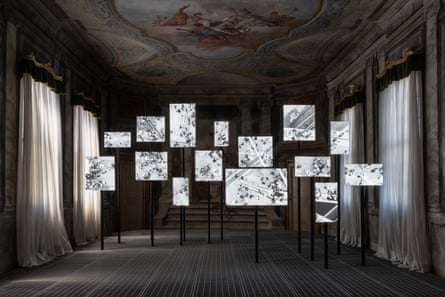
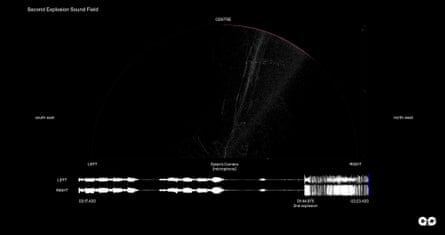
Abu Hamdan describes the team’s work as building the sonic equivalent of the kind of visual reconstructions that we are used to seeing in the news. They use a combination of open-source data, “earwitness” testimonies and sound data (recordings, videos) gathered at the scene. The sonic weapon investigation, for example – which was the catalyst for the work on show in Venice – came out of an investigation into the dispersal in Belgrade of a mass silent anti-government protest.
Held in March 2025, the demonstration was one of many silent vigils that have taken place in the country since a deadly accident at a railway station the previous year. The protesters keep 15 minutes of silence, one minute for every person killed. That evening as many as 300,000 people were gathered. And into that long, grief-filled silence of mourning and resistance came an intolerable, frightening noise – one that at first seemed as if a vehicle was approaching at speed, then felt as if it were being produced inside the bodies of those who experienced it. The Serbian government denied that a sonic weapon was used to panic and disperse the crowd.
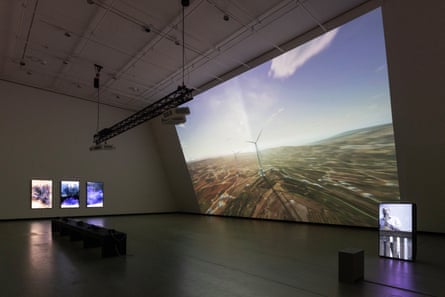
“It was a really interesting case for us as an organisation because of the way we got pulled in,” says Abu Hamdan. “Generally we get requests from media organisations, or from NGOs – there’s usually an institution, except for a few random individuals telling us, ‘My wife’s trying to brainwash me with microwaves,’ or something, which we ignore. But this was the first one where we had multiple individual requests. We woke up and there were what felt like hundreds of emails.” This was the morning after the protest. A Serbian music student based in Vienna, they discovered, had suggested Earshot might help them find out what had really happened; the word had gone out among the protesters.
Earshot took on the case, amassing thousands of witness statements and working in detail with individuals to reconstruct the sound. To do this they played the “earwitnesses” samples, first “eliminating sounds that were claimed by the government to have caused the panic, like firework, drone,” says Abu Hamdan. The team concluded the sound was likely produced by a US-made device called an LRAD 450XL.
“To me there were two sonic weapons that night. There was the silence of the vigil, and there was the counterattack,” he says. “That silence was just so unbearable to the state that they had to find a way to undermine it.” The sheer silence of the vigil also resulted in extraordinary listening conditions. When the sound erupted into the crowd, the protesters were uniquely sensitive and alive to its quality. “It was a silent vigil that was also vigilant in its silence,” he says. “And it produced, in very similar way to the Sednaya prison, an acute type of listening.”
A version of the multiscreen work that was shown in a frescoed chapel in Venice – on a single screen, with a live score – will be shown at a “takeover” of the Barbican in London that Abu Hamdan and Earshot are staging in September. Earshot are also running workshops on gathering sound evidence; introducing film screenings (such as the 1955 French heist movie Rififi, which has a lengthy, almost silent robbery scene); and hosting musicians such as Busher Kanj, a composer from the Israeli-occupied Golan Heights in Syria, who is creating a new work incorporating field recordings and electronics.
Earshot worked with inhabitants of the area to demonstrate the levels of noise pollution that would be produced by wind turbines that are planned close to a village, building a kind of walk-through video game where the sounds of community life and of nature can be encountered against the deafening whoosh of the blades. That work, Zifzafa, can also been seen in Glasgow this summer at the Common Guild, and Abu Hamdan and his collaborators will present a live version for the closing event of the Edinburgh art festival.
I ask Abu Hamdan about how he and his team cope with the often distressing material. After our interview, for example, he is meeting New York Times journalists to look at some killings by ICE, the Immigration and Customs Enforcement agency in the US. And one of their most significant works has been a year-long investigation into the killing of ambulance workers in Gaza. According to Earshot’s analysis, Israeli soldiers fired at least 910 rounds in Tel Al-Sultan, near Rafah, on 23 March 2025 – at least 789 of them directly at aid workers.
Evidence included a recording made by one of the killed people, his phone exhumed with 15 bodies from a mass grave. One of the paradoxes of this investigation, says Abu Hamdan, is that the sheer destruction around – only three walls intact, everything else reduced to rubble – helped them to map the shots. “Usually in an urban environment that would be extremely complex.”
But working on the cases, taking an active role, is easier than passively staring at his phone in despair, he says. “Ambiently scrolling – that is so much more destructive.” And, he points out, there’s always music to think about, not just gunshots. There is so much in the world to listen to.
Zifzafa is at the Common Guild, Glasgow, until 17 October, with a live performance at Leith theatre as part of the Edinburgh art festival on 29 August. Lawrence Abu Hamdan: Repercussions is from 23-26 September at the Barbican, London. 450XL: The Story of a Fugitive Sound is on show in Canicula, at Complesso dell’Ospedaletto, Venice, until 22 November.