3 months ago
61
3 months ago
61
Last week, on the morning the government published its Pfas action plan, I got a worried phone call from a woman called Sam who lives next door to a chemical factory in Lancashire. Sam had just been hand-delivered a letter from her local council informing her that after testing, it had been confirmed that her ducks’ eggs, reared in her garden in Thornton-Cleveleys, near Blackpool, are contaminated with Pfas.
Pfas – per- and poly-fluoroalkyl substances, commonly known as “forever chemicals” due to their persistence in the environment – are a family of thousands of chemicals, and I have been reporting on them for years. Some, including those found in the eggs Sam and her family have been eating, have been linked to a wide range of serious illnesses, including certain cancers.
The levels recorded in one of the eggs was so high that if Sam ate just one a week, it would exceed the European safe weekly level for Pfas exposure 10 times over. This threshold sets out the maximum level of Pfas that can be consumed weekly over a lifetime without risking adverse health effects. Sam and her children have been eating these eggs every single day for decades.
This is what living on the frontline of regulatory failure looks like.
Sam stopped eating the eggs about a year ago, when the local council started investigating the factory at the end of her garden due to concerns around the historic airborne emissions of PFOA, a banned and carcinogenic type of Pfas chemical. But before this, Sam believed she was making healthy choices, growing her own vegetables and rearing her own ducks, aiming to teach her children where their food comes from.
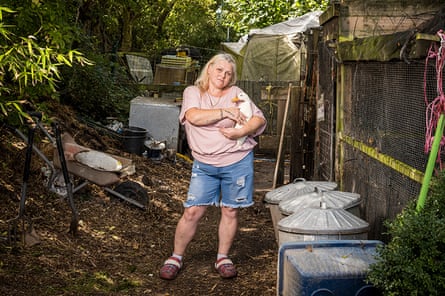
She told me over the phone that she now feels terrified to go into her own garden. The following day, she messaged to say she had been unable to sleep. “Are these chemicals in my blood?” she said.
On the one hand, it’s great to see that the government has finally published its plan for Pfas. It has been a long time coming. On the other, this plan fails to lay out any concrete steps that the government will take today to help people like Sam. It is a plan to make a plan, a promise to act – when parliamentary time allows, subject to consultation, and as the government itself says, taken in collaboration with the chemical industry. All the while, Sam, and who knows how many others across the country, are still at risk of potential exposure to toxic chemicals.
The factory on the edge of Sam’s garden is still allowed to release large amounts of a new Pfas chemical into the environment, despite evidence that this chemical could cause damage to a person’s sexual function, fertility or their child’s development. This chemical was not mentioned once in the plan.
After years of reporting on industrial Pfas pollution, I know only too well that Sam is not the only person living with the real-world impact of this chemical pollution. In an investigation for the ENDS Report and the Guardian in 2024, I revealed that the small Yorkshire town of Bentham is polluted with what was described by experts as the highest level of Pfas pollution ever recorded in the UK. How many more communities are going to learn that their homes and public spaces are contaminated with toxic chemicals before the government finally does something?
Since Brexit, the UK’s regulation of Pfas has fallen woefully behind the EU’s. The bloc is drawing up plans for a blanket ban on all Pfas. The UK, meanwhile, is looking to group and then restrict certain chemicals – an approach described as being akin to “Whac-A-Mole”. Why? Because when you ban one chemical, the industry can simply tweak the formulation slightly to produce a new variant that, while slightly different, may pose identical or perhaps even worse health risks.
Speaking at a parliamentary inquiry on Pfas last week, the lead chemical expert at the Health and Safety Executive described the UK’s reason for not matching the EU’s safeguards with a direct copy as being philosophical in nature. “There is a slightly different way of thinking in the UK [compared with the EU] in terms of philosophy,” he said. The difference was that rather than a blanket ban, the UK would choose what to ban a “a bit more slowly or gradually in a prioritised way”.
I haven’t asked Sam, but I’m not sure that she and the other people in her position have time for a slow, gradual approach from government when weighing up the potential risks to their health – and that of their families. They just want to be safe, and to live without fear.
What the government’s new plan does do is pledge to undertake more research. While no one could deny that more research is needed, this seems to be coming at the expense of acting on what we do already know. For example, we already know, without doubt, that a number of these chemicals are toxic, that they are persistent, and that they are everywhere. The Environment Agency has itself estimated that there could be as many as 10,000 Pfas hotspots across England. Until these chemicals are banned at the point of production, that number is not going to get smaller.
Back in Lancashire, Sam has now stopped eating her eggs, but has the damage to her health already been done? These are the questions she is left to grapple with alone, while the government pledges to take action – once it has spoken with the chemical industry.
-
Pippa Neill is an environmental journalist and the news editor at ENDS Report