2 months ago
65
2 months ago
65
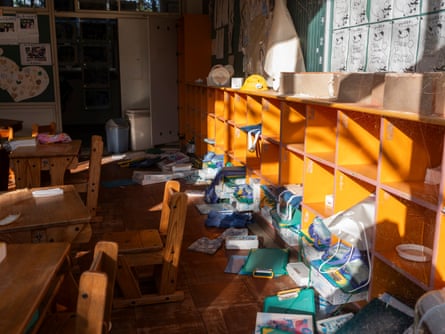
Norio Kimura pauses to gaze through the dirt-flecked window of Kumamachi primary school in Fukushima. Inside, there are still textbooks lying on the desks, pencil cases are strewn across the floor; empty bento boxes that were never taken home.
Along the corridor, shoes line the route the children took when they fled, some still in their indoor plimsolls, as their town was rocked by a magnitude-9 earthquake on the afternoon of 11 March 2011 which went on to cause the world’s worst nuclear disaster since Chornobyl.
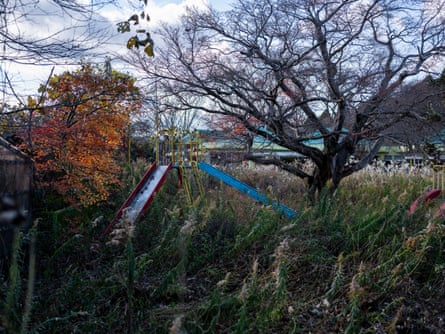
The building is frozen in time, but outside, the once-pristine playground is a tangle of weeds and susuki wild grass, the top of a slide just visible in the background. The upper rungs of a metal ladder children once scaled as part of an obstacle course have become indivisible from the trunk of the tree it has leaned against, untouched, for 15 years.
Rusting bicycles nestle in the undergrowth, yards away from a monitor informing us that atmospheric radiation on this sunny afternoon in December, while posing no danger to our health during our short visit, is still too high to allow former residents to return home.
At the entrance, sections of a stone pillar bearing the school’s name lie on their sides, testament to the destructive force of the most powerful earthquake in Japan’s recorded history.
Among the 330 children who ran from their school that afternoon was Yuna, Kimura’s seven-year-old daughter. She reached her home, less than two miles from the sea, just before the tsunami arrived, killing more than 20,000 people along Japan’s north-east coast.
Yuna died along with her mother and grandmother, leaving behind Kimura, a former pig farmer who had been at work that day, and his eldest daughter and father.
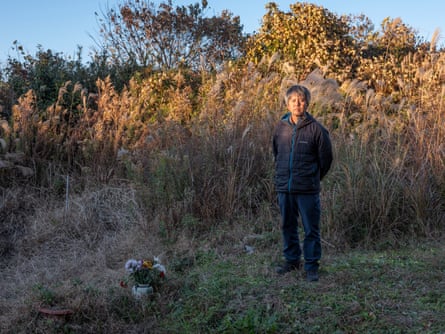
After years living in nuclear limbo, Kimura has never abandoned his dream of returning permanently to the coastal plot where his family once lived – and where half of its members perished.
“The only things left are the tiles to the main entrance,” he says. “All I can do for now is clear the weeds and grass. But I definitely plan to return one day.”
Fifteen years after disaster hit Fukushima, the area’s authorities are still wrestling with how to persuade people to return – and how to attract new blood. They are also considering how much of the land should be given over to nature.
And can populations of wild animals that have proliferated since the disaster be controlled in a way that makes coexistence with humans possible?
Evidence of the relentless march of the natural world is everywhere in Okuma and other communities located in the shadow of the Fukushima Daiichi nuclear power station.
The plant, which is now being decommissioned, suffered a triple meltdown after tsunami waves knocked out its backup power supply, sending large quantities of radiation into the atmosphere.
Gardens have become jungles and homes places of nocturnal refuge – and food – for the wild boar, raccoons and black bears that now have free rein to roam streets long deprived of artificial light.
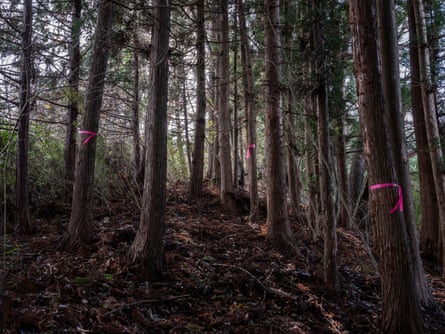
Several miles inland, in the village of Tsushima, radiation and forestry experts announce their arrival at the edge of a forest with a chorus of whistles – a precaution to scare off the bears.
A year after the triple meltdown, Japan’s government launched an unprecedented clean-up of Fukushima’s irradiated neighbourhoods. An army of workers removed contaminated topsoil near homes, schools, hospitals and other public buildings, generating about 15m cubic metres of waste now being held at interim storage sites near the wrecked power plant.
The clean-up did not include the mountainous forests that carpet 70% of the contaminated region and where elevated levels of the radionuclide caesium-137 have been recorded in woods and streams, and in the wildlife that inhabit them. While most Fukushima produce is safe, some types of mushroom, bamboo shoots and wild boar are among the list of banned food items.
Today, university experts are working with Rise Wood, a local forestry firm, to extract core samples, taken at different heights, from the trunks of four selected Japanese cedar trees.
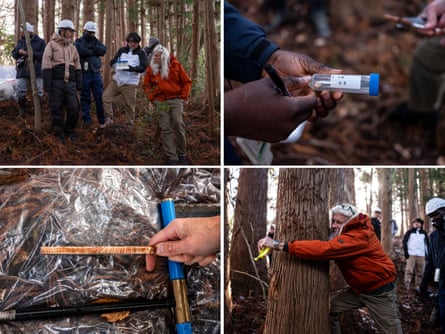
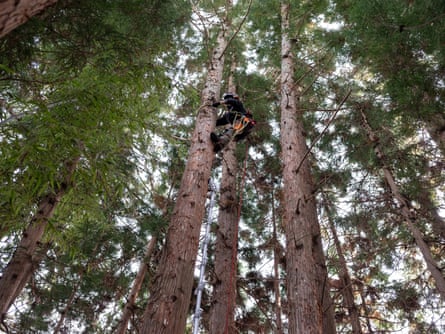
Trees “circulate” problematic radiocaesium – a radioactive isotope of the metal caesium – using light energy, according to Prof Kenji Nanba, director of the Institute of Environmental Radioactivity (IER) at Fukushima University and an expert on the impact radiation has had on Fukushima’s wildlife.
“Rain and falling leaves transfer radiocaesium to the forest floor,” he says. “The trees then absorb it through their roots along with potassium, which they need for growth.”
The radioactive fallout from Fukushima Daiichi did not trigger dramatic declines in animal populations, according to Prof Vasyl Yoschenko, a Ukrainian expert on forest radioecology at IER. On the contrary, wild boar, bear and racoon populations have increased. “The only animals in danger in these areas may be humans,” he says.
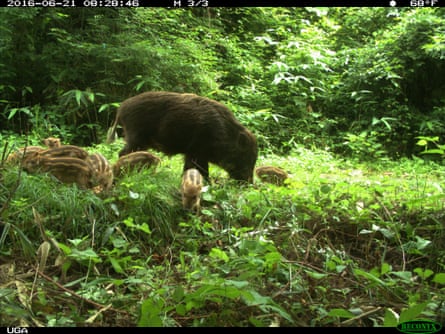
Thomas Hinton, a retired Fukushima University professor who has conducted extensive fieldwork on the disaster zone’s fauna and flora, says limiting areas for human use would be a “hugely beneficial” move, albeit politically sensitive, given official campaigns to encourage people to return.
“Humans are generally the bane of nature and, if removed, nature seems to thrive, even in the presence of chronic radiation,” he says. “However, to my knowledge, there doesn’t appear to be any interest from the Japanese people impacted by the accident or from politicians to carve out such a wildlife haven at Fukushima.”
Like other experts, Hinton believes measures must be taken to control the local wild boar population – although that is not a problem unique to Fukushima.
“If wild boar were not present, then perhaps a strong case could be made to let all wildlife proliferate in Fukushima,” he says. “Boar, however, are so prolific and damaging that their numbers must be controlled.”
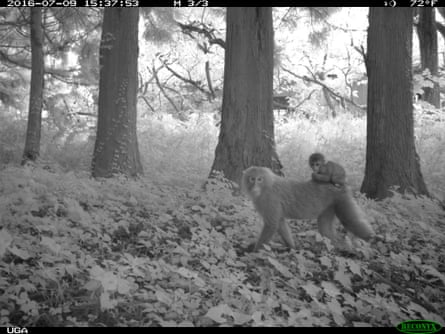
In the long-term, the decision not to impose a Chornobyl-style ban on human resettlement means Fukushima “is particularly well suited for addressing questions about human impacts on wildlife and the rewilding of nature once humans are removed”.
Priority, though, will inevitably be given to human preferences on how to develop once-abandoned areas as soon as radiation drops to acceptable levels.
“Establishing nature preserves will not be high on the list of priorities,” Hinton says. “At Chornobyl and Fukushima, the absence of humans following the accidents allowed wildlife to thrive temporarily. However, as people eventually return, the presence of humans and their associated activities will once again threaten the recovering ecosystems.”
Sanjiro Sanpei, dressed in a white protective suit and hat, a dosimeter hanging around his neck, has a personal interest in how proximity to Fukushima’s forests could affect human populations in the long-term.
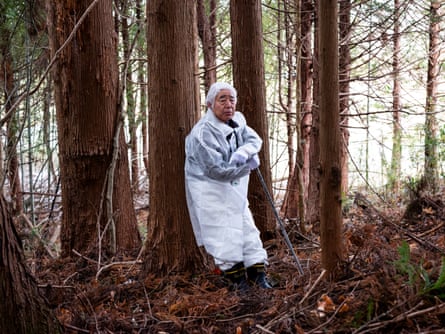
The 77-year-old, who lost his cattle farm as a result of the disaster, is hoping to return to the home he and his wife fled after the meltdown. “If the decontamination work is finished, we’ll come back and repair the damage to our house,” says Sanpei, who has come to check on the university team’s progress. “But I’m getting old, so I don’t know how long we’ll be there for.”
Not all evacuees share his optimism. The population of seven towns and villages in Fukushima prefecture that were evacuated after the meltdown stood at 12,300 people in March 2025 – just 17% of the total before the disaster. Many have built new lives elsewhere.
Evacuation orders have been lifted in several areas, but Sanpei’s home stands in a “difficult-to-return zone” – where radiation levels are deemed too high for permanent residence.
In 2023, however, Japan’s parliament amended the law to enable individual households in those zones to return on a case-by-case basis, provided their homes and surroundings have been decontaminated.
“We never thought we would be away for so long,” says Sanpei. “I was convinced that we would be back within a year. But now it could be about 30 years until the entire village is safe.”
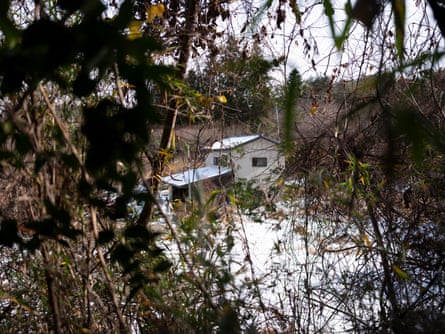
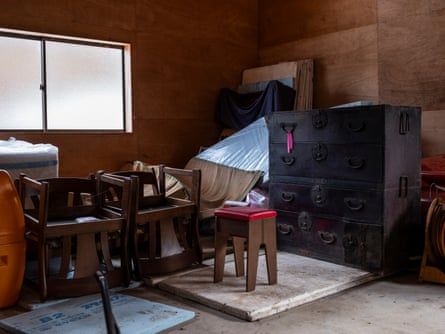
In Okuma, where just 300 people who lived in the town in March 2011 have returned – along with 700 newcomers – Kimura is making a regular pilgrimage to a clearing in the bushes near the coast, the sea view now obstructed by a defensive seawall.
A bunch of flowers marks the spot where, almost six years after the disaster, soldiers found fragments of Yuna’s neck and jaw bones, concealed in her favourite pink Minnie Mouse scarf. Kimura is still searching for the rest of her remains.
He and others in the town are urging the council to preserve Kumamachi primary school as a reminder of the disaster – and as a warning to future generations about the dangers posed by tsunami and nuclear power.
“It’s part of our history now, and we need to protect it,” the 60-year-old says.
Kimura would like to see the space temporarily being used to store contaminated soil eventually turned into an “eco-museum”, where visitors can learn about the 2011 triple disaster.
“Making the entire area into a museum would more realistically convey the history of this area that has been lost and the lessons of the nuclear accident,” he says.
“I think it would be good to have a place to return things to nature. Most areas have been developed by humans, except for the mountainous areas where it is difficult for people to live.
“I think the nuclear accident should be an opportunity to consider returning to nature,” he says. “Humans have gone too far.”
Nanba agrees that the interim storage facility is a candidate for a nature conservation area after the soil is transferred in 2045 for final disposal – provided new locations can be found elsewhere in Japan.
“It will be necessary to consider how the site should be used after the interim storage period ends,” he says. “Designating it as a nature conservation area could be one option, but the current status of national-level discussions on this matter is unclear.”
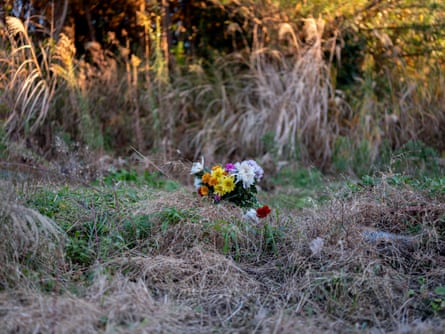
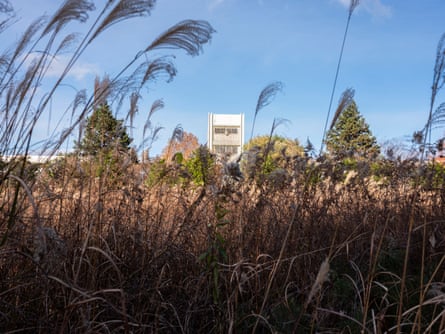
Whatever physical transformations the area undergoes in the coming decades, it is here at his makeshift memorial to Yuna, not far from the home they shared before it vanished beneath the waves, where Kimura says he has found something resembling closure.
“I want people to come here to learn the truth about what happened. I’m convinced that if I keep searching I’ll find more of my daughter’s remains,” he says. “But a big part of me thinks it might be best to leave her in peace.”
Find more age of extinction coverage here, and follow the biodiversity reporters Phoebe Weston and Patrick Greenfield in the Guardian app for more nature coverage