2 weeks ago
64
2 weeks ago
64
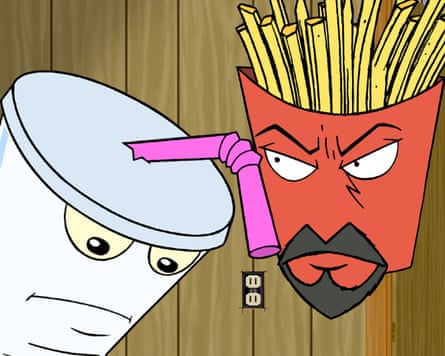
Twenty five years ago this coming week, a strange block of programming suddenly began airing in the wee small hours on the US cable channel Cartoon Network. Anyone half-watching with the sound off might have mistaken the shows as a continuation of the toons airing in the daytime: bright, big-eyed affairs full of energy and slapstick comedy. Those paying attention, though, would have noticed something was off: old-fashioned Hanna-Barbera superheroes had been recast as attorneys or talkshow hosts; a crew of talking fast-food items, supposedly a hero squad called the Aqua Teen Hunger Force, just seemed to be bickering with each other and watching TV rather than fighting crime; and the whole mood of the programmes, with their halting, babbled dialogue, juvenile humour and janky animation, seemed not quite right. The name of the block was odd too: Adult Swim.
Piggybacking on the adult animation boom of the 90s – The Simpsons, South Park et al. – Adult Swim steered things off in to bizarre and unsettling new territory. If anything, it’s only gotten weirder in the quarter of a century since it started. Close to 100 shows have aired in this insomnia-friendly night-time block (though today it arguably operates as its own independent channel within a channel), almost all of them strange enough to make you feel like you might be asleep after all and having a particularly psychedelic dream. It has platformed demon-fighting death metal bands, redneck squids, preposterously dark claymation parodies of Rankin/Bass, and a crime-fighting, gun-toting backside – as well as real-life figures with faces as boggle-eyed and elasticated as their cartoon counterparts. It has remained a defiant corner of freakery in a homogenised TV landscape.
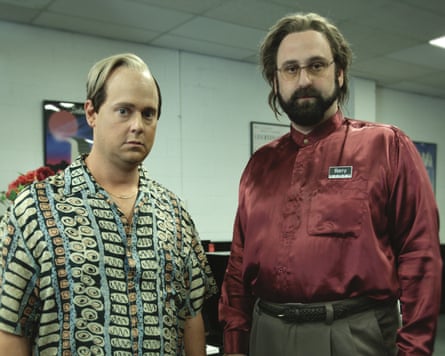
I’d wager that if you were to ask anyone in the US (or UK, where the programming block has been broadcast in some form, on some channel or streaming service, since 2006) whether they were familiar with Adult Swim, most would draw a blank. Adult Swim’s viewing figures have always been pretty impressive for a block that airs in the hours when most of us are in our beds, but it can hardly be said to have been widely watched. Many of its biggest shows, revered as they may be to fans – Tim and Eric (pictured above), Aqua Teen Hunger Force (pictured below), Robot Chicken, The Eric Andre Show – never really reached far beyond college dorms, too acquired a taste for mainstream consumption. The one exception, the show that you almost certainly will have heard of, is Rick and Morty (pictured top) – though I’d argue it exists in its own massive planetary orbit; most people will have discovered it on Netflix, and scarcely paid attention to the tiny bracketed Adult Swim logo ahead of its opening credits.
But as niche a prospect as Adult Swim may be, it has also proved strikingly influential. Comedically, its fingerprints can be glimpsed all over everything from the frenzied work of Tim Robinson, to the existential animated comedies of BoJack Horseman creator Raphael Bob-Waksberg, to the gonzo chatshows of Adam Friedland. Long before anime became a billion-dollar industry in the west, Adult Swim was importing and sometimes even making it. Its habit of “dropping” shows unannounced into schedules predated the surprise album release trend by almost a decade. And liminal internet horror, which crashed violently into the mainstream this year with Kane Parsons’ hit film Backrooms, absolutely owes its style to Adult Swim, whose shows and specials were often as unsettling and scary as they are funny.
More broadly, Adult Swim has been predictive of, and an influence on, the entire mode of comedy that has sprung up online in the past 25 years. You can absolutely see the building blocks of much meme culture – the surrealism, the non sequiturs, the inside jokes and knowing references, the keenness to shock – in Adult Swim’s output over the years. Perhaps that isn’t wildly surprising, given that the programming block’s rise happened precisely in time with the emergence of an internet voice and humour; many of its creators clearly spent their formative years deep in the bowels of chatrooms, forums and early social media platforms. Indeed, Adult Swim often commissions shows and shorts from online animators and YouTube comics and sketch troupes.
Its influence hasn’t been wholly positive. Adult Swim exhibited edgelord tendencies before the term was even invented, and at times the brand of humour it propagates can curdle into something more unpleasant, the sort seen in darker, 4chan-ish corners of the internet. The block’s most notorious show, Million Dollar Extreme Presents: World Peace, was cancelled after one season after talent protests over the alleged far-right tendencies of its star, Sam Hyde. Some other shows – such as the long forgotten misstep Minoriteam, about a group of crime fighters defined by their exaggerated racial stereotypes – ended up prioritising provocation over all else. There have been criticisms in the past too over the absence of female creators at Adult Swim – though that is something the channel has sought to rectify in recent times.
But if Adult Swim occasionally overshoots the line – other unforced errors include accidentally prompting a Boston-wide bomb scare over an Aqua Teen stunt – its desire to push boundaries has more often resulted in success. It has continually found ways to form-break: even during its paid infomercial slots, which occasionally contain spoof ads so convincing you mistake them for real at first – such as the satirical prescription medicine ad smuggled into some nature footage. And experimentation doesn’t always mean edginess: perhaps the most radical thing Adult Swim ever aired, given its fearsome reputation, was Joe Pera Talks With You, a mesmerically slow, quiet series about the humdrum life of a church choir teacher, described by its creator as “the shipping forecast with jokes”. That such a show could sit alongside, say, Mr Pickles, a truly grotesque cartoon about a devil-possessed border collie going around disembowelling people, shows that truly anything goes on Adult Swim. Here’s to another 25 years of strange TV for sleepless nights.
after newsletter promotion
To read the complete version of this newsletter please subscribe to receive The Guide in your inbox every Friday