3 weeks ago
53
3 weeks ago
53
‘Norway is a hilly country,” shrugs Glenn Roar Berge. He’s not wrong, though he is fond of an understatement. I’m in Valdres in southern Norway to explore the cycle routes that skirt the edges of Jotunheimen national park. Glenn from Jotunheimen Travel is our guide, a born-and-bred local of these mountains.
For most of our three-day ride, we’ll be following the Mjølkevegen, or Milky Way, a 155-mile (250km) route from Vinstra in the north to Gol in the south. It was developed after the second world war, when increased demand for fresh milk meant connecting the mountain farms with the towns below. While farming continues, the road has been embraced in recent years by gravel cyclists, (typically riders on drop-bar bikes favouring unpaved roads and trails), looking for a multi-day adventure far from towns and cities.
Ruten Fjellstue is a traditional inn, set up for cross-country skiing in winter, hiking and biking in summer. My trip starts here and it’s where I’ll meet my guide and group, and pick up my hired bike. It’s set high above the valley and painted falun red – the iron-oxide agricultural paint typical across Nordic countries. Berit and Arthur are the third-generation owners. I arrive late, so Arthur picks me up from Vinstra train station (about three hours north-west of Oslo) and Berit has kept a home-cooked meal warm: a generous plate of fish with potatoes, vegetables and cream sauce, followed by apple crumble.
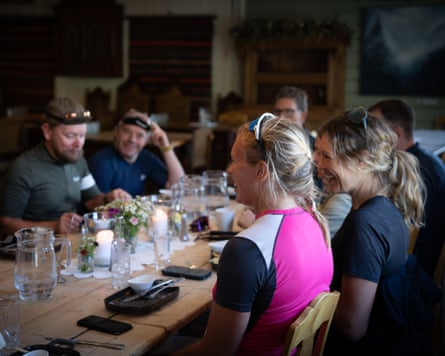
These small inns are part of what makes cycling through the region work. At breakfast, there’s an expectation that you’ll make your own sandwiches from the buffet, with provisions laid out ready. We’re even given a reusable beeswax wrap. Cycling here is powered by sandwiches, waffles with sour cream and berry jam, and plenty of cinnamon buns – and that’s just to keep you going between meals.
Our first morning begins with a cruisy downhill run before the road turns into a rough track. A temporary road closure has sent us on to a mountainous diversion. I’ve never used drop handlebars before and it takes me a while to figure out the gears.
Silje Wilson, who works to promote the mountain hotels in the area, is also joining our group of 12 riders from across Europe. She tells me she has never ridden a gravel bike either, so I’m hopeful I’ll have company at the back, but she leads every climb and is often miles ahead. That night she reveals she has spent her summer mountain biking and lifts a large rock in her garden to build strength. “A typical Norwegian girl,” says Glenn.
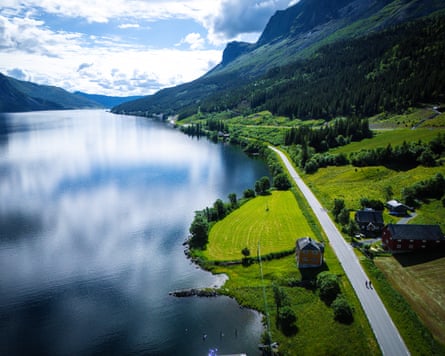
While you don’t have to be a “typical” Norwegian to enjoy these trails, a certain tolerance for hills helps. As we descend towards Lake Vinstre, the Jotunheimen mountains, northern Europe’s highest range, appear ahead. There’s just a tiny road stretching into the distance; beyond it, mountains in every direction. The lake is a deep turquoise-blue, and the shores are dotted with tiny wooden farmhouses painted red or yellow, many with grass roofs for extra protection when the snow arrives.
At Lake Bygdin we stop to stretch and eat burgers at Bygdin Høifieldshotel before catching the M/B Bitihorn passenger ferry, where bikes and luggage join us on deck. The boat has been in regular service on the lake for more than a century. We sail past the peaks of Øystre Torfinnstinden and Galdebergtinden, with waterfalls tracking down the steep mountainsides to the inland fjord.
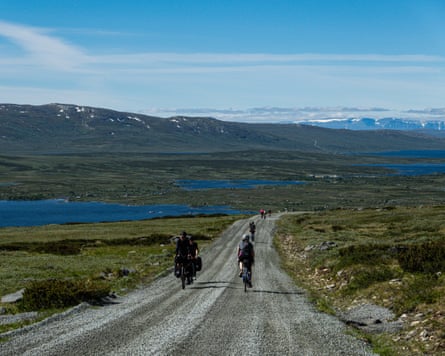
At Eidsbugarden, at the far end of the lake, we climb back on to our bikes and follow Lake Tyin towards Filefjellstuene hotel. We pedal past summer mountain dairy farms but barely see a soul. The roads are almost entirely traffic free, but the sheep are worth being wary of: twice I have to swerve at speed when one runs into the road.
We’re cycling for long days, averaging about 45 miles (75km) a day, with 1,500 metres (4,900ft) ascent, but there are gentler ways to experience the Mjølkevegen: shorter stages mean more time to explore the cosy family hotels or add in hikes, while some riders hire an ebike. Self-guiding on the main route is straightforward and well signposted; for diversions, or extra challenges, hiring a guide is advisable. I decide to lean in to taking it slowly, drinking in the spaciousness and letting the miles roll by.
At Øye, on day two, we stop to admire the steep tiered roof of the stave church, one of only 28 still standing across the country. Many Norwegian churches, including medieval stave churches, were destroyed in a wave of more than 50 arson attacks in the 90s by anti-Christian black metal bands. Øye was built towards the end of the 11th century, then replaced in 1747. During renovations in the 1930s, the old church was discovered dismantled under the floorboards for reasons lost to time, and rebuilt here by the lake.
Further along the valley, Glenn points out a steep triangular cave up high. We’re into troll territory. “Up there a big rock is starting to move,” Glenn says. “It’s being surveyed, and it will fall sometime in the next 200 years. It’s because of lang bane, the troll ‘long bones’. Trolls sleep for hundreds of years. He’s starting to wake up now. Newspapers don’t report it, but local people know that it’s the troll.”
Time to get back into the hills then, and Glenn has planned a detour from the main route. It includes what he calls “the mother of all climbs”: a long incline with dozens of switchbacks, requiring all the cinnamon-bun fuel I can muster. On the Smådalen plateau we rest among the wildflowers framed by steep peaks rising above the snow line. There are moose in this area, but our whoops on the downhills probably keep them well hidden.
On my last day, the weather turns. The Mjølkevegen sits about 800–1,300 metres above sea level, and the weather can shift quickly. We reach the bottom of the Slettefjell mountain pass in driving rain. There’s a small cafe here, so we stop for waffles and refill our water bottles. Then the only way is up, and up, and up. It’s 600 metres of elevation in just 6km. All I can do is concentrate on the next bend.
At the top, it’s flat and exposed, and the clouds have transformed the mountains again. Distances are hard to measure, and the craggy rocks? Petrified trolls. I give them a wave, and freewheel downhill for miles.
In this part of Norway, hotels are never built at the bottom of the valley. “Everyone prefers to have a view,” says Glenn. For a cyclist, this means that every day there is a final few kilometres up to the hotel. It’s tough, but it makes the arrival all the sweeter. And the best views are those you’ve earned.
The trip was provided by Jotunheimen Travel, Mountains of Norway, Innlandet Fylkeskommune and Visit Valdres. Jotunheimen Travel offers three-day self-guided cycling trips on the Mjølkevegen from NOK7,800 (£612) based on two sharing, including hotel accommodation, all meals, luggage transport, boat tickets on M/B Bitihorn, an app with directions and maps, backup support and CO2 compensation, with bike hire for an additional cost