3 months ago
86
3 months ago
86
While serious film lovers reach for Francis Ford Coppola’s Rumble Fish as their favourite screen adaptation of an SE Hinton novel, I can never go past The Outsiders, as much for what it did to me as a gay kid growing up in the mid-80s who was terrified of being discovered as for any artistic merit.
There are cheesy things about the movie, for sure – it’s superficial wash of nostalgia for the 60s, there are a few egregious continuity errors, some rawness in the performances – but none of that matters as the opening strains of Stevie Wonder’s Stay Gold hit your ears and the cinematographer Stephen H Burum’s montage of overexposed sunsets fills the screen. The story of kids from the wrong side of the tracks in Tulsa, Oklahoma, always makes me, a kid who grew up in the leafy suburbs of south-east Melbourne, feel entirely at home.
I consider The Outsiders to be the first gay film I saw – despite the fact it doesn’t have a single gay character in it. All that male beauty (including a teen Rob Lowe! Matt Dillon! Tom Cruise!) pushed to the front of the frame borders on the fetishistic. The expressive eyes of our sensitive working-class teen protagonist Ponyboy (C Thomas Howell) and his Greaser-gang pals Johnny (Ralph Macchio) and Dallas (Dillon). The cheekbones and jawlines, and the gentle ripple of upper-arm muscles. A pendant falling in the valley created by the muscles of a naked back. There is more than a hint of Jean Genet and Walt Whitman in the lighting and the centring of these male bodies, rugged and raw but leaning always into pure aestheticism.
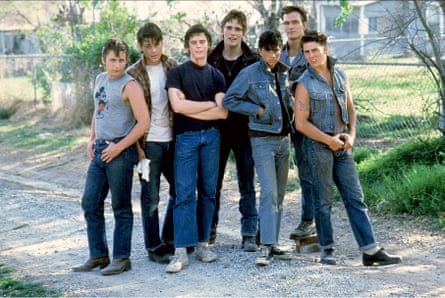
On one level, this is a movie about two types of straight boys – the working-class Greasers and upper-middle-class Socs – battling it out for a supremacy that was never in doubt, no matter who won the rumble. As Randy (Darren Dalton) tells Ponyboy, “Greasers will always be Greasers and Socs will always be Socs. It doesn’t matter.”
While objectively class is the key dividing line in this work, neither Hinton nor Coppola seem particularly interested in exploring it. There’s clearly a social divide between the Greasers and the Socs but the film is content to establish the division and move on. Like its major antecedent, West Side Story, The Outsiders seems less interested in the nuances of social politics than in two groups of teenagers who despise each other.
I grew up on what would have been considered the right side of the tracks but in my mind I was a Greaser – an outsider, a marginalised kid. I didn’t buy Soc cheerleader Cherry’s comment that “things are tough all over” because I knew precisely how tough they were for me, and that wasn’t “all over”. I loved the film because I could see a community of people rallying around Ponyboy – a character I could project my sexuality on to: sensitive, literate, introverted – in a way that seemed unlikely in real life. Nobody knew I was a Greaser; I was a Greaser of one.

That is a typical indulgence of adolescence, of course – the tendency to see yourself as tragically solitary; uniquely persecuted. The film powerfully underscores this by framing its narrative as one of banishment and return (it has a clear Eden metaphor at its centre). Ponyboy is thrust out of the family unit and then reintegrated, strengthening the community’s homosocial bonds. It’s a teenage hero’s journey, immensely appealing because it centres teenage agency as a bulwark against fate and inevitability. It’s an operatic film of emotional broad strokes and heightened angst.
Rewatching The Outsiders as an adult, admittedly, is a strange experience. It’s a curiously sexless film, somehow, despite how sexy I found it in my youth. There are only two speaking parts for females, and only one of any significance, and even though Diane Lane brings a nobility and beating heart to Cherry’s fiery defiance, her function in the story is in no way sexual.
Sure, there’s an offhanded misogynistic comment early on by Dallas but even he seems to lose interest in her as a sexual being. Eventually Cherry serves as a mediator between two worlds, a kind of female Charon ferrying the souls across the River Styx. She’s no Helen of Troy, in other words.
As for the boys, there are two ways to look at them: strictly non-sexual or deeply homoerotic. Of course, for me there was only one way. And really, who in their right mind would see the film as strictly non-sexual? In the absence of females (isn’t it weird that the muscular Darry, dreamy Sodapop and even the outwardly randy Two-Bit don’t have girlfriends?), the film takes on a strange, unspoken sexual meaning about boys and men. It seems to imply that the true Eden is one where God created more Adams instead of an Eve; where the greatest thing men can do is fight each other in the rain.
-
The Outsiders is streaming on SBS On Demand and Stan (Australia) and is available to rent in the UK and US). For more recommendations of what to stream in Australia, click here