4 weeks ago
48
4 weeks ago
48
After Tony Romo’s arrest last month, TMZ published a 31-minute “extended cut” of the body-camera footage from the Wisconsin police officer who arrested CBS Sports’ star NFL analyst on suspicion of operating a vehicle while under the influence.
It’s an uncanny watch. The former Dallas Cowboys quarterback’s familiar goofy geniality collides with the gravity and stilted formality of an encounter with law enforcement. The video of a disoriented Romo struggling to answer basic questions and failing a field sobriety test, and his rictus-grinning, disheveled, head-askew mug-shot, form a glaring contrast with his smart-suited look a year earlier: beaming as he posed in the spotlight with his play-by-play partner, Jim Nantz, at the network’s preseason media preview.
Romo initially told the officer he had not been drinking before saying he had had a single Corona. He has not issued a public statement on the incident since.
The arrest and the attention mean that one of the best-known television personalities in American sport will start the season as a color commentator in a grey area. Romo was scheduled to be in Minnesota on 13 September to call the game between the Vikings and the Green Bay Packers on the first Sunday of the season. Instead he is on indefinite leave and former Houston Texans star JJ Watt has been promoted from CBS’s second-tier crew to call the game with Nantz.
Every week matters given the NFL’s short season but it’s unlikely that CBS will determine Romo’s future before his court date on 21 September. Unusually among US states, Wisconsin typically treats a first-offense DUI as a civil rather than a criminal offense. This is an important distinction in law, and perhaps in Romo’s employment contract, but less relevant in the court of public opinion.
The incident is another strike against a 46-year-old broadcaster who has lately drawn scrutiny for a questionable work ethic, according to the Athletic, as well as occasional on-air gaffes and apparently waning skills. While Tom Brady has grown into his Fox Sports role after a wooden start, Romo’s analytical talent arguably diminished as seasons passed, rosters refreshed and his first-hand knowledge of the league’s teams, players and coaches became outdated.
Born in California and raised in Wisconsin, Romo spent all 13 years of his NFL career with the Cowboys and rose from relative obscurity to become one of the league’s biggest names. He was a star at the NCAA second-tier Eastern Illinois University yet went unselected in the 2003 draft. Still, he signed for Dallas as a free agent. Initially a raw third-stringer, he spent three-and-a-half seasons as a back-up before seizing his chance in 2006 when the struggling veteran Drew Bledsoe squandered the starting job. Although his career never reached Hall of Fame levels, he remains the franchise’s leader in career passing touchdowns, a remarkable achievement for an undrafted player from a small school.
CBS hired Romo immediately after he retired in 2017. Eyebrows were elevated by the network’s then-rare decision to slot an untested broadcaster into a lead position but the gamble quickly paid off. Though Romo never reached a Super Bowl and had a record of two wins and four losses in the playoffs, he turned out to be a fresh and telegenic character who delivered insights and highly accurate in-game play predictions that drew rave reviews.
In 2020 CBS handed Romo a then-record 10-year, $180m contract: about $53m more than he earned during his playing career. It was evidence of his appeal as well as the network’s desire to keep him away from rivals such as ESPN. The former Dallas quarterback Troy Aikman signed a five-year, $90m contract with ESPN in 2022. But the $18m-a-year benchmark did not last long: that year Brady, a singular figure who was still playing, agreed to a 10-year, $375m deal to talk for Fox Sports once he retired.
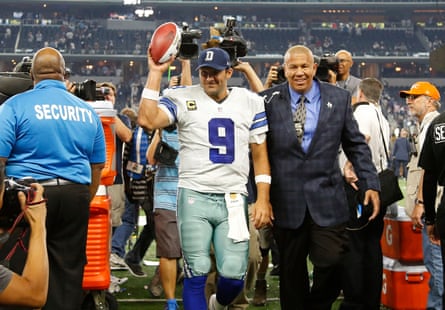
These amounts may seem extravagant – because they are – but are comprehensible in the context of the NFL’s importance to the networks and the broader sums at stake. CBS shells out $2.1bn a year to air games. Even this isn’t enough for the league, which has reportedly been seeking a 50% increase in rights payments.
“Everyone thinks they can do this job. Trust me, it’s harder than it looks. A lot harder than it looks. There’s 17 people screaming in your ear while you’re talking,” says Patrick Crakes, a media consultant who tested contenders in his former role as a Fox Sports executive. “When Romo’s at his best, he understands the game, he sees it and he can articulate it quickly and lots of times he narrows down the possibilities to two or three, he picks one and he’s right a lot.”
Predicting his fate now is far from easy. Discussing the fall of Romo on 11 August, the CBS Sports president David Berson told reporters there is “no timetable” to decide his future. “We had to consider the impact on our image and on our brand. That’s very important to us. Whether the games, marketing, PR, social, the focus should and needs to be on our presentation and not on any other factors,” he said.
Aside from issues of morality, loyalty and reputation, a ruthlessly pragmatic calculation could also enter the picture: if Watt proves a success, perhaps the network will conclude it makes sense to cut a fading Romo and potentially save $72m if the rest of his contract can be voided on the basis that the drunk-driving charge damaged the network’s reputation. Another possibility is that Romo returns to air with CBS at some point this season or next, but on the “B” team, calling less attractive match-ups.
Industry standards have undeniably evolved. Though Howard Cosell’s drinking – said to occur before, after and even during broadcasts – was an open secret, the great ABC sportscaster’s consumption did not preclude him from a long and storied career, nor was it widely publicized until a former ABC executive wrote a book in 1988 that alleged Cosell threw up on his co-commentator’s cowboy boots in the booth after imbibing too much vodka before a Monday Night Football broadcast in 1970. (Cosell, who left the stadium at half-time, claimed he was sick with a virus.)
Will Romo’s troubles dissuade networks from giving out lavish contracts in the future? Crakes doubts that executives will be rushing to offer more decade-long deals – not because of Romo’s personal travails but since today’s media landscape is so turbulent, making future rights deals and negotiating leverage hard to predict. CBS’s parent company, Paramount Skydance, wants to acquire Warner Bros Discovery in a potential $110bn deal that could see CBS Sports merge with TNT Sports.
CBS was the most-watched NFL broadcaster last season according to Nielsen ratings, with an average of 25.8 million viewers for its late Sunday afternoon games. Its Thanksgiving clash between the Cowboys and the Kansas City Chiefs attracted an average of 57.2 million viewers – the largest-ever audience for an NFL regular-season contest.
Such huge figures, especially remarkable at a time when traditional broadcast television is in decline, underline the value of the NFL to the legacy networks. They explain why charismatic personalities such as Romo who can elucidate a complex sport for mainstream audiences are able to command vast salaries. Constant scrutiny and high expectations are part of the bargain. “You’re really carrying the brand flag for your network, for your sport and for the league and that’s why those guys make so much money. There’s a lot of trust that goes into that,” Crakes says.
If a commentator becomes divisive and derided, that’s a problem. “Football in the United States is the most general market product that we have any more. It’s the closest thing to going to blockbuster movies that you can find,” Crakes adds. “It’s the closest thing we’ve got any more in the United States to talking to everybody.”