3 weeks ago
50
3 weeks ago
50
It’s official: after years of tense negotiations and missed deadlines, there is finally a plan to govern the future of the imperiled Colorado River - or at least the makings of one.
With the previous framework set to expire in October, the US Bureau of Reclamation publicly released its proposal for a new plan on Friday.
The broad, 10-year blueprint sets parameters for operating guidelines that will be decided every two years.
Under the new federal framework, California, Arizona and Nevada could collectively lose up to 3m acre-feet of water – roughly 40% of their supply – per year. One acre-foot, a unit denoting the amount of water that can cover a football field one foot deep, is equal to roughly 326,000 gallons (1.2m liters) – enough to supply roughly three families for a year.
The document doesn’t spell out how exactly those cuts would be handed out. But the so-called lower-basin states would see a mandatory 1.25m acre-feet shaved off from their share in 2027 and 2028 with the possibility of larger cuts, depending on conditions.
Rather than a steadfast solution to the water crisis rapidly unfolding across the American west, the new rules set by the federal government are a stopgap, experts said. The goal is to protect the infrastructure at the heart of the system, they said, while giving the seven states still embroiled in an impasse over how to inflict the enormous cuts needed to pull the entire system back from the brink and allow more time to come to their own agreement.
For the last three years, the upper-basin states (Colorado, New Mexico, Utah and Wyoming) and the lower-basin states (California, Arizona and Nevada) have blown through deadline after deadline in attempts to form a lasting consensus.
With little hope of a reprieve from warm and dry conditions that have widened the gap between water demand and supply, there are also concerns that the proposed cuts won’t go far enough.
Tensions are still high, and time is running short.
The Colorado River crisis – explained
Show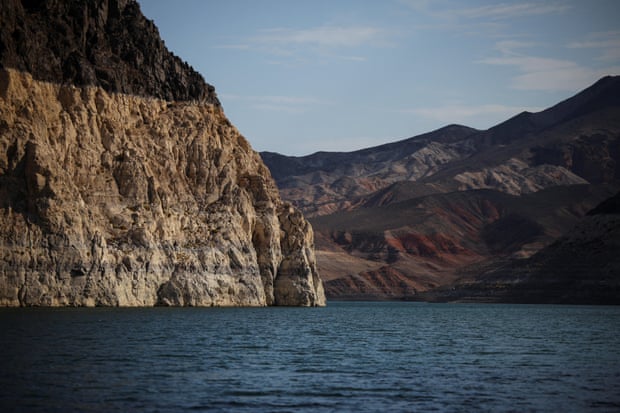
What is the Colorado River?
The Colorado River is one of the largest waterways in North America, snaking across 1,450 miles (2,300km) from the Rocky Mountains into Mexico. It supplies roughly 40 million people in seven states, dozens of Indigenous tribes and two countries, and irrigates 5.5m acres (2.23m hectares) of farmland.
Its waters raised bustling cities, including Los Angeles, Phoenix and Las Vegas, and fuel an estimated $1.4tn in economic activity. Large dams on the river’s two main reservoirs – Lake Mead and Lake Powell – provide hydroelectric power to millions of people. The sprawling basin is also home to diverse ecosystems, with scores of birds, fish, plants and animals, and provides critical habitat for more than 150 threatened or endangered species.
Why is the river in crisis?
The river has been overdrawn for more than a century. An outdated compact agreed to in 1922 doled out more rights than there was water in the system, a gap that’s only widened as the climate crisis takes a larger share and the region warms and dries.
Colorado, Utah, Wyoming and New Mexico, which form the upper-basin states, have resisted any mandatory cuts to their share, insisting the lower-basin states – California, Arizona and Nevada – are responsible for drawing down the reservoirs. The lower-basin states have already agreed to take substantial cuts but are demanding their neighbors to the north share the burden.
What’s being done about it?
There have been layers of agreements and emergency orders to conserve water over the years, but the framework currently governing the waterway is set to expire in October 2026. States urgently need to agree to a new plan, but that hasn’t been easy. Negotiators have spent years trying to iron out the thorny disagreements, without success, and the seven basin states remain at an impasse.
The US federal government has limited jurisdiction to force more cuts or compliance but it does control Lake Powell and Lake Mead. By managing flows through them, federal officials have some power over how much water reaches the lower-basin states.
The threat of lawsuits hangs over the process. Stakeholders agree that letting the courts decide through long, drawn-out legal battles would be a catastrophic outcome for all. In the region where water has long been the source of survival and conflict, the challenges that hinder consensus are as steep as the stakes are high.
Words by Gabrielle Canon
Photograph: Daniel Cole/REUTERS
“This just kicks the can down the road,” Noah Garrison, a water researcher at UCLA’s Institute of the Environment and Sustainability, said after the contours of the plan first became public in July. He and others are concerned the federal plan leaves the stakeholders across the basin limited ability to move forward, locked in endless negotiations.
“There is a potential for extremely serious consequences if we don’t address this,” Garrison said. “We’re putting the water supply for 40 million people at risk.”
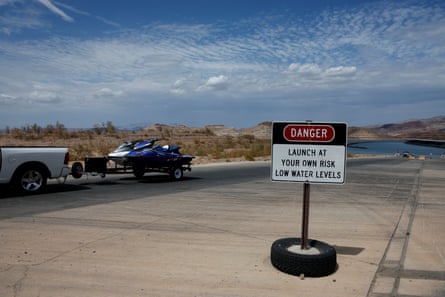
More than 3m acre-feet (3.7bn kiloliters) of cuts are needed to bring the basin back into balance – an amount equal to more than a quarter of its annual average flow. In years as dry as this one, even that amount may not be enough. Lake Powell and Lake Mead recently fell to the lowest combined levels recorded since Lake Powell was built.
“In order to best protect the system, there needs to be pretty significant shortages,” said Dr John Berggren, regional policy manager at Western Resource Advocates. “We’re going to have to do more.”
A tipping point
The intractable conflicts over the Colorado River are more than a century in the making.
A water compact from 1922 initially divided water resources equally between the upper-basin and lower-basin states, with each awarded rights to 7.5m acre-feet. Since 2020, the Colorado’s flows have averaged just more than 10m acre-feet a year, creating a staggering gap between the water available and the rights issued for it.
Consumption has fallen in recent years even as some communities and industries have continued to grow, thanks to conservation efforts and increased efficiency. But that hasn’t kept up with a dwindling water supply as the region warms and dries. Snowmelt that feeds the river is evaporating more quickly, and thirsty soils and plants soak up more water. Since 2020, average flows in the Colorado have dropped by 32% compared with the last century.
The ecosystems on the river have already paid a heavy price. But water shortages affect communities and businesses too. More than 70% of Colorado River water used goes to agriculture, including thirsty crops such as alfalfa and hay, which feed cattle, and the bulk of the winter lettuce and leafy greens grown in the US.
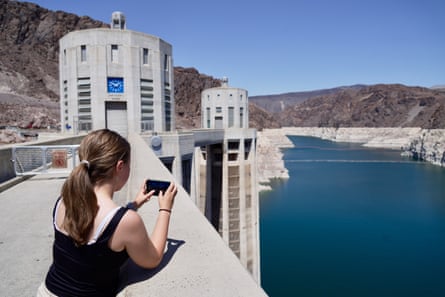
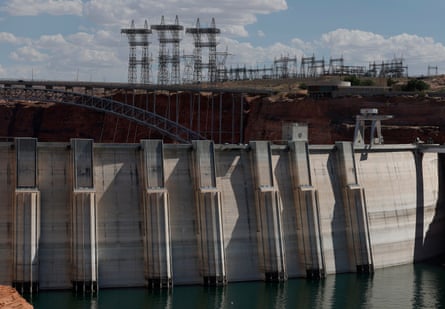
The crisis came to head this year, as a devastating snow drought and an extreme spring heatwave served as the one-two punch.At the start of summer, the water line at Lake Powell hovered just 37ft above the point where Glen Canyon Dam would fail to generate hydroelectric power relied on by nearly 6m households and businesses.
If the reservoir’s levels fell far enough, gravity would cease carrying the water downstream. A so-called “deadpool” would be catastrophic.
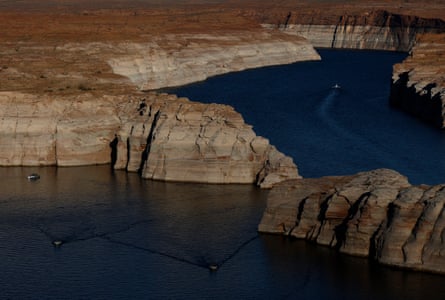
The reservoir levels typically don’t peak until early summer, which means there are months left before new snowmelt flows in. That is, if there’s even snow to melt off.
“If we have another mediocre year of runoff – not an excessively low year, just a mediocre year – we’d go over the cliff,” said Dr Jack Schmidt, the director of the Center for Colorado River Studies at Utah State University. “Even if we had the ultimate gangbuster year,” he added, “we would still not get out of the crisis we’re in.”
Even with the possibility that the climate phenomenon known as El Niño, which models show could pack a punch this winter with surges of precipitation, will provide some relief, wet conditions don’t always guarantee strong flows.
“El Niño is not gonna save our bacon here,” Brad Udall, a senior water and climate research scientist at Colorado University, said. A century of data shows there isn’t a strong connection between El Niño’s strength and water supplies in the Colorado.
“If we had a decent winter, it would only buy us a little time,” he added. “ But arguably, that could confuse the nature of the serious steps we’d still need to take.”
Battle lines and sharp divisions
While the federal government has limited authority over the states’ water policy and can’t force cuts across the board, the Bureau of Reclamation operates Lake Powell and Lake Mead, which gives it more jurisdiction over the lower basin’s water supply.
The federal plan does go further than previous ones, more than doubling the maximum reductions required under the previous frameworks.
The framework also attempts to incentivize conservation, allowing users to store large amounts in federal reservoirs for future use. Rather than sacrificing the water, water users could get credits for conserved amounts. While the plan doesn’t force any cuts to the upper basin, this is one mechanism the federal government is using to encourage up to 200,000 acre-feet of water savings from Colorado, Utah, Wyoming and New Mexico.
But state negotiators haven’t hung up their hats.
“This is a bridge, not a permanent solution,” JB Hamby, chair of the Colorado River Board of California and Colorado River commissioner for California, said in a statement issued with the announcement. “Three states cannot carry the responsibility of all seven.”
He added that the next two years under the federal plan provide an opportunity to reach an agreement between all the basin states that “spread that responsibility fairly across the basin”.
Others were more critical of the proposal. “We need to plan for our future. And this deal does not let us do that,” Bill Hasencamp, the southern California metropolitan water district’s manager of Colorado River resources, told Cal Matters before the plan was officially adopted.
Representatives from states facing the harshest cuts were also quick to push back after the proposal was first published in late July. The Arizona governor, Katie Hobbs, said some of the federal options were unacceptable. The Nevada governor, Joe Lombardo, promised to fight “any outcome that imposes unreasonable impacts” to his constituents.
The rhetoric reflects sharp divisions that remain – and the still-present threats that these fights could be taken to the court. The legal challenges that still loom large could sink urgent management decisions into years of drawn-out courtroom battles.
“Some states in this basin are preparing to sue their sister states,” said Amy Haas, executive director of the Colorado River Authority of Utah, in a Senate committee hearing before the federal plan was released. Citing a “public display over hiring high-dollar firms” and war chests with litigation funds being set aside, she warned lawsuits could tie up decisions for decades.
Even with this plan in place, lawsuits from the lower basin against the upper could fly this year. Legal disputes would center on whether the upper basin can be held responsible for losses in supply due to the climate crisis. An interstate water law conflict like this would go straight to the US supreme court.
“By this September or October, there’s going to be a pretty compelling argument from the lower basin that the upper basin hasn’t met its delivery obligation,” said Rhett Larson, a professor of water law at Arizona State University.
With no end to the crisis in sight, experts agreed the federal plan is a starting point - not the final word.
“We are going to have to at some point agree on reductions in supply across the seven basin states, and we have absolutely not been able to do that,” Garrison said. “But even more, we need to look at ways to maximize water supply, and that’s going to require a host of solutions.”
He pointed to increasing the use of recycled water or setting new price signals on growers that use large amounts. “Otherwise, in two years, we’re going to be right back where we started – if not sooner.”