3 months ago
58
3 months ago
58
In the summer of 1989, Karen Palmer bought a used car for cash, filled it with belongings – some clothes, toys, one pot, one pan and a shoebox of photos – and “disappeared” with her new husband and two young daughters. She didn’t tell her mother, her friends or her neighbours where she was going. She gave no notice to her employers and landlord, leaving items out on her apartment balcony as a sign she still lived there.
“I have such a clear memory of the day we left Los Angeles,” says Palmer. “It was this weird combination of fear and exhilaration, heart pounding, driving into the unknown.” Palmer was fleeing her ex-husband, Gil, the man she feared, and the father of her two daughters, Erin and Amy, then seven and three.
They headed east, and eventually stopped at Boulder, Colorado, in the foothills of the Rocky mountains, partly because Gil would never think to look for them there. “I’ve always lived on the coast as I liked to be near the ocean,” she says. “He would not expect me to go inland.” They had no ID, no references, no papers linking them to who they were. In the weeks that followed, they changed their names, faked documents, found jobs, a home and a school for the girls. Palmer terms it “do-it-yourself witness protection”: she was “one person one day, and the next someone else”.
It worked. Gil never found them. She stayed in touch with friends and family by phone so they knew they were safe – but didn’t tell them (even her mother) where she was, so that they wouldn’t know if Gil came and demanded information.
The family thrived under their new names. The girls grew up. Yet those ordinary, uneventful decades that followed gave Palmer space and time to doubt all that had gone before. “I spent 20 years questioning whether I had done the right thing, and that felt terrible,” she says. “It’s a big thing to take a man’s children away. It’s the worst thing you can do to somebody.” Had it been an overreaction? How real was the danger? Should she have stayed, and fought through the courts for a better, legal solution? Palmer’s newly published memoir, She’s Under Here, attempts to answer these questions.
Through all the years Palmer spent with Gil, she never heard the terms “domestic abuse”, “coercive control” or “gaslighting”, although she now knows that this is what she lived with. “Courts and law enforcement still don’t take it as seriously as they should. But 35 years ago we didn’t even have the vocabulary,” she says. “Over the course of the relationship, I never went to a shelter. I didn’t know anyone who had even been abused, which doesn’t mean that they weren’t. ‘Grooming’ is another thing I had no language for – but what happened was absolutely that.”
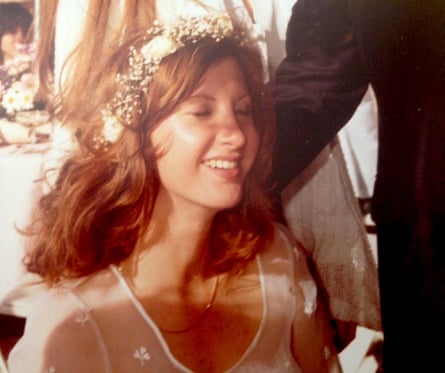
Palmer had been painfully vulnerable when she met Gil. She was an adopted only child; her father was an alcoholic and her parents had a difficult marriage. “It was not a happy home,” she says.
At 16, she became pregnant by a teenage boyfriend, and went to the maternity home where she herself had been born and adopted. She describes it like a “fairytale”. Girls entered, gestated, delivered and departed. She was allowed to hold her son for one hour – “solid as a football” – before he was taken from her and she returned home. A couple of months later, back in college, she took a part-time job in an office supply firm. Gil was her boss. He was 36, a father of three, in the process of divorcing.
“After giving up the baby, I was in this deep grief and I mistook that grief for maturity,” she says. “I couldn’t be around teenage boys. They were abhorrent to me. An older man meant something different.” By now, Palmer’s father was in hospital with the cancer that would kill him, and though her mother never liked Gil, she accepted the relationship.
“She was very weirdly religious, and I think she thought that an older man would be more accepting of ‘tainted goods’,” says Palmer. “And also, it was the 70s. Lots of rock’n’roll stars had teenage girlfriends. It was a different era.”
Gil was wild and funny, impulsive and very charismatic – Palmer describes him as “a salesman to the core”. He looked like Jack Nicholson and was sometimes mistaken for him. A functioning alcoholic, he was never faithful. Palmer caught him with another woman a few weeks before their wedding and this continued.
Their marriage lasted 14 years, much of it centred around the “ordinary” raising of their two daughters, with Gil moving between jobs and money-making schemes. He was rarely violent, but bullied and belittled Palmer. He didn’t like her to have friends. He somehow kept her in tight parameters. “There was an undercurrent of control,” she says, “and the long stretches of normal day-to-day were punctuated by moments of intense stress and fear.” In one, Gil pointed a loaded gun at Palmer’s pregnant belly – she grabbed his arm and the gun exploded into the sink. In another, he locked her in the broom cupboard and took the children, aged two and six, out for the day. When they finally came home, he turned it into a game, telling the children “mommy’s hiding” and helping them look for her.
When Palmer left him, she had begun a relationship with their close friend Vinnie, who Gil had known for years. (She and Vinnie are still married today.) “When I first filed for divorce from Gil, I always thought in the back of my mind that he would get over it,” says Palmer. “Eventually, we’d have a normal divorce and he’d be a normal divorced father who’d see the kids when he wanted. But he just got worse and worse.”
Gil’s fury was compounded by alcohol and substance abuse. He fell apart and stopped working. For two years, he stalked Palmer, threatening to kill her and Vinnie, and to put her head in the fridge for the children to find. He head-butted her, slashed their tyres, threw rotten meat in their yard, stuck dynamite on Vinnie’s windscreen wipers, superglued their gate. He phoned so often that she had to have another line installed so she could speak to other people.
For two years, they lived like this. “I didn’t sleep well. I lost my ability to read a book or even a newspaper as I couldn’t focus. I got scary skinny because I had no appetite.” The police were unhelpful – their response to the death threats was: “Call us when he’s in your apartment.” The divorce lawyers were somehow charmed by Gil. (“That’s a nice guy,” one told Palmer. “Divorce is messy!”) Yet, even if she’d been taken seriously, Palmer doubts any intervention could have really helped her. Arresting Gil – and ultimately releasing him – would have brought him straight to her door, whatever the consequences. “And he’d have been worse because he’d have been mad,” she says. Gil would have laughed in the face of a restraining order and the thought of jail didn’t seem to bother him.
It was a kidnapping that finally made her flee. Custody and contact still hadn’t been settled when, during a fraught, harried “handover”, after Gil had spent unscheduled time with Erin, he took three-year-old Amy from Palmer’s arms – she had handed Amy over in order to embrace Erin – and walked briskly away. He disappeared, travelled 60 miles, dyed Amy’s blond hair brown and cropped it short to disguise her as a boy. Palmer and Vinnie made up flyers, drove the streets, called everyone Gil knew. She was awarded emergency custody of the children and a warrant was issued for Gil’s arrest.
“It was the worst thing that ever happened to me – and I gave up a child for adoption – but in my mind, at least, that was for the best, to give that child a family,” says Palmer. “This time, a maniac had taken charge of my daughter.”
After 10 days, Gil called and ranted while Palmer begged, pleaded and wept. After 45 minutes, he agreed to return Amy if Palmer promised to leave Vinnie. She agreed. The handover took place the following night on a San Francisco street corner. (“No cops,” he’d warned.) The very next day, Palmer, Vinnie, Amy and Erin fled.
Palmer had recorded that phone call with Gil but never listened to it until she came to write her memoir. “I carted the tape with me everywhere because it was evidence of this thing that happened, but I was afraid of hearing his voice,” she says. Playing it back was like being in the room with him. “His voice, his pet phrases, his weird cliches, were so distinctive to me. I was shaking through the entire thing.”
On the recording, she could hear Amy singing in the background and herself sobbing and whining. And then Gil.
The transcription set out in the book is chilling.
You can see how easy it was for me to take her? I could do it again and again and again. Wake up to reality! … And I don’t care who’s looking for me. Do you have the police there now? No, you know better. I’d just get violent … [Police] don’t want to be bothered anyway. Until you kill somebody. Then they listen to you. I’m telling you, I’ve been absolutely insane. Suicidal, maniacal. I hate. I am full of hate … I either have to kill somebody and get it over with, and then I’ll be able to relax, or I get my way …

Amy’s young, that’s why I took her. Isn’t it sick? It took seven days for her to completely forget about you. Isn’t that sad? She was tough the first three, but now, the last six have been nothing. It’s like, no memory. Totally gone. She doesn’t miss Erin, she doesn’t know who that is. She doesn’t miss anything. Everything is out of her life. Right now she only knows me, and that’s who she loves. Daddy.
“At the point when I finally played it back, I was still asking myself: did I do the right thing? Was it really necessary to go?” says Palmer. “But I did the right thing – and I’d do it again.”
Their escape and “reinvention” would not be possible now. “You couldn’t do what we did,” she says. “There was no internet, no social media. Each state was in charge of its own records without much cross-referencing.” In Boulder, they chose Palmer as a new surname for everyone, although the girls kept their first names. Palmer’s birth name is Kerry – she became Karen, as it was similar enough to explain any slips. Vinnie switched his first and middle names around. They both took new driving tests to secure new licences.
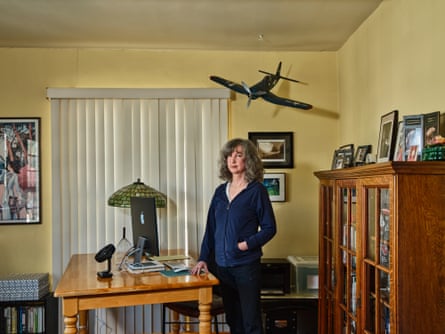
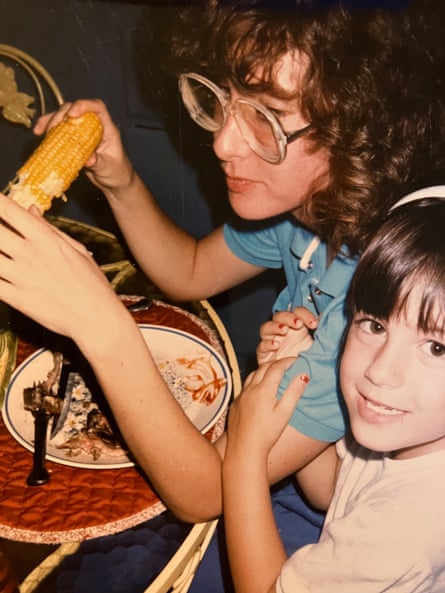
“We were just a regular family on the block,” says Palmer. Vinnie found work restoring furniture and Palmer as a graphic designer. “Amy has no memory of Gil, but Erin was seven, and the amazing thing is that in all those years, even through her teens, she never told anyone. She understood that it was serious.”
Writing the memoir has taken years. “One of the difficulties was that I had these dramatic things that happened to me and then 20 years where not much happened,” she says. “What I came to realise was that the second half was actually as important, if not more important. It’s as if I didn’t get to be a real person until I left.
“For years, Gil was pushing me down, under his thumb, telling me, ‘You’re ugly’, ‘You’re stupid.’ Vinnie was the first person who thought I was funny. I could have friends. I could feel competent. If the dishes didn’t get done, there was nobody to yell at me. I could find interesting work, be good to people and have them actually be good to me.”
Gil died in 2008 – although Palmer didn’t discover this until years later. He had spent his final years in and out of jail for firearms offences, chronic substance abuse, assault and resisting arrest. By the end, he was living in a tent in a city park. “Writing the book was a kind of exorcism,” says Palmer. “I don’t feel angry at him any more. I feel angry that we had to go through this, but I feel pity for him that he ruined his life and it was all so unnecessary.”
Legally straightening out their true identities after learning of Gil’s death was a lengthy, messy process. Palmer and Vinnie now live back in LA. Erin and Amy are in other states, but they are a tight unit – Vinnie officially adopted them, at their request, when they were 20 and 25. “He is, without doubt, the love of my life,” says Palmer. “It was kind of a wartime romance. Nothing could pull us apart after that.”
For Palmer, it was changing her identity that gave her herself – and she has been surprised by the way other women have responded to her book. Many have told her that running away and starting over still seems to be the best option. “There’s this whole sisterhood,” she says, “these women who come and tell me what happened to them. All kinds of women have said, ‘I wish I could do that. If only I could.’”