3 months ago
68
3 months ago
68
Over the past six months, thousands of students have been walking out of their schools in protest of Immigration and Customs Enforcement’s (ICE) presence in their communities. Some of their schools supported the protests; some didn’t, threatening disciplinary action. Other schools stayed neutral out of fear of inviting unwanted attention to vulnerable immigrant students.
The Guardian spoke to seven teenagers who led or participated in school walkouts. Many said their organizing went beyond leaving class, extending to checking social media for suspected ICE sightings, distributing “know your rights” materials and making political posters. All were resolute about the need to protest against ICE regardless of any risk – and whether or not they got support from the grown-ups around them.
Nathalie, 17, whose family didn’t want to give their last name out of fears for their safety, planned their Wisconsin school’s walkout on 30 January. Beforehand, Nathalie sent an email to teachers saying they were welcome to join the students, but the students were not asking for permission.
Here they are in their own words.
Lark Jeffers (they/them), 16, and Kiran Almazor (he/him), 16
Participated in the Free America walkout on 20 January in Silver Spring, Maryland
Lark: This was our way to make our voices heard, because at the end of the day, we’re 16 – what we say isn’t going to make the lawmaker listen to us.
Kiran: Our school population is majority Hispanic, and those are the people who are racially profiled by ICE, so it’s this huge fear.
Lots of people in my family are immigrants, lots of people in my family are scared of what’s going on. Ethiopian immigrants, people in my family, we aren’t Hispanic. So when I am protesting and speaking out against ICE, I’m not just thinking about my family, because I know my family has some level of privilege against what ICE is doing. I’m really trying to think about all the other people who don’t have that privilege, who are losing their lives.
Lark: You have to care for your community, you have to look out for your friends, your family, your found family. All of it is so important.
Even though by protesting and talking about this, you are putting your heart out there, you are allowing it to get beat up and you’re allowing your feelings to get hurt, you can’t let these feelings of hopelessness and despair take over. You have to remain involved. And if even we can do it, so can you.
Henders Aponte (he/him), 17
Joined his high school walkout in The Woodlands, Texas, on 6 February
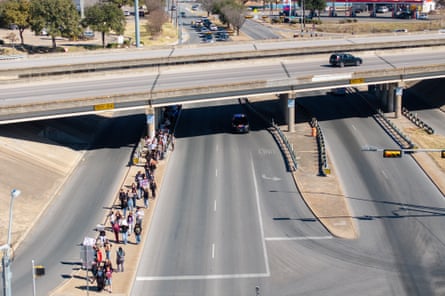
This is a really Republican area, so my school’s really Republican and conservative. The students are, and the school board is, really conservative [too]. They’ve banned over, I don’t know, 100 books at this point.
It’s important that we actually express how we feel, especially because there’s a lot of fear-mongering in our community. When Trump was campaigning to be president, many of the ESL students were scared of what was going to happen to them, and I think that continues to be a thing.
Mostly everyone here in the area supports ICE and their actions, and pretty much everything that Trump is doing right now.
But today [during our walkout], our student body demonstrated its commitment to social justice and we are proud of it. We will never tolerate the incitement of violence in our community.
Nathalie (all pronouns), 17
Led and spoke at a multischool walkout on 30 January in Milwaukee, Wisconsin
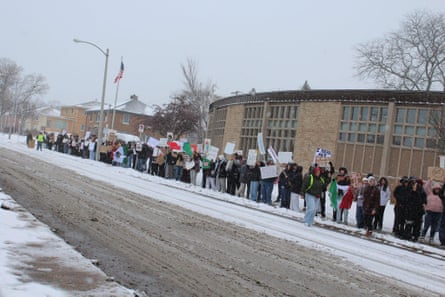
I started off my speech naming the victims [killed by federal agents] in January. Hearing the names out loud just really makes you realize how many people that is in such a short span of time.
The protest was because of those people, and I wanted them to know that we were thinking of them – not only our families [who are being targeted], but also them.
Then I started talking about how we’re very much tired of being blamed and targeted by the same man that had called us animals. It really breaks my heart because we’re being dehumanized in that way, and there’s nothing we can really do about it because we’re high schoolers. I mentioned how this was a very dangerous time for us all because not only are our parents being hunted, taken and kidnapped, but it’s also our little siblings being used as bait and then being taken. And it’s just not OK.
I wanted to connect personally with the other protesters and my classmates and peers, because my dad is an immigrant. Though I may not look stereotypically what I am, I’m still that person. That blood is still in me. It definitely breaks my heart because my father is very much, very much fitting [a racial] profile. ICE would take him, and it made me angry thinking about it.
Samiya Portugal (she/her), 17
Led and spoke at her high school’s walkout on 30 January in Los Angeles
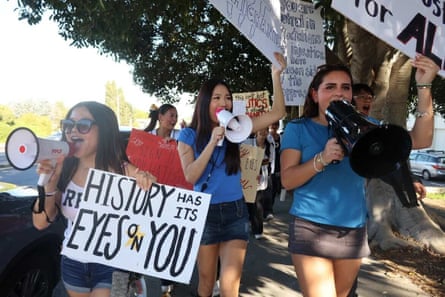
The White House has a TikTok account, and they’ll post things like “deportation ASMR”. You go on YouTube the night before [school], and you watch an ad of [the US secretary of homeland security] Kristi Noem threatening everybody who has ever come to this country. It’s frightening.
Kids in high school, they’re taking US history, or they’re taking government – they’re understanding what their rights are. Then to go online and to see that even citizens are having those violated is what’s making it such an issue.
There’s a lot of students who are scared of how maybe their own parents, but also other people and other people’s parents, might react to trying to organize something like [our school’s walkout]. The more people who stand up for this and try to make a difference, the better. As long as you’re not risking your own safety, it’s a really noble and really brave cause to stand up and speak out against.
Arianna Collado (she/her) and Rhy Serrano (she/her), 17
Joined their high school walkout in New York City on 30 January
Arianna: My grandmother is an immigrant. I live with my grandmother. I wouldn’t be here without my grandmother. That’s why [protesting is] really important to me – because she’s one of the strongest women I know.
Immigrants contribute so much to this country that people fail to realize. You can’t be mad at us for doing jobs that you don’t want to do, and you can’t be mad at us for bringing culture, especially in New York City. This is a city built by immigrants, for immigrants; this has never been for the transplants. Every neighborhood you go to, it’s a different immigrant community, and I think that’s what makes New York City so special. It’s never been about Times Square, respectfully.
I feel scared [about ICE] every day. I go to sleep and I have nightmares about it. But I’m not going to let that stop me, because bravery is just the positive way to say you’re scared, and I’d rather be brave than scared.
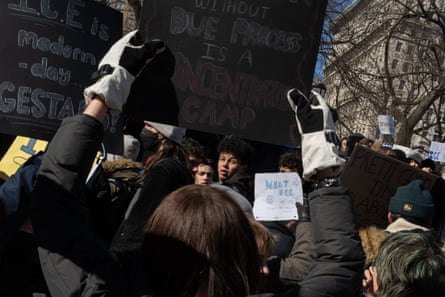
Rhy: Being scared just makes me want to be more involved. My little cousins – my mom was just telling me about this – at school, they’re scared because people are telling them, you’re brown, you’re going to be deported. There’s no reason why people should be scared to walk outside.
Arianna: You remember in 2016 when Trump got first elected, everyone in elementary school was crying because we all thought we were going to get “sent back to Africa”, even though none of us were Africans?
Rhy: That’s so messed up. There’s no reason why this leader of our country is sending all these people into fear. Land of the free? I do not feel very free right now.
The education part is really important, especially now, like in Texas, in Florida and all those places that are removing important history about immigrants. Be involved and don’t be afraid to protest. One suspension is not that deep if you are standing up for people you care about. Just be brave.
Arianna: Yeah. Home of the brave.