7 hours ago
18
7 hours ago
18
‘Achtung! Staatsgrenze!” OK, the signpost marking the “state border” didn’t have exclamation marks but, with its no-nonsense Prussian font, it did feel quite shouty. The only thing was, no one on the Feistritzer Alm – a peaceful sweep of Alpine pasture at the meeting of Austria and Italy – was paying any attention to it at all.
Hikers hiked straight past. Mountain bikers used it to prop up their cycles. Cows grazed willy-nilly. And the patrons of the Schutzhütte Oisternig enjoyed their cold beers regardless of which country they were in. While official boundaries may have changed in these parts over the centuries, the magnificence of the mountains has not.
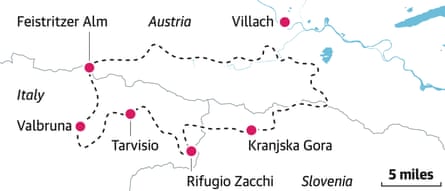
My husband and I had woken that morning in Austria, in the Carinthian village of Feistritz. After breakfast at the old Gasthof Alte Post, we’d bought a loaf from the bäckerei, climbed past the 15th-century church as its bells called worshippers for prayers and continued up through pine forest to these high Alpine meadows – and into Italy.
We were hiking the Alpe Adria, a long-distance trail jointly developed by Austria, Slovenia and Italy that runs from the foot of Grossglockner (Austria’s highest mountain at 3,798 metres) to the Adriatic coast. At 750km (466 miles), the full trail is too long for most people’s summer holidays. But a 135km (84 mile) loop – moderate-graded, doable in a week, with walking days of 15-24km (9-15 miles) – has been created where the three nations meet, to offer a multicultural taster. It’s an appealing idea; hikers love circuiting multiple countries – just look at the numbers crowding the Tour du Mont Blanc these days. While the Alpe Adria loop isn’t quite as dramatic as that, it does offer a much quieter alternative.
We started our journey by catching an early Eurostar to Amsterdam, where there was time for canals, beer and crispy bitterballen before boarding the Nightjet sleeper to Salzburg. In our adjoining capsule-like cabins, we watched the Netherlands segue into Germany, and woke at dawn to pasture, pines and peaks. On the final train from Salzburg to Villach, where we were beginning the loop, the Alps pressed closer, drawing us in.
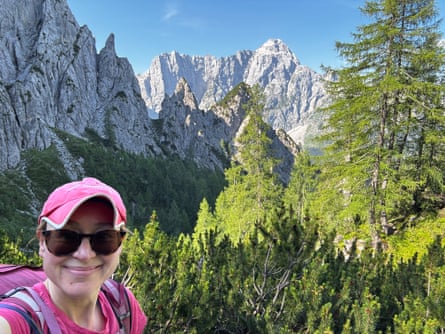
Now, on the Feistritzer Alm, a day and a half into the walk, Austria was behind us (for the time being) and Italy beckoned, beautifully. Just around the hill from the Schutzhütte Oisternig sat the chapel of Our Lady of the Snows (or the Chiesa Madonna della Neve/Almkapelle Maria Schnee, depending on your linguistic preferences); beyond spread deep-green foothills and the jagged Julian Alps, sawing into a hot-blue sky.
From here, the rest of the day was all downhill, a drop through blessed shade and butterflies, on paths weaving through the pines and peeping out to the peaks, to end in the village of Valbruna, at the Valbruna Inn. We had a wonderful room, and spent time on our balcony, gazing past the geraniums to the sheer Jôf Fuart range, which reaches up to 2,666 metres.
We also spent time in the hotel’s Julius Kugy Library, a cosy den of books on alpinism, named after a writer-mountaineer legend. Born in 1858 to a Slovenian family in Gorizia – then part of the Austrian empire, now in Italy – Kugy is credited with opening up the Julian Alps. He never lost his reverence for nature, always encouraging others to explore with respect, curiosity and awe. I picked up one of his books and read from his introduction: “[This] tries to describe the mountains as a source of happiness, because such they were in my life.”
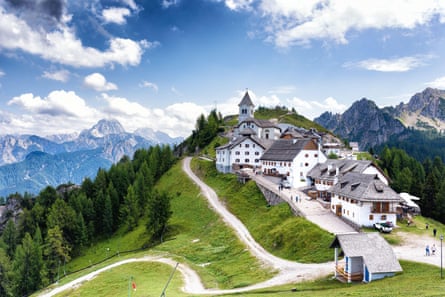
I couldn’t have agreed more and, with great happiness, we continued the next morning, following the Alpe Adria from Valbruna, across the Saisera River and up through fir and spruce to the Sanctuary of Monte Lussari, a ridge-top pilgrim church and hamlet, where the Virgin Mary is said to have appeared in 1360. I was less moved by the miracle, or the shops selling branded tote bags, liqueurs and slippers, than by the mountains scattered far and wide. We lingered to enjoy the view, then descended via alpenrose and ambling goats to Tarvisio, finding a different kind of happiness in the town’s gelaterias. Then, later that evening, we sat with cold beers on our balcony at the Hotel Nevada, watching as a storm crashed through, briefly erasing every mountain.
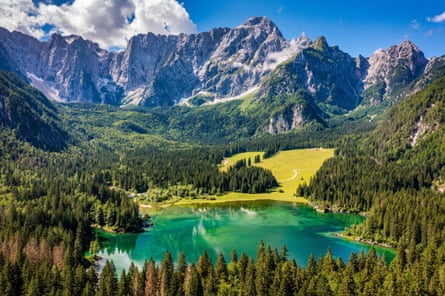
The next day brought more joy as the trail took us along the woodland-weaving Sentiero del Orso and then via a busy cycle path to the Fusine lakes. These twin glacial bowls are so arrestingly blue-green you’d think they’d been AI-ed if you weren’t standing right there. We found a quiet spot to picnic, listening to the whinnying of little grebes and staring beyond the dazzling water to the afternoon’s challenge via the rocks ahead: the haul up to Rifugio Zacchi.
after newsletter promotion
The Alpe Adria loop usually ends each day in a valley bottom, where there are plenty of inns. But not tonight. Zacchi sits at 1,380 metres, tight-hugged by the intimidating peaks that mark the Slovenian border. After a muggy, magical ascent through forest to the refuge, I sat on the terrace, drinking a superb Aperol spritz, and stared at them, transfixed; a few booms of thunder rippled, just in case the power of nature had been in doubt.
The food at Zacchi was excellent – venison ragù, chargrilled peppers, potato-pancake-like frico, made with local montasio cheese. Also excellent was the fact that, in a stroke of luck, we had a dorm to ourselves. We woke, refreshed and ready for the next border hop.
The most striking route would have been over the forbidding-looking Vratca Pass. The Alpe Adria took us there, for views east into Triglav national park, but didn’t cross. Instead, the trail backtracked down on the Italian side to follow a path through the verdant Sava Valley to the outdoorsy town of Kranjska Gora.
It was a pleasant entrance into Slovenia; however, our exit was spectacular. To get back to Austria the next day, we had to cross the Karavanke Alps and conquer the highest point of our route, the 1,842-metre Schwarzkogel. It was an unrelenting climb, at first amid pasture and shingle roofs, with sublime views to the Julian peaks, then deep in forest serenaded by thrushes, streams trickling to our side.
As we neared the top, we could see south across Slovenia’s surging summits, north across Carinthia’s electric-blue lakes and low hills. Squat white marker-stones began to appear too, strung along the ridge’s spine – an international border marked more casually than most front gardens. We slalomed between the posts, enjoying both the freedom of movement and the majesty of nature. For millennia the Alps have been physical and cultural barriers. The Alpe Adria is a bringing together; a source of mountain happiness.
The trip was provided by Walks Worldwide; the eight-day, self-guided Alpe Adria Tri-Country Trek is from £895 B&B. Accommodation in London was provided by Generator (rooms from £75, dorm beds from £11)