3 months ago
69
3 months ago
69
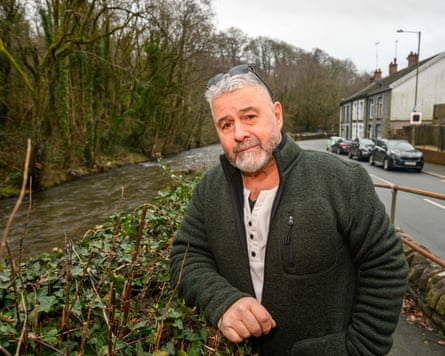
When Storm Dennis hit the UK in 2020, a wall of dirty, frigid water from a tributary of the Taff threw Paul Thomas against the front of his house in the south Wales village of Ynysybwl. He managed to swim back into his home before the storm surge changed direction, almost carrying him out of the smashed-in front door.
“I was holding on to downpipes to stop myself being dragged out again. It was unbelievably strong, the water,” he said.
“You’re sitting on the stairs watching it come up each step and wondering when it’s going to stop … All you can do is wait and hope it does stop.”
Life on Clydach Terrace, next to the river of the same name, has been difficult ever since, Thomas said. Heavy rain or amber weather warnings mean no one on the street can sleep. “There’s so many triggers that take us back to that night … Even now, [my grandson] has a problem when it rains. He doesn’t like it.”
Clydach Terrace is one of the most dangerous places in the country, classified as “high risk to life” by the flooding management authority. The residents’ six-year-long nightmare ended last week when Rhondda Cynon Taf (RCT) council voted to buy 16 of the street’s 18 houses at a cost of £2.6m, and the doomed homes will now be demolished.
It is believed to be the first time anywhere in the country that such drastic measures have been taken as a result of the climate emergency, earning the road’s residents an unenviable moniker: they are the UK’s first climate evacuees.
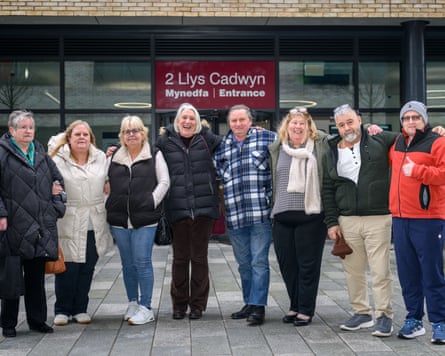
This group of approximately 40 people could be a cross-section of any street, in any town. The terrace is home to a teacher, a contractor, retirees, NHS employees, a children’s carer and office workers who commute to Pontypridd and Cardiff.
Over the years, two families have bought properties next door, so several generations live side by side, and at least four households are home to young children. Some people have lived in Clydach Terrace for decades; one young couple bought their first home there in 2020, and yet more people are renting.
Of the 18 houses on the street, only 6a and 6b – newer builds set back from the road, and up a slope – will remain. One woman living there said she would not be moving, but her son, a little further down the road, will be.
For now, the street is united in relief. “It was the right decision. It’s for everyone’s safety,” said Paige Didcote, 27.
“I won’t have the anxiety if I am at work, and my partner’s at work, of having to rush back. We both work over an hour away and anything can happen within that hour,” she said.
Thomas said: “Not feeling physically sick when you see a weather warning coming your way … Not going to bed and wondering: ‘Are we going to wake up in the morning?’ To live a normal life again, it’s a dream come true.”
The climate crisis is shifting weather patterns, intensifying wind-rain extremes in some parts of the UK, which are also becoming more susceptible to flooding – and Storm Dennis was one of the most intense extratropical cyclones ever recorded.
A cubic metre of water weighs about 1 tonne, or roughly as much as a small car. It is estimated that at Dennis’s peak, the Taff, which Nant Clydach flows into, carried 805 cubic metres a second – enough to fill an Olympic size swimming pool in just over three seconds.
Thomas, a carpenter, believes that the weight of the water in another storm like Dennis could be enough to collapse the fronts of the terrace houses.
“If you’re upstairs, all the floor joists you and your family are standing on collapse as well, and you go into the river,” he said.
Storms and heavy rainfall have overwhelmed Clydach Terrace’s residents several times in the six years after Dennis. It has been either impossible or very expensive to obtain insurance since, putting the houses in an even more vulnerable position.
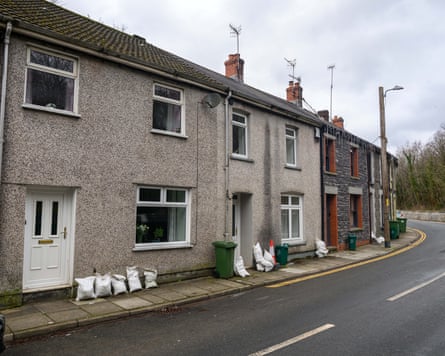
During the Guardian’s visit last week, the homes on the street were in various states of repair; many were damp and mossy, with sandbags piled up outside the doors. In the front rooms of several homes, children’s toys, photo frames and other bric-a-brac of family life were piled up in plastic boxes, ready to move upstairs when the next storm arrives.
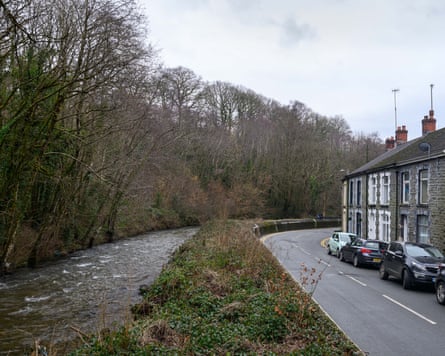
On the other side of the road, the river hummed along. Thin winter sun filtered through the woodland on the sloping far bank and a water depth gauge board said its level was approximately 0.5 metres higher than normal.
Thomas, a 66-year-old who has lived on the terrace for 40 years, said he loved living by the Clydach. “It’s a beautiful place. In the summer, I sit over the river, and the only danger is to be hit by a flying kingfisher … But in the winter, that river changes.”
Nant Clydach rises from the ground at the top of the mountain; it joins the River Taff just outside Pontypridd, the market town where three steep valleys meet, and from there, as the topography softens, meanders down to Cardiff and the sea.
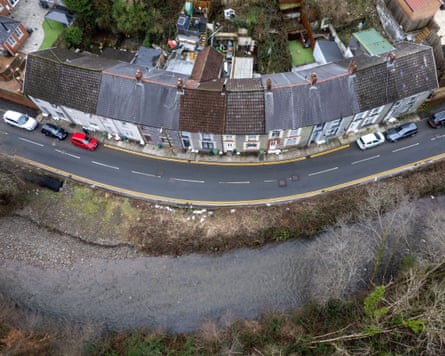
The river was artificially diverted by mining activity in the 1930s and a tunnel built at the southern end of the street to channel the water. The terrace, which follows the curve of the watercourse, marks the eastern boundary of Ynysybwl.
A retaining wall separates the Clydach from the road, but neither the wall nor the tunnel are big enough now to stop homes being badly inundated.
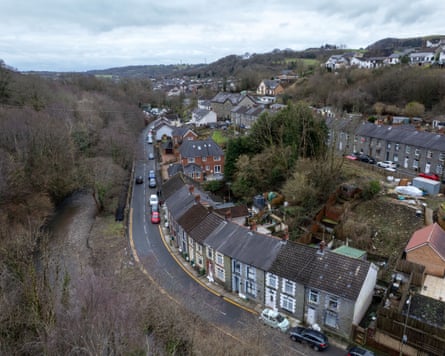
In some ways, the street is uniquely unlucky. The classic mining community row of early 20th-century stone houses was built on a natural floodplain, and its narrowness means there is no room for flood waters to dissipate. Crucially, the terrace is in a basin, meaning that a rise of just a centimetre over the retaining wall can almost instantly turn into 2 metres of water, engulfing nearby houses within minutes.
Everyone on Clydach Terrace the Guardian spoke to said the speed with which the water can arrive was their biggest worry. “The water will come up the street faster than you can walk,” Thomas said.
Caitlin Gibbs, 24, described living through Storm Bert in 2024, before her three-year-old daughter Layla died of cancer. Gibbs was pregnant at the time with Nyla, now one.
“It was a horrific time for us anyway. It was like: ‘What the hell do we do?’ What if something happens with her feeding tube?’ We have got no way of getting out of here,” she said.
Flooding management authority Natural Resources Wales (NRW) explored dozens of ways to help Clydach Terrace after Storm Dennis, including building a taller defence wall and removing or enlarging the river culvert.
After five years of surveys, modelling, assessments and back-and-forth with RCT council, the authority concluded in June 2025 that Welsh and UK government funding rules meant none of the options met a viable cost-benefit ratio. The news was met with frustration by Clydach Terrace’s residents, many of whom said they had voiced the same conclusion years earlier.
“Even if we build a wall, it’s not a guarantee. Monmouth, for example, has flood defences, but it was flooded anyway,” said Jeremy Parr, NRW’s head of flood risk management, referring to November’s Storm Claudia.
“Our staff live in these communities too, no one wants to see this happening … long-term viability is very difficult and we are going to see more of this extreme weather.”
NRW’s decision led RCT council to consider buying the 16 homes on Clydach Terrace judged to be at risk and knocking them down. Council leader Andrew Morgan described the local authority’s vote last Monday as “the right thing to do”.
“We’ve spent close to £130m on repairing infrastructure damaged by Dennis and £30m on flooding infrastructure in the last five or six years, so in the scheme of things, it’s a small amount.
“Ultimately, if we don’t do this, the risk to these residents is going to continue to grow, and it’s already clear that their mental health is affected. Some of them have PTSD,” Morgan added.
A purchase price of £2.3m has been agreed in principle. Additional relocation assistance, incidental and legal costs and land transaction tax takes the total to about £2.57m.
Thomas and his family have already started viewing houses for sale elsewhere in the village. A young couple at the far end of the street said they are going to move to Cardiff, where one of them is from; Gibbs, a renter, isn’t sure what her options are.
“I don’t want to go further up the valley, but if I end up in council housing and that’s what they’ve got, that’s what I’ll have to do,” she said.
Clydach Terrace may be the first UK community to disband in the face of the climate emergency, but it won’t be the last.
Fairbourne, in Gwynedd, and Seasalter in Kent have been listed for “managed retreat” over the next 20 years due to rising sea levels, while the UK’s east coast is one of the fastest-eroding in Europe: last month, the residents of a dozen clifftop homes in Hemsby, Norfolk were told to evacuate and offered temporary accommodation.
Another 713,000 homes, mostly in Lincolnshire, Lancashire, Kent and Doncaster, will face significant flood exposure by the middle of the century, according to the Byline Times.
Clydach Terrace will hold a street party before the houses are emptied and demolished; by September, Thomas said, everyone should have moved.
“I would have loved them to fix [the river] but there’s nothing else they can do. You’d be a fool to think there isn’t climate change … The weather has changed, it’s as simple as that,” he said.
“My world turned upside down in 2020. Hopefully, now we can move on from this.”