2 months ago
65
2 months ago
65
When I was nine years old, my grandfather took me to the museum at the former Stutthof concentration camp near Gdansk, in northern Poland. Established by the Nazis in the German-annexed territory of the Free City of Danzig, he had been imprisoned there as a teenager. It was his first visit since the second world war. When we went through the gate, he began to cry, to shout, to reconstruct scenes. The past returned all at once and he fell into a state of trauma. During his imprisonment he had been responsible, among other things, for carrying bodies from the camp infirmary.
Most of the most infamous Nazi death camps have been turned into memorials like Stutthof, in the hope that they can teach something to future generations and avert a repeat of this darkest of chapters in Europe’s history. But it is a fact that few visitors to Auschwitz-Birkenau, Dachau or Stutthof are shaken like my grandfather was. Sites of memory increasingly fail to reach new generations. Visitors learn facts, dates, perpetrators. But knowledge of past crimes does not automatically prevent future ones. Many institutions still teach a reassuring lesson: there were evil people once, they were defeated, we are different. Evil is placed safely in the past. The visitor leaves morally intact.
Jonathan Glazer’s film The Zone of Interest marked a much needed shift in perspective in this regard, and one that gives sites of memory a historic opportunity to rethink the function they serve. The Oscar-winning film captured the banality of the commandant of Auschwitz Rudolf Höss’s family living in a villa next door to the death camp. It led to the villa, long a private home, being bought by the Counter Extremism Project, with the support of the Auschwitz-Birkenau museum, and being opened to the public. It redirected attention away from the machinery of killing towards the conditions of everyday normality that surrounded it.
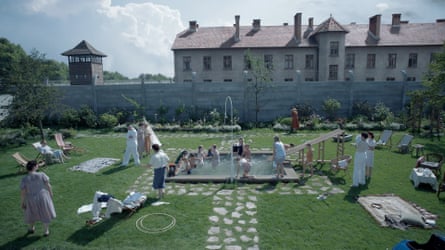
Similar questions are being asked across Europe. At Sachsenhausen in Germany, the commandant’s house is part of educational work on perpetrators. At Bełżec in Poland, the former commandant’s house functions as a research centre. There is no single model. What these spaces share is an intuition that they confront us not with spectacular evil, but with proximity and adaptation.
They show how violence can coexist with domestic routine, with gardens, children, meals. They show how a person can move a few metres and cross a moral border.
At the commandant’s villa next to the former Stutthof camp, meanwhile, ordinary life continues. Built by prisoners and directly bordering the museum grounds, it is now used as municipal housing for several Polish families. It stands next to a camp where approximately 65,000 people were murdered, yet the former villa itself remains unmarked and uncontextualised, indistinguishable from any other residential property.
The current residents are not the problem. Their dignity matters more than any historical argument, and this is not an appeal for their eviction. If anything is done, it must begin from the principle that no one should be harmed in the name of memory.
But after a recent change of leadership at the museum, now may be the time for a serious examination, with full public consultation, of whether any form of reflection is possible around this building. Perhaps the answer is a digital reconstruction. Perhaps archival research. Perhaps extremely limited curated access. Perhaps the honest answer is that nothing should be done. But the question itself matters, because it concerns how memory speaks to the present.
Perhaps the directors of sites of remembrance could also learn something from another film director, the late David Lynch. Twin Peaks disturbed millions more deeply than many institutional exhibitions because it made evil intimate and local. It showed how violence hides inside routine and familiarity. Dale Cooper looks into a mirror and sees something looking back. The scene is simple. The implication is not. Institutions often fail when they place evil behind glass, explanation and distance.
The villa at Stutthof is not a metaphor. It is a fact. It stands next to a place where people were starved, beaten, humiliated and killed. Nearly half of Stutthof’s victims were Jewish. Yet the site often functions primarily as a museum of Polish martyrdom. The Jewish victims and their shoes do not easily fit this narrative. Selection produces blind spots. Blind spots are not neutral.
Every day we see images of mass killing in Ukraine, Gaza, Sudan. We scroll. We continue with our lives. We are not indifferent, but we are becoming accustomed. The question is not only who the perpetrators are. The question is who the watchers are.
The commandants’ villas, in Auschwitz and in Stutthof, can serve as mirrors. Not places of accusation, but of analysis. Everyone wants to believe they are on the side of good. The real question is how one gets there, and whether we are willing to look long enough to notice the moment when normal life becomes complicity.
-
Grzegorz Kwiatkowski is a writer and musician, and a member of the band Trupa Trupa