1 month ago
55
1 month ago
55
The second Trump administration recorded its highest number of immigration arrests so far last month. One significant and alarming reason that is far less noticeable than armored, masked agents swaggering in the streets with weapons may be a sudden change in America’s immigration courts.
Here, in recent months, accelerated mass hearings are giving people facing existential questions about their future little time to prepare for their cases, and judges are often ordering vulnerable immigrants deported without them even being in the courtroom.
Coast to coast, many judges are swiftly wrapping up immigration cases in unprecedented numbers. More than 100,000 immigration cases were closed in June alone, driven first and foremost by courts across the US issuing orders to deport.
While thousands of people received these removal orders without ever having the chance to defend themselves, others were shuttled en masse into crowded hearings that attorneys are calling “mega-masters”, nicknamed after their size and the type of court appearance known as a master calendar hearing.
The results of this policy were on clear display in Chicago earlier this summer, where, for instance, a single immigration judge in the US’s third largest city oversaw as many as 185 fast-tracked cases in one sitting, a huge number compared with a more typical 20 previously.
From March to June, Chicago judges’ orders green-lighting someone’s deportation have suddenly shot up by 120%. And more than 78% of completed cases last month ended in what’s called a removal order in absentia, where the judge decides an immigrant or asylum seeker should be deported because they were no-shows at their hearings.
Notwithstanding that many immigrants have said they never received a letter telling them their appointments had been rescheduled, often to months or years earlier than their previous dates. Or that people are scared to attend their hearings after high-profile arrests at immigration courts across the country. Or even that the Chicago court is scheduling so many of these mass hearings with different judges around the same time that up to 611 people are being told to arrive at the courthouse at once, causing chaos.
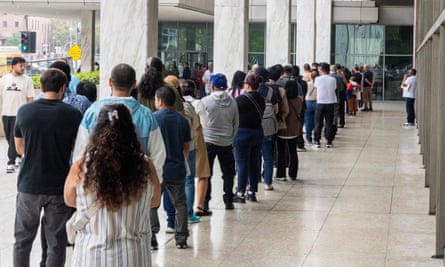
Immigrants who receive absentia removal orders unbeknown to them were likely going about their days, thinking they’ve filed applications for relief and are following the law to the letter, unaware that they ever had a change to their court date or that they are now at imminent risk of deportation.
Historically, master calendar hearings have been for basic administrative tasks, like the judge reading immigrants their rights and responsibilities, determining if the allegations in their immigration records are accurate, and setting dates for hearings to determine if they qualify for asylum or another form of immigration relief.
But under the second Trump administration, these hearings – often a person’s earliest interactions with the court – have become increasingly perilous, amid courthouse arrests and attempts to disqualify cases not on their merits, but instead because of unpaid fees or the possibility that the federal government could send someone to another country they’ve never even visited.
Master calendar hearings are also typically a group affair, with more than one person or family on the schedule. But the sheer scale of today’s “mega masters” – 70, 100, 150 cases at once – was relatively rare up until May, when the phenomenon started ballooning, before exploding in June.
Once people’s court dates are suddenly rescheduled, even if they’re among the lucky ones who receive notice, it means taking time off work, sometimes traveling hours, maybe paying for a hotel – all logistics that require time, savings and plans that can be extra difficult to make happen at short notice.
When the same judge in Kansas City considered two dockets in early June, the first – where 93 people had a median lead time of, at most, 15 days to be alerted that their court date had changed – resulted in 56 absentia orders. The second, where 96 people had a median lead time of 196 days, ended with just nine, showing the disproportionate toll of mega masters that have especially fast timelines.
By one count, mega masters last month resulted in over 20,000 absentia orders nationwide. That represents nearly two out of every five absentia orders in June, despite only a fraction of the nation’s roughly 700 immigration judges presiding over these mass hearings and other, smaller master calendar hearings proceeding as normal.
At the same time, absentia orders constituted more than two-thirds of all removal decisions from immigration judges last month, which clocked in at just under 79,000 in total. Only 1,883 completed cases – or fewer than 2% – ended with the person winning any form of relief.
That’s part of what makes the mega masters, and the absentia orders that follow, such a potent tool for the Trump administration’s mass deportation campaign: those immigrants who didn’t show up, often for no fault of their own, have now lost the chance to make their case for asylum or other protections. They simply won’t advance to the next stage where they could argue their eligibility to stay in the US legally.
In theory, they could try to reopen their cases, but doing so is complicated, and unless they have access to an attorney, they’re unlikely to succeed. Legal representation is hard to come by, with just over one in five immigrants having a lawyer when they were ordered deported in June.
And, once people have a removal order, they’re generally fair game for deportation, whether that’s after being identified by immigration agents or increasingly by local and state law enforcement through partnerships with the federal government. That means a routine traffic stop can easily turn into a detention, and now with so many more active removal orders out there, it’s no surprise that immigration arrests have increased in recent weeks.
This erosion of due process may not be as visible as the dramatic scenes of immigration agents patrolling Los Angeles, Chicago and Minnesota earlier in Trump’s second term. But it has the same consequences, for many of the same communities: more people are being detained in life-threatening conditions, and vanishingly few are getting the justice they seek.