1 hour ago
5
1 hour ago
5
UK's economy more productive than previously thought
Newsflash: Britain’s economy has been more productive since Tony Blair’s first election win than previously thought.
A new measure of measuring productivity, just released by the Office for National Statistics, shows that annual productivity growth since 1997 has been stronger than it had estimated in the past.
The ONS now believes that output per hour was 40.7% higher in 2024 than in 1997 under its new “component approach”, compared with 34.0% under the previous methodology.
This implies annual productivity growth of 1.3% since 1997, compared with 1.1% under the current approach (which is based on the ONS’s shonky Labour Force Survey).
The new “component” approach introduces explicit adjustments for annual leave, sickness, bank holidays, furlough and overtime, while benchmarking hours worked to employer-reported data; it will replace existing UK labour productivity statistics, the ONS says.
Interestingly, the new approach shows that between 2009 and 2019, output per hour worked has grown faster than previously estimated. Under the old approach, growth slowed to 0.7% – but the new component approach shows growth of 1.3% after the financial crisis.
But output per job growth slowed to 1.0% a year under both approaches.
Key events
Eurozone inflation revised down a little
Some good news from the eurozone – inflation is not quite as high as first thought.
Consumer prices across the euro area rose by 3.2% in the year to August, according to a new estimate from eurostat. It had initially estimated inflation rose to 3.3% in August.
That’s still a rise from July, when prices rose at an annual rate of 2.9%.
The lowest annual rates were registered in Sweden (0.3%), Estonia (1.3%) and Czechia (1.5%). The highest annual rates were recorded in Romania (6.3%), Lithuania (5.6%) and Cyprus (5.2%).
Productivity puzzle partly solved
The ONS appears to have partly solved the UK’s productivity puzzle.
That puzzle is why UK output per hour after 2008 only grew at a much slower rate than would have been expected from the pre-GFC trend.
The answer, is that Britons have not been working as many hours as the ONS estimated.
It now estimates that total actual hours worked in 2024 were 11.1% above their 1997 to 2007 average – it had previously estimated growth of 18.5%.
The ONS says:
Under the component approach, improvements to actual hours worked can explain half of the productivity slowdown. The “productivity puzzle” therefore remains under both approaches, but it is smaller under the component approach framework.
The component approach does not remove the post-GFC slowdown, but it suggests that part of the measured shortfall reflects labour input measurement, particularly the treatment of average actual hours worked.
Chart: UK productivity closer to pre-GFC trend
This looks to be the key finding from the Office for National Statistics’s new report into UK productivity:
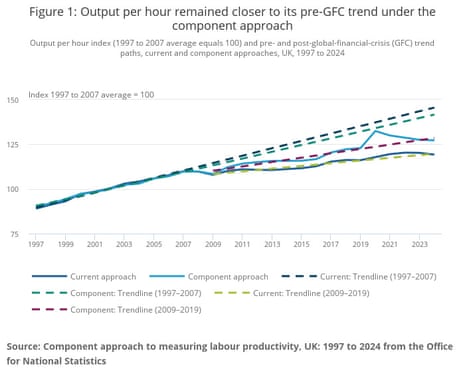
It shows that under the ONS’s new approach, UK productivity is closer to its trend line before the global financial crisis (GFC) rocked the economy.
In other worse, Britain’s productivity crisis has not been as severe as feared.
One factor is that the ONS now believes the downward trend in average hours worked continued after the GFC (better late then never, I suppose!)
The ONS says:
Under the component approach, the distinction between the pre- and post-GFC trends are less pronounced. Growth still slows after the financial downturn, but the post-GFC trend lies closer to the earlier trajectory than under the current approach.
Component output per hour also shows stronger post-crisis growth, increasing by 1.3% a year between 2009 and 2019, compared with 2.0% a year between 1997 and 2007.
UK's economy more productive than previously thought
Newsflash: Britain’s economy has been more productive since Tony Blair’s first election win than previously thought.
A new measure of measuring productivity, just released by the Office for National Statistics, shows that annual productivity growth since 1997 has been stronger than it had estimated in the past.
The ONS now believes that output per hour was 40.7% higher in 2024 than in 1997 under its new “component approach”, compared with 34.0% under the previous methodology.
This implies annual productivity growth of 1.3% since 1997, compared with 1.1% under the current approach (which is based on the ONS’s shonky Labour Force Survey).
The new “component” approach introduces explicit adjustments for annual leave, sickness, bank holidays, furlough and overtime, while benchmarking hours worked to employer-reported data; it will replace existing UK labour productivity statistics, the ONS says.
Interestingly, the new approach shows that between 2009 and 2019, output per hour worked has grown faster than previously estimated. Under the old approach, growth slowed to 0.7% – but the new component approach shows growth of 1.3% after the financial crisis.
But output per job growth slowed to 1.0% a year under both approaches.
Long-dated UK government bond prices are flat this morning, ahead of the Bank of England’s decisions at noon.
This leaves the yield on 30-year UK gilts unchanged at 5.85%, and the 10-year yield marginally higher at 5.301%.
Both measures hit multi-year highs earlier this week.
London stocks rise after Fed rate hike
The London stock market has opened higher, as investors shrug off last night’s US interest rate rise.
The FTSE 100 share index has gained 82 points, or 0.8%, to 10,771 points.
Although the Dow Jones industrial average of US stocks fell by 1.2% yesterday, the wider market reaction is quite subdued.
Mark Haefele, chief investment officer at UBS Global Wealth Management, says:
“We remain positioned for further equity gains while preparing for near-term volatility. If tightening remains measured, credit spreads remain stable, and profits continue to grow, the rally should have scope to broaden across sectors and regions.
We recommend diversified equity exposure while avoiding excessive concentration in areas that are particularly sensitive to interest rates or rely on a single return driver.”
Haefele also gives three reasons why markets might not be too rattled by the Fed:
-
Much of the tightening is already priced in.
-
Economic strength makes tightening more manageable.
-
Strong earnings can counter higher yield
There’s only a 20% chance that the Bank of England raises interest rates at noon today, according to the money markets.
A hold – maintaining Bank rate at 3.75% – is an 80% shot.
Next warns of UK slowdown despite lifting profit forecast
In the City, shares in retail chain Next have jumped after it lifted its profit forecast again.
Next cheered shareholders this morning by reporting it has increased its profit guidance for this financial year by £12m, to £1.255bn.
The increase is the result of a small upgrade in sales expectations and some additional cost savings, mainly in warehousing, it said.
This looks to be the fourth profit upgrade from Next this year.
However… the company has also lowered its forecast for sales growth in the UK this year, down from +2.8% to +2.0%.
Next predicts a slow, steady decline as the year progresses, and warns chancellor John Healey not to raise taxes in next month’s budget, saying:
Our primary concerns are rising inflation, higher mortgage interest costs and a weak employment market. These worries will only be compounded if they are accompanied by tax increases.
Next’s shares are up 3.2% to £150, putting it at the top of the FTSE 100 risers.
Given high energy prices are driving up UK inflation, the Bank of England will not be pleased to hear the latest transit data from the Middle East.
Commodity vessel transits through the strait of Hormuz dwindled to just three ships on Wednesday, down from 12 a day earlier.
Although this exclude any vessels that might have passed through the waterway with their Automatic Identification System transponders turned off to avoid detection, it underlines that oil and gas flows from the Middle East are still badly affected by the Iran war.
Reuters has more details:
Of the three vessels, an empty Supramax dry bulk ship entered the strait via the Iranian route, while an empty petroleum product tanker entered through a dark route, shipping data from Kpler showed at 0445 GMT.
A Panamax tanker exited the waterway using a dark route, the data showed.
Today’s interest rate decision comes at an increasingly difficult point for UK policymakers, says Daniela Hathorn, senior market analyst at Capital.com:
This week’s data has painted a distinctly mixed picture: inflation is moving further above target and producer costs are accelerating, yet the labour market continues to soften.
The result is an uncomfortable trade-off between guarding against a second inflation wave and avoiding unnecessary damage to an already fragile economy.
QT explained
Why is the Bank of England in the business of selling bonds anyway?
In 2009 (after the financial crisis), the BoE began buying bonds with newly created money to push up their prices and bring down long-term interest rates. This process, called quantitative easing (QE) also aimed to support inflation and boost asset prices, and thus spur economic activity.
After another burst of QE after the Covid-19 pandemic, the Bank build up its stock of bonds to £895bn.
But it is now reversing that process, though QT.
Quantitative tightening can be done through two ways – either selling a bond, or simply holding onto it until it matures, and then not reinvesting the money.
Active bond sales have been criticised because the Bank is selling bonds for less than it paid for them.
So, given QT pushes up government borrowing costs, and creates a loss for taxpayers, why do it at all?
The Bank says:
Unlike QE – which is used to reduce interest rates and therefore support inflation – the aim of QT is not to affect interest rates or inflation. Instead, the aim is to ensure that it is possible to undertake QE again in future, should that be needed to achieve the inflation target.
There’s a full explanation here.
Although the Bank of England may not raise rates today, money market pricing suggests borrowing costs are going to increase over the next year or so.
As of last night, investors were pricing in four quarter-point increases by the end of 2027, which would lift Bank rate from 3.75% to 4.75%.
Introduction: Bank of England to set rates and bond-selling programme
Good morning, and welcome to our rolling coverage of business, the world economy and the financial markets.
It’s a crunch day for the Bank of England. The UK central bank will announce its latest interest rate decision at noon, and also reveal whether it has made any changes to its bond-selling programme.
The City are pretty confident that the Bank will leave rates on hold, at 3.75%, despite inflation rising further away from its 2% target yesterday.
But while perhaps three members of the monetary policy committee might vote for a hike, they’ll probably be outvoted by the other six…. (but you never know for sure!).
The problem facing the Bank of England is that it has a mandate to control inflation, but there are signs that consumers are struggling – and a rate hike would add to that pressure on households.
Kathleen Brooks, research director at XTB, explains:
The labour market is weak, payrolled employment is falling, wage growth is negative in real terms and job vacancies are also at a multi-year low.
July growth was stronger than expected, however, this was driven by AI Capex spend, and construction and manufacturing contracted last month.
BoE policymakers might also feel slightly uncomfortable that other central bankers have been raising rates – including the US Federal Reserve yesterday (to the annoyance of Donald Trump).
As Fed chair Kevin Warsh pointed out:
“The plain fact is that [US] inflation is too high, and has been for too long.
“This summer’s inflation readings do not tell me that underlying trends have meaningfully improved.”
The Bank’s decision on quantitative tightening (QT) – the sale of bonds bought to stimulate the economy – is harder to call, and potentially more explosive.
Economists expect the Bank to slow the pace of QT – perhaps to an annual pace of £50bn, down from £70bn over the last year. It might even halt the sale of long-dated bonds, where it has faced criticism for helping to push borrowing costs to multi-year highs.
[This is because bond yields rise when prices fall, and prices are pushed down if one major bond-holder is determined to sell their gilts].
The Bank has already faced criticism from the Reform party for pressing on with QT, given the losses being incurred by taxpayers.
The Guardian wrote earlier this week that QT needs to be revised, explaining:
No other major central bank carries on in this way. Whatever one thinks of the losses, making the Treasury settle them immediately turns monetary choices into fiscal interventions. A report this week says that the Bank and Treasury are drawing up changes to QT to reduce pressure on raising interest rates. Independence seems to have been discarded in favour of quiet coordination. The MPC’s decisions cannot be beyond challenge.
Andrew Bailey, the Bank’s governor, calls the overall cost of QT “neutral” – but only, as the economist Patricia Pino points out, when assessed over six decades. In fact, billions in cash demands fall within a parliament. Governments do not set budgets, fight elections or run public services over 60 years. It is unsustainable for the Bank to make decisions and have ministers face voters for the political consequences.
The agenda
-
10am BST: Eurozone inflation report for August
-
12pm BST: Bank of England decision on interest rates and QT
-
1.3pm BST: US initial jobless claims data