3 months ago
60
3 months ago
60
The UK government has approved the construction of a vast new Chinese embassy complex in east London, despite concerns about security and its impact on political exiles in the capital.
The decision by the communities secretary, Steve Reed, brings to an end, for now at least, the saga that has been running since 2018 over the site at Royal Mint Court near Tower Bridge.
However, residents of Royal Mint Court plan to mount a legal challenge to the decision within weeks, amid concerns they could be forced out of their homes, and potentially delaying the project by months or years.
“Ethical or similar objections to the provision of an embassy for a specific country cannot be a material planning consideration,” Reed said, as he largely endorsed a report from the department’s Planning Inspectorate.
MPs from across the political spectrum voiced their opposition to the application, although the security services have said they can handle the risks of espionage that may stem from the enlarged site, which sits close to data cables that run to the City of London.
The communities secretary, however, noted that neither the Home Office nor the Foreign Office, having discussed the issue with the police and the intelligence agencies MI5 and MI6, had any site-specific security concerns that would justify blocking the development.
“No bodies with responsibility for national security, including HO and FCDO [the Home Office and Foreign Office], have raised concerns or objected to the proposal on the basis of the proximity of the cables or other underground infrastructure,” Reed said. Nor had the owners of the cables raised any concerns with the minister, he added.
Critics of the site say its size – the embassy site would be the largest in Europe, hosting more than 200 staff – means it would become a hub for Chinese espionage and intimidation of dissidents, including from Hong Kong.
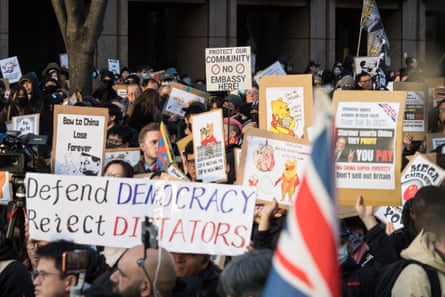
Priti Patel, the shadow foreign secretary, accused Keir Starmer of a “shameful super-embassy surrender”. The Conservative MP said the prime minister was giving China’s president, Xi Jinping, “what he wants – a colossal spy hub in the heart of our capital”.
Iain Duncan Smith, a former Conservative party leader who is a co-chair of the Inter-Parliamentary Alliance on China, also accused Reed of ignoring security warnings and wider considerations.
“This is a terrible decision that ignores the appalling brutality of the Chinese Communist party as it practises forced labour at home and spies on the UK and uses cyber-attacks to damage our internal security,” he said.
But Reed said China had agreed to consolidate seven existing diplomatic sites into one once the new embassy was built – which MI5 has indicated would make monitoring of the site easier.
Any spying on the UK, harassment of dissidents or surveillance conducted by China from the embassy site could be dealt with by “other legal processes and by various agencies” and could not be controlled “through the planning system”, Reed concluded in a 23-page letter released on Tuesday morning.
People living next to the site said they hoped to seek a judicial review if they could raise £145,000 to fund legal representation. Mark Nygate, the treasurer of Royal Mint Court residents’ association, said: “The residents are determined to keep fighting today’s decision.”
The former head of GCHQ’s National Cyber Security Centre Ciaran Martin said on Sunday that the British intelligence agencies would not allow the “mega embassy” to go ahead if it posed unmanageable risks.
Although officials say there has been no political input in the planning process, the green light is likely to smooth relations before Starmer’s visit to China, expected at the end of January.
Beijing has made the embassy a priority in the UK-China relationship. Xi raised the matter directly with the prime minister in their first phone call in August 2024.
The UK’s plans to redevelop its own outpost in China’s capital have been blocked for years by Xi’s government because of the London embassy row.