3 months ago
61
3 months ago
61
US not trying to dismantle Nato or undermine current world order, US ambassador says in response to MSC's criticism report
US ambassador to Nato Matthew Whitaker is responding to some of the report’s findings now, saying he “completely rejects everything I just heard,” after the Munich Security Conference report editors warned that the greatest challenge to the liberal international order is “coming from within” through the dramatic shift in the US administration’s thinking about its alliances (11:54).
But Whitaker insists the US does not want to dismantle Nato or undermine the existing alliances as implied by the report’s authors, but merely to “balance” the way the defence burden lies on different Nato countries by pushing European allies to “do more and to be capable and strong, because that strength is what guarantees the peace.”
“That’s the first thing I reject; we’re trying to make Nato stronger, not to withdraw or reject Nato, but make it work like it was intended as an alliance of 32 strong and capable allies,” he said.
Whitaker also said that on trade, the US wanted to challenge the “unfair” trade arrangement with Europe, which “turned into Europe taking advantage and running huge trade surplus with the US.”
He also said that the US was frustrated that “there is a lot of discussion and not a lot of action” in Europe, with allies spending more time to discuss issues rather than address them.
Whitaker says that on security, the European partners need to actually step up their defence spending and show they can “follow through” on their promises, including the new Nato spending targets.
He then gets pushed on Greenland, and insists the US interest in the territory is only about ensuring that Greenland – whether as part of Denmark or an independent country in the future – needs to be able to defend itself from Russia and China.
“The Chinese have taken two runs, at least at Greenland; one through the ports trying to invest in the ports and second, through trying to invest in the airport, and so these are real issues,” he claims (something that has been repeatedly questioned by the Danish officials.)
He then distances himself a bit from Trump’s aggressive rhetoric there, saying that he learned during the first Trump administration that “responding to every single Truth Social or tweet by president Trump would be a full-time job,” but insists the underlying security analysis is sound.
Key events Show key events only Please turn on JavaScript to use this feature
US Nato ambassador rejects Zelenskyy's suggestion of US setting deadline for peace deal on Ukraine
US Nato ambassador Matthew Whitaker also denies the suggestion that the US has set a new deadline for peace talks on Ukraine.
Whitaker says “that June deadline was mentioned by president Zelenskyy,” and adds “I don’t think that is anything that the United States has put out there.”
“We want the fighting to end. We want both sides to come together and agree to a peace deal. We’d like it sooner rather than later, and … we just want … to see the suffering and the killing end in Ukraine.”
He added that deadlines tend to be “very dangerous” in this setting, adding:
“We want a peace deal done.
I think we’ll just get this done as soon as it’s ready to get done. But ultimately, both sides, the Russians and the Ukrainians, are going to have to agree to any deal that’s hammered out.”
US expects Europe to 'share burden and ultimately take over conventional defence' of European continent, US Nato ambassador says
There are some more good lines coming from US Nato ambassador, Matthew Whitaker, as he gets pushed on the US intentions on Europe’s security and defence during the MSC ‘kick-off’ briefing.
He gets asked about why US defence secretary Pete Hegseth is going to skip this week’s Nato ministerial on Thursday, and he says that allies should not read too much into this, as “we have a big world and, only one secretary of war and only one secretary of state, and they have a lot of places to be.”
He says the undersecretary, Elbridge Colby, is “the perfect person” to talk about the US defence strategy and the US view on Europe “right now and going forward” to “talk about capabilities that may need to be ultimately transitioned out of Europe and replaced by European capabilities.”
He says the US expects Europe “to equalise, as we expect them to be stronger and to share the burden of European security with the United States and ultimately take over the conventional defence of the European continent, together with the United States overarching nuclear umbrella.”
Expect red lights to go off (again) in some countries, particularly in central and eastern Europe, as they read these quotes above.
Ukraine 'top of agenda,' but Europe should focus on how to truly respond to US challenges, MSC chair says
Munich Security Conference’s Wolfgang Ischinger also gives a preview of what’s to come this week, saying he “certainly hopes that this coming weekend will demonstrate that Ukraine deserves to be at the top of the agenda for a variety of reasons.”
He says Russia continues to “pretend to be willing to negotiate” on Ukraine, while it “continues to … territories the civilian population” instead, and he says this remains the biggest challenge for Europe “in a long time.”
He picks up on Whitaker’s comments earlier too, and says he hopes the MSC will offer an opportunity for Europe to discuss how to move on from discussions to taking “more credible, meaningful decisions on foreign policy and security.”
“I think the United States is giving us the best ever reason to take these questions seriously,” he says.
But he also pointedly says that the US interest in Greenland has proven to be “a public relations disaster,” dramatically affecting “the respect that the US deserves to enjoy in Europe.”
He’s right there: a recent YouGov poll showed that the US president’s attempted Greenland grab has succeeded in turning Europeans solidly against his country, the pollster’s latest survey found.
Large majorities in Denmark, France, Germany, Italy, Spain and Great Britain all declared an unfavourable opinion.
US not trying to dismantle Nato or undermine current world order, US ambassador says in response to MSC's criticism report
US ambassador to Nato Matthew Whitaker is responding to some of the report’s findings now, saying he “completely rejects everything I just heard,” after the Munich Security Conference report editors warned that the greatest challenge to the liberal international order is “coming from within” through the dramatic shift in the US administration’s thinking about its alliances (11:54).
But Whitaker insists the US does not want to dismantle Nato or undermine the existing alliances as implied by the report’s authors, but merely to “balance” the way the defence burden lies on different Nato countries by pushing European allies to “do more and to be capable and strong, because that strength is what guarantees the peace.”
“That’s the first thing I reject; we’re trying to make Nato stronger, not to withdraw or reject Nato, but make it work like it was intended as an alliance of 32 strong and capable allies,” he said.
Whitaker also said that on trade, the US wanted to challenge the “unfair” trade arrangement with Europe, which “turned into Europe taking advantage and running huge trade surplus with the US.”
He also said that the US was frustrated that “there is a lot of discussion and not a lot of action” in Europe, with allies spending more time to discuss issues rather than address them.
Whitaker says that on security, the European partners need to actually step up their defence spending and show they can “follow through” on their promises, including the new Nato spending targets.
He then gets pushed on Greenland, and insists the US interest in the territory is only about ensuring that Greenland – whether as part of Denmark or an independent country in the future – needs to be able to defend itself from Russia and China.
“The Chinese have taken two runs, at least at Greenland; one through the ports trying to invest in the ports and second, through trying to invest in the airport, and so these are real issues,” he claims (something that has been repeatedly questioned by the Danish officials.)
He then distances himself a bit from Trump’s aggressive rhetoric there, saying that he learned during the first Trump administration that “responding to every single Truth Social or tweet by president Trump would be a full-time job,” but insists the underlying security analysis is sound.
70 heads of state, government expected at Munich Security Conference this weekend
Former German ambassador to the US, Wolfgang Ischinger, is now giving a quick briefing on what to expect from the Munich Security Conference this weekend.
He says there will be some 70 heads of state and government, more than 140 government ministers, and more than 40 heads of international organisations.
The proceedings will be opened by German prime minister Friedrich Merz in his first MSC speech in this role, as he is expected to “set the tone” for the forum.
Ischinger also confirms some names of the top decision-makers attending, including French president Emmanuel Macron, UK prime minister Keir Starmer, Poland’s prime minister Donald Tusk, and Denmark’s prime minister Mette Frederiksen.
European Commission president Ursula von der Leyen and Nato secretary general Mark Rutte will also be present.
It was earlier announced that the US delegation will be led by US secretary of state Marco Rubio.
Jakub Krupa
Oh, and this blog will be coming to you from Munich on Friday and over the weekend, so we will bring you all the key lines from the MSC.
If any of this blog’s readers are coming too, let me know and say hello!
Europe entering 'prolonged era of confrontation,' Munich report warns
Jakub Krupa
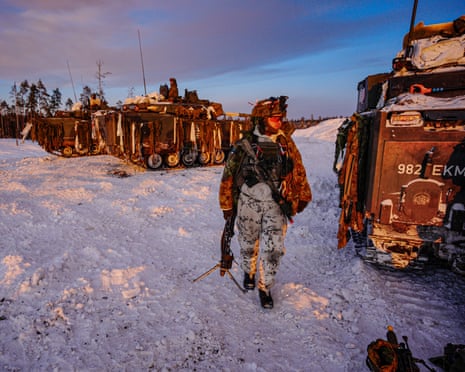
In its section on Europe, the Munich Security Conference report has also warned that the continent was entering “a prolonged era of confrontation, as Russia’s full-scale war of aggression and expanding hybrid campaign dismantle the remnants of the post-cold war cooperative security order.”
It also added that:
“Washington’s gradual retreat from its traditional role as Europe’s primary security guarantor – reflected in wavering support for Ukraine and threatening rhetoric on Greenland – is heightening Europe’s sense of insecurity and exposing its unfinished transition from security consumer to security provider.”
The report also included a series of stark security warnings, noting that “some intelligence agencies estimate that Russia could reconstitute its forces for a ‘regional war’ in the Baltic Sea area within two years of a potential ceasefire in Ukraine – and for a ‘local’ one against a single neighbour within six months.”
It noted that “the first signs of this widening of the battlefield are already visible,” with “a growing number of suspected Russian incidents, including sabotage, vandalism, cyber-attacks, and arson.”
“Analysts widely view these operations as deliberate efforts by Moscow to probe Europe’s defences, sow division, intimidate publics, and weaken support for Ukraine by diverting attention toward domestic security. Europe now faces the challenge of proactively deterring further provocations while avoiding inadvertent escalation.”
The study also pointedly warned that Europe’s reliance on US security was posing new risks as the Trump administration has been dramatically changing its priorities and shifting away from Europe.
“European leaders have long refrained from overt criticism of US policies. Instead, they have pursued a dual strategy: striving to keep Washington engaged at almost any cost while cautiously preparing for greater autonomy. …
Recent confrontations over Greenland, in turn, suggest that Europe’s strategy of accommodation may be reaching its limits.”
Setting out its recommendations for the continent, the report said:
“Given the urgency of these tasks and the limits of consensus-based decision-making, progress will depend on courageous leadership coalitions.
Smaller avant-gardes, such as the Weimar Plus countries (France, Germany, Poland, and the UK) or the European Group of Five (the former plus Italy), will be essential to drive defense industrial consolidation, articulate a coherent European vision for Ukraine, and prepare the EU for enlargement. These steps will involve sharing costs and political risk.
But continued hesitation would leave Europe exposed in a gray zone between competing spheres of influence – steadily eroding its ability to shape its own destiny.”
Europe’s ‘painful’ realisation it must be bolder with US set out in security report
Patrick Wintour
Diplomatic editor
Europe has come to the painful realisation that it needs to be more assertive and more militarily independent from an authoritarian US administration that no longer shares a commitment to liberal democratic norms and values, a report prepared by the Munich Security Conference asserts.
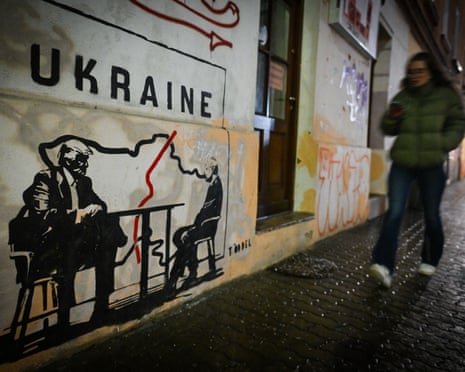
The report sets the scene for an all-out ideological confrontation with the Trump White House at the high-level annual meeting of security policy specialists, which starts on Friday.
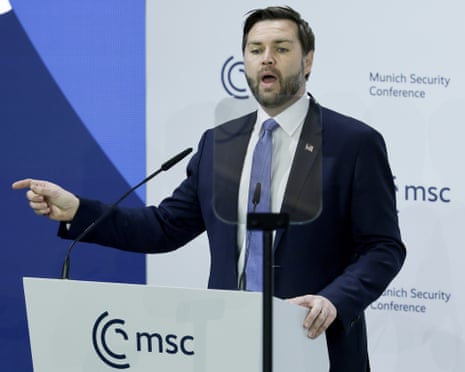
In a now infamous speech to last year’s MSC, the US vice-president, JD Vance, claimed European elites were suppressing free speech and “opening the floodgates” to mass migration. The address marked the moment Europe realised the Trump administration would no longer be a reliable trading and security partner.
Since then European leaders and Donald Trump’s team have waged a series of running battles over topics including the US push to force Ukraine to make territorial concessions to Russia, Trump’s threats to seize Greenland, and a series of protectionist US measures ranging from tariff barriers to inward investment bans.
Vance is not expected in Munich this year, but the US secretary of state, Marco Rubio, and a congressional delegation are scheduled to attend.
Polling commissioned for the report shows Europeans are increasingly willing to operate without US leadership and say it is no longer necessary.
The MSC report accuses Trump of having a lust for destruction and of siding with Vladimir Putin.
“Most of Europe is watching the United States’ descent into ‘competitive authoritarianism’ with rising concern or even horror, wondering how resilient US democracy really is,” the report says.
The MSC report suggests European leaders need to adapt to the techniques of the Trump administration and be more daring in how they make decisions and communicate.
“Effectively pushing back against the demolition men requires much more political courage and innovative thought. The actors defending international rules and institutions need to be just as bold as the actors who seek to destroy them,” it says.
The report adds that “relying on sterile communiqués, predictable conferences, and cautious diplomacy” in a world where the opponents have become more ruthless and much more innovative is a recipe for failure.
Norwegian ambassador resigns amid scrutiny of her family's Epstein links
Elsewhere, a Norwegian ambassador who was involved in Israeli-Palestinian peace efforts in the 1990s and most recently served in Jordan has resigned as she faces scrutiny over her contacts with Jeffrey Epstein, the country’s foreign ministry said.
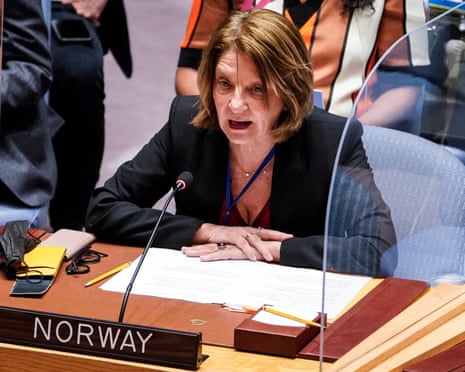
The ministry announced Mona Juul’s resignation on Sunday evening, days after she was suspended as Norway’s ambassador to Jordan. That followed reports that Epstein left the children of Juul and her husband, Terje Rød-Larsen, $10m in a will drawn up shortly before his death by suicide in a New York prison in 2019, AP reported.
Foreign minister Espen Barth Eide said Juul’s decision was “correct and necessary.” Her contact with the convicted sex offender showed a “serious lapse in judgment,” he said, adding that “the case makes it difficult to restore the trust that the role requires.”
A ministry investigation into Juul’s knowledge of and contact with Epstein will continue, and Juul will continue discussions with the ministry “so that the matter can be clarified,” Eide said.
AP noted that the latest batch of Epstein files has cast an unflattering spotlight on several prominent Norwegian figures. Crown Princess Mette-Marit on Friday issued an apology “to all of you whom I have disappointed” after documents offered more details of her relationship with Epstein.
As reported last week, the country’s economic crimes unit has also opened a corruption investigation into former prime minister Thorbjørn Jagland (Europe Live, Friday).
Germany charges Ukrainian national over alleged Russian-inspired parcel bomb plot
Meanwhile, Germany has charged a Ukrainian national in connection with allegations of a plot linked to Russian intelligence to detonate parcel packages in Europe, the country’s prosecutors said in a statement.
The prosecutors allege that the man, identified only as Yevhen B., worked with the Russian intelligence services and two other people to send GPS-enabled tracking devices from Cologne to Ukraine to “gather information about shipping routes and transport procedures at the parcel service provider and later to send packages containing incendiary devices.”
“These packages were meant to ignite in Germany or elsewhere en route to parts of Ukraine not occupied by Russia, causing as much damage as possible to undermine the public’s sense of security,” they said.
EU leaders send congratulations to Portugal's president-elect Seguro
Several EU leaders have taken to social media this morning to pass their congratulations to the Portuguese president-elect Seguro, praising him for big win over his far-right rival.
European Council president António Costa, who beat Seguro to be the Socialist Party’s candidate for prime minister in 2015, said:
“I congratulate António José Seguro on his election as President of the Portuguese Republic and wish him every success in the exercise of his mandate. Today, the Portuguese people demonstrated their commitment to democracy, reaffirming Portugal as a pillar of European humanism.”
European Commission president Ursula von der Leyen said:
“Congratulations, António José Seguro, on your election as President of Portugal. The Portuguese citizens have spoken and, in the face of devastation caused by the storms, demonstrated remarkable democratic resilience. Portugal’s voice for our shared European values remains strong.”
Spain’s prime minister Pedro Sánchez said:
“Congratulations, António José Seguro, the new President of Portugal! Social democracy advances with your victory.”
A number of other national leaders, including Romania’s president Nicușor Dan and Croatia’s Andrej Plenković, also sent their congratulations.
Portugal elects socialist as president but far-right rival takes record vote share

Sam Jones
Meanwhile in Portugal, the moderate socialist António José Seguro won a resounding victory in the second round of the country’s presidential election on Sunday, triumphing over his far-right opponent, André Ventura, whose Chega party still managed to take a record share of the vote.
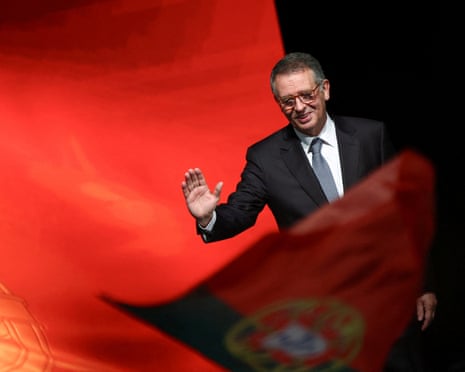
The vote to elect a successor to the outgoing president, Marcelo Rebelo de Sousa, was marked by a cross-party push to head off the prospect of a Chega victory, with some senior rightwing figures throwing their weight behind the centre-left candidate to keep Ventura from entering the presidential palace.
Seguro won 66.8% of votes to Ventura’s 33.2% in the election, which went ahead despite weeks of disruption caused by deadly storms.
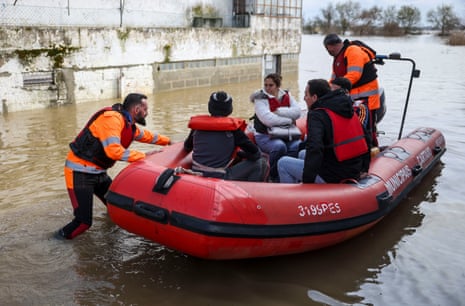
“The response the Portuguese people gave today, their commitment to freedom, democracy, and the future of our country, leaves me naturally moved and proud of our nation,” said Seguro.
Ventura, a former football pundit, columnist, seminarian and novelist who founded Chega seven years ago, said the result showed that “the message from the Portuguese people is clear”, adding that Chega was now the main party on the right and would “soon be governing Portugal”.
Earlier on Sunday, he had accused “the entire political system” of uniting against him.
Media watchdog RSF says 'outraged' by 'harsh' Lai sentence
Media watchdog Reporters Without Borders (RSF) also condemned the 20-year jail sentence handed to Jimmy Lai, urging the UK and others “to intervene” in the case.
“Today, the curtain falls on press freedom in Hong Kong. We are outraged by the harsh sentences handed down to Jimmy Lai,” RSF director general Thibaut Bruttin said in a statement, reported by AFP.
“Democracies, such as the UK and the US, must stop prioritising the normalisation of relations with China and instead exert pressure on the Chinese regime and Hong Kong authorities to ensure that Jimmy Lai and all other journalists are released from prison,” he added.
Lai's son warns Hong Kong court decision amounts to 'life sentence' as 'time is running out'
Sebastien Lai, Jimmy Lai’s son, has just been speaking to BBC News, offering his first reaction to his father’s overnight sentence.
He said:
“It’s obviously heartbreaking, but unfortunately it’s not unexpected. Look, I think that what was unexpected was that it took five years to get to this point. The last five years, my father has spent in solitary confinement in the maximum security prison.”
He warned that with his father’s age and health conditions, this could essentially be a “life sentence.”
“Unfortunately, time is running out for my father. The clock is ticking at his age, given the conditions and he’s got heart issues. He’s lost ten kilos over the last year alone. Time is not on his side.”
He added that:
“In a time when we’re talking about closer relationships to China, a normalisation of relationships … despite all the national security concerns that we have, rightly so, in this country … if they can’t even put a 78 year old man who’s guilty of nothing more than giving all that he has to stand up for freedom and liberty for the people of Hong Kong on a plane and sending him back here now, especially given his deteriorating health, that tells you all you need to know about the relation that we have with China.”
Ukraine faces 'one of most challenging electricity situations' during war, Lviv mayor warns
Jakub Krupa
Lviv mayor Andriy Sadovyi has warned this morning that Ukraine faces “one of the most challenging electricity situations in the past four years” as it nears the fourth anniversary of the full-scale Russian aggression later this month.
The latest overnight Russian strikes killed at least three people in Odesa and Kharkiv, local authorities reported.
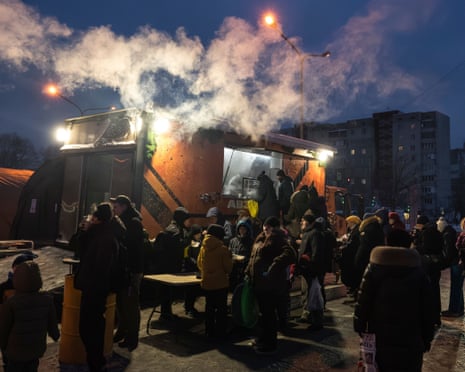
Ukraine is seeking to accelerate the peace talks with Russia and the US, after the country’s president Volodymyr Zelenskyy revealed that the US administration has given Ukraine and Russia yet another deadline to reach a peace settlement, and is now proposing the war should end by June.
Ukraine’s foreign minister Andrii Sybiha said on Sunday that Kyiv was “ready to speed up peace efforts,” as he thanked for the US leadership on the issue.
“It is up to Russia to demonstrate its willingness to advance diplomacy instead of war. So far, we can only see new strikes and disregard for peace efforts,” he said.
He also repeated his call to put more pressure on Moscow “so that it starts treating peace efforts seriously.”
Elsewhere, we will be looking at reactions to last night’s presidential vote in Portugal, and other stories breaking across the continent.
It’s Monday, 9 February 2026, it’s Jakub Krupa here, and this is Europe Live.
Good morning.
EU calls for 'immediate and unconditional' release of Jimmy Lai after his jail sentence
The European Union has called for the “immediate and unconditional” release of the Hong Kong pro-democracy figure, Jimmy Lai, after he was sentenced to 20 years in prison, the harshest penalty handed down for national security offences in Hong Kong.
In a strongly worded statement released just now, a spokesperson for the EU’s diplomatic service said the EU “deplores the heavy prison sentence” and called for his immediate release, “also in consideration of his advanced age and health condition.”
She added:
“The politically motivated prosecution of Jimmy Lai and the former Apple Daily executives and journalists harms Hong Kong’s reputation.
The EU calls on the Hong Kong authorities to restore confidence in press freedom in Hong Kong, one of the pillars of its historic success as an international financial centre, and to stop prosecuting journalists.”