3 months ago
74
3 months ago
74
What would Wallace – everyone’s favourite amateur Yorkshire inventor – look like with a moustache, straw boater and postal worker’s coat? Would a huge set of teeth suit his faithful beagle, Gromit? How about a nose shaped like a banana?
Such questions are answered by an illuminating and sometimes alarming exhibition at east London’s Young V&A that showcases the work of the world’s leading stop-motion outfit, the Bristol-based Aardman studios. Early sketches for Nick Park’s much-loved characters reveal that Wallace was once just a few bristles short of Hitler, while Gromit had fangs and the ability to speak.
Such designs were judiciously smoothed along the way: Gromit became toothless and mute, and Wallace’s long, thin face was massaged into something wider and friendlier after Park watched Peter Sallis, the original voice of Wallace, enunciating the word “cheese”.
Inside Aardman: Wallace & Gromit and Friends opens on Thursday and runs until 25 November, two months after the release of the studio’s third Shaun the Sheep movie, The Beast of Mossy Bottom. Aardman, which celebrates its 50th anniversary this year, is one of UK film’s most enduring and endearing success stories, with a current total of four Oscars and eight Baftas.
Its first film, Chicken Run, is still the highest-grossing stop-motion movie of all time, taking $225m – about five times its budget – while its latest, Wallace & Gromit: Vengeance Most Fowl, became the BBC’s most-watched scripted show in two decades after it aired on Christmas Day in 2024.
Sales for the exhibition are comparable to those enjoyed at the V&A’s main site in South Kensington. More than a quarter of the tickets have already gone, and the first three weeks are entirely sold out.
More than 150 items are on display, including never-before-seen models, sets and storyboards from Aardman’s archives. They are all the more precious for their scarcity. A fire destroyed thousands of items in 2005, including the original Creature Comforts and Chicken Run models.
The exhibition’s layout intends to recreate the experience of touring the company’s studios, offering children “a peek behind the curtain” – and hopefully inspiring them to similar endeavours said the chief curator, Alex Newson. Boards around the four large rooms precis the key jobs across the studio – such as writer, puppet maker and director of photography – and the skillsets needed.
Aardman’s co-founders, Peter Lord and David Sproxton, began modelling together as schoolboys in the 1960s on Lord’s kitchen table in Woking. “Our working hours were constrained by mealtimes,” he said. “We had to finish by 6pm and get out of the way.”
They borrowed a 16mm clockwork camera from Sproxton’s father, “which meant we were in an unusual and privileged position”, Lord said. “Now it’s democratic because everyone’s got a camera. And it’s such a powerful thing for young people to be able to bring something to life.”
The studio was founded in 1976, then given fresh energy by Park’s arrival in 1985. It now employs more than 500 people.
“Aardman is an incredibly complex and skilled operation,” said Newson. “It’s also slow. Each animator only produces around two seconds of footage a day. Yet it’s one of the most accessible creative processes; even a small child can grasp it.”
The exhibition offers ample opportunity for children to get hands-on – repeat visits are encouraged and included in the price. One area enables them to shoot a 20-frame stop-motion short using Playmobil figures, while another offers the tools – rubber gloves, drumsticks and coconuts – for them to provide a soundtrack.
Many models on display are designed to be handled, as are samples of their malleable metal skeletons. One scene featuring Feathers McGraw – Wallace and Gromit’s sinister penguin nemesis – is set up so visitors can manipulate the lighting rig and witness the dramatic effect that subtle changes can make.
The demographic of visitors is likely to stretch beyond primary school age, but the exhibits have been tailored to children. “What we see with kids is that they run to the interactive things first,” said Newson. “Without those things to do, they won’t engage with things in cases and on the walls.”
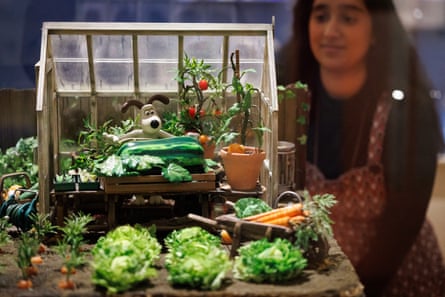
These include meticulous models such as Gromit’s vegetable patch, the local museum from The Wrong Trousers and a remarkably large and detailed ship from 2012’s The Pirates! In an Adventure with Scientists! – which Lord says is the exhibit of which he’s fondest. “I love that thing,” he said. “It was a totem for the whole production: wonderful, bonkers, mad.”
Scores of spare mouths are on display – inserted and ejected from figurines to speed production – likewise a selection of everyday objects occasionally drafted in, such as clingfilm, tinfoil, icing sugar and lentils, the lentils used as rivets on Wallace’s space rocket.
TV screens explain various Aardman idiosyncrasies, such as the “model hospital” that specialises in ear repair and eye wiping. One striking video shows Park acting out storyboards with co-directors, the better to later recreate plausible facial expressions in clay.
Park can appear a self-effacing figure on awards podiums, but such footage reveals him to be a highly adept and rubbery performer, a match for any of the A-listers he brings on board for voice work.
Many of Aardman’s films have explored the tension between embracing technical advance and being wary of it turning on its originators, but the exhibition suggests the studio has found a happy medium. Thumbprints are generally left intact, but cutting-edge software is employed to aid innovation. “The digital processes support the handcrafted processes,” said Newson.
“Stop-motion is maybe more loved than it ever has been. It’s not an antidote to AI, but there is something about its homespun nature that resonates. It’s a counterpoint.”
That such a sentiment has international reach is supported by Aardman’s theme parks in Japan, Sweden, New Zealand and Australia, as well as outside Liverpool. Wallace and Gromit are remarkably popular in South Korea, but the lack of dialogue in Shaun the Sheep helps to explain why those characters account for 35% of the studio’s overseas business.
Other diffusion lines include a Shaun circus show, scheduled to open in Manchester this year, partnerships with hotels and restaurants, and a few on-the-hoof ventures. The Shaun the Sheep restaurant in Dubai, for instance, with its menu of lamb’s brain, tongue, eyes, brain and trotters, is unlikely to be official.
The concepts behind the exhibition have been road-tested by years of schools’ workshops and young internships pioneered by the company, said Newson. For Lord, his involvement in the former has led him to believe the “simple pleasure” of working with clay remains consistent. “Modelling is engrossing,” he said, and it can work in symbiosis with the attractions of an smartphone.
“What we do at Aardman is really technical and complicated. It requires great skill and great patience, but even so, it’s basically telling jokes and funny stories and creating good characters. Yes, we’ve done clay for 50 years. But we’ve also done play.”