3 months ago
69
3 months ago
69
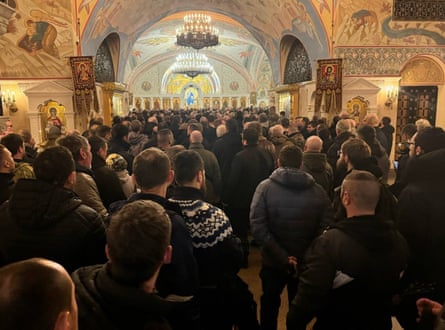
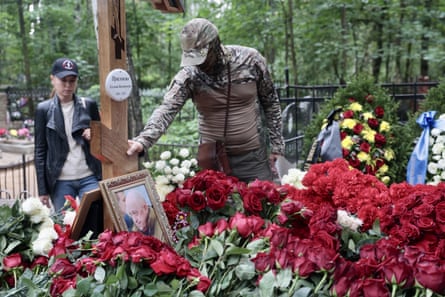
Beneath the frescoed ceilings and golden icons of Moscow’s Cathedral of Christ the Saviour, hundreds of men packed tightly into the lower hall as priests intoned prayers for the dead. Dressed in dark winter jackets, the mourners on Monday filled one of Russia’s most sacred spaces – a church usually reserved for moments of state ritual and national commemoration. Later, near his grave, the crowd lit bright flares and shouted: “One for all, and all for one.”
They had gathered to bid farewell to Stanislav Orlov, better known by his callsign “Spaniard”, the founder of the far-right Española unit – a formation of football hooligans and neo-Nazi volunteers who fought as a paramilitary force on Russia’s side in Ukraine.
Russian pro-war Telegram channels framed the funeral as an act of consecration: a battlefield commander laid to rest at the heart of Moscow’s spiritual and political establishment. Yet amid the solemnity, one detail was conspicuously absent. No official cause of death was mentioned – a silence that only underscored the unease surrounding Orlov’s final days.
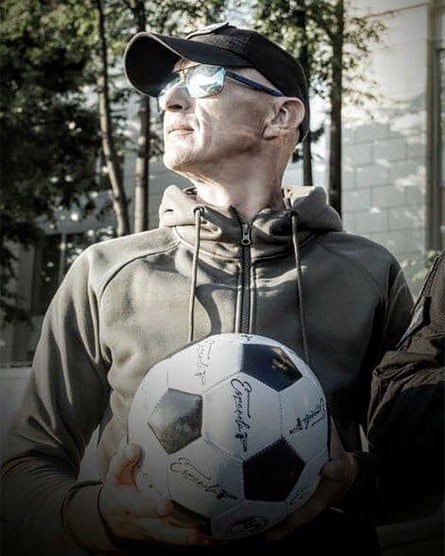
For more than two weeks, Orlov’s death, first rumoured online on 9 December, was the subject of intense speculation and debate. Kremlin-linked Russian news websites and independent outlets soon reported that Orlov was not killed on the battlefield in Ukraine, but was ambushed and shot at his home in Russian-annexed Crimea by Moscow’s own security services.
On Monday, Astra, an anti-war outlet operating in exile, published CCTV footage that it said showed the moments before Orlov was killed, with a group of armed Russian servicemen arriving outside his house, followed by the sound of gunshots. Astra reported that an ambulance only arrived to collect Orlov’s body six hours later.
Analysts say Orlov’s death reflects a broader, increasingly visible crackdown by the Kremlin on renegade ultranationalist figures and semi-autonomous armed groups as a result of the Wagner mutiny.
For much of Vladimir Putin’s full-scale invasion, the Russian state tolerated – and at times encouraged – radical formations that could mobilise fighters quickly and project uncompromising zeal. Units such as Española were useful militarily and ideologically, embodying a raw, street-level patriotism that complemented official propaganda.
Española – which has been sanctioned by the UK and the EU – took part in some of Russia’s bloodiest assaults on Ukrainian cities, including the battles for Mariupol and Bakhmut.
But it also served its purpose away from the frontlines. Española, which brought together football hooligans from Russia’s biggest football clubs, ran a particularly effective publicity campaign and managed to intersect with Russian sports culture and broader social life.
The group attracted prominent former athletes as poster children, including the ex-Russian football international Andrei Solomatin, who enlisted with the unit in 2022. The group’s imagery also surfaced at major sporting events: during a popular CSKA Moscow ice hockey match, Española symbols were displayed, and patches linked to the unit were worn.
But tolerance for irregular units operating outside the main chain of command, such as Española, narrowed sharply after June 2023, when Yevgeny Prigozhin’s Wagner mercenary group rebelled, briefly seizing a military headquarters and sending an armed column towards Moscow.
Although the rebellion collapsed within hours, it marked the most serious challenge to Putin’s rule in decades. Two months later, Prigozhin was killed in a plane crash widely seen by western officials as a Kremlin-ordered reprisal. Since then, Russia’s security apparatus has moved systematically to reassert control.
Independent armed formations have been dismantled or absorbed into the regular military. Prominent ultranationalist critics have been silenced: Igor Girkin, a former commander, was jailed last year on extremism charges after attacking Russia’s military leadership and mocking the war effort.
The same fate awaited Española, which in October abruptly announced that it was disbanding and that its units would be absorbed into Russia’s regular army. Two months later, its founder was dead.
“Orlov’s death is yet another demonstrative elimination of radicals who have slipped out of control, following the same logic as the removal of Prigozhin,” said Andrei Kolesnikov, a Moscow-based political analyst.
Kolesnikov said the apparent killing was intended to serve as “a warning meant to discourage others from pursuing an independent path”, particularly with the prospect of large numbers of embittered and armed men returning from the front if ongoing peace talks open the way to an end to the war.
The message appears to have landed. Few of the hundreds of influential pro-war bloggers have commented publicly on the circumstances of Orlov’s death, with most remaining silent.
Española itself issued a carefully worded statement on Telegram, saying: “We cannot fail to note that many people are interested in the reasons for Spaniard’s death – and we are no less so.” The group urged supporters, however, to wait for the results of an official investigation.
Still, the decision to allow Orlov to be buried at Moscow’s Cathedral of Christ the Saviour captures one of the central paradoxes of wartime Russia, Kolesnikov noted.
“Radical zealots are celebrated, sanctified and mourned in the most sacred of spaces,” Kolesnikov said. “But when they step beyond the narrow boundaries set by the state, they can be eliminated.”
Kolesnikov argued that the Kremlin had applied the same logic to Prigozhin. While the Russian president has disowned Prigozhin for his treachery, he has also been careful not to diminish the warlord or his fighters’ role in the war in Ukraine, wary of antagonising their many admirers.
Prigozhin’s memorial, just 300 metres from Red Square in one of Moscow’s most tourist-heavy areas, has been left untouched. “Russians are free to keep the memory of men like Prigozhin alive, by all means” Kolesnikov said. “But the message is clear: do not lay claim to power – not even a small share of it.”