3 months ago
66
3 months ago
66
On a quiet Montréal street of low-rise brick apartment buildings on one side and cement barrier wall on the other, a crowd has gathered, binoculars around their necks and cameras at the ready. A European robin has taken up residence in the neighbourhood, which is sandwiched between two industrial areas with warehouses and railway lines and, a few blocks away, port facilities on the St Lawrence River.
Ron Vandebeek from Ottawa, Ontario, is here on a frigid February morning hoping to see the rare bird, which was first spotted at the beginning of January.
This is the first recorded sighting of a European robin in Canada, and only the fifth or sixth in North America. That it has taken up residence in Quebec is a source of delight but also consternation for birders. How did it travel thousands of kilometres from its home territory, and will it survive a very cold Montréal winter?
The bird’s normal home range is western Europe, from Scotland to Turkey and as far north as Sweden during breeding season, and visiting Iceland on a seasonal migration stop.
“Did it island hop from Iceland to Greenland to here?” Vandebeek wonders. “That’s a lot of hopping.”
The new local celebrity has brought hundreds of birdwatchers to witness this “rare bird” or “vagrant”, as birds outside their normal territory are called.
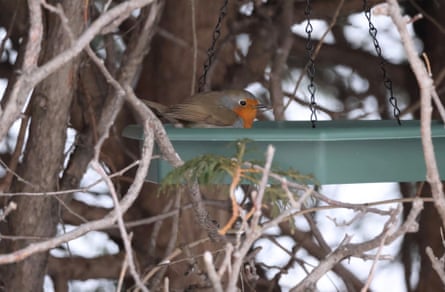
While he’s waiting, Vandebeek is joined by others, including Serge Benoît of Laval, Quebec. Benoît says it is worth making the effort to see such a curiosity.
“It’s a very rare bird and it’s the first time it’s been reported in all of Canada. We’ve never seen it before. So, when a bird is very rare, we’ll travel farther.”
Vandebeek is the first to spot the bird as it alights on a platform feeder set high in a hedge. With its striking orange breast feathers, it is easy to identify. It seems unfazed by the excitement and whirr of digital cameras, perhaps having adapted to its celebrity status after drawing hundreds of birdwatchers over the past weeks.
The European robin is a very distinctive bird, says Ted Floyd, the editor of the American Birding Association’s (ABA) Birding Magazine, and that has made it easier to spot.
“A lot of the really rare birds that show up in North America are pretty drab and brown and boring so they’re easily overlooked,” he says. “But the European robin is one of the most iconic birds on Earth and American birders know what it looks like. So they would have noticed that.”
“Oh, it’s beautiful,” says one man, as he snaps some photos using a long-range lens.
Montrealer Valéry Landry is here on her second attempt to spot the robin. This time, her patience is rewarded. “I was lucky,” she says. “In 10 minutes, he was there.”
The bird is also lucky. Montréal is having its coldest winter in four years, with temperatures one January weekend dropping to -25C. While its usual diet consists of insects, it is omnivorous when required, and bird fans are ensuring it has enough to eat.
Sheldon Harvey of Bird Protection Quebec says as long as it can find sustenance, it should survive. “For that type of bird, it’s really driven by food,” he says. “As long as they can find food, their metabolism will keep them through the cold.”
Bird experts are puzzled and delighted by the bird’s arrival.
“It’s wild for a lot of reasons,” says Maggie MacPherson, an evolutionary ecologist who studies bird ranges at Trent University in Ontario. If the European robin migrates at all, it only travels short distances, she says, making it even less likely that it would make such a long journey of its own accord. “That makes this sighting just amazing,” she says.
The first North American sighting of a European robin was in Pennsylvania in 2015. “It was such a shocking find that it took the ABA checklist committee three years to approve it,” says Floyd. “The question that arose was did it really get here on its own or could it have gotten out of an aviary or a private collection?”
The two leading theories as to how this European robin arrived are that it either caught a ride on a container ship all the way to the Port of Montréal or was caught in a storm that blew it there.
MacPherson thinks it is more likely that it was caught up in an autumn storm, and that it has probably been in the area since last autumn, and not identified until January.
“It was part of a population that was migratory, got to the coast and then got swept up in a storm that actually carried it across the ocean,” she theorises. Or a storm could have swept it out to sea, she says, where it boarded a ship bound for Montréal.
Although researchers are still investigating changes in storm incidence and severity due to the climate crisis, North Atlantic storms are predicted to change direction with increasing wind speeds. Those changes could mean more unlikely birds visiting North America, says MacPherson, and also more bird deaths as they are caught in severe storms.
“I think it’s not out of the question that if we’re having more storms, we could get more vagrants that are being swept up in this storm situation, which can happen both in fall and in spring migration.”
The boat theory is also not far-fetched because birds are known to use human-made infrastructure. Warblers use oil rigs in the Gulf of Mexico as rest stops during migration, MacPherson says. In Florida, European robins have been spotted on cruise ships, says Floyd. “We actually know they’re coming on cruise ships because people are photographing them on cruise ships. So these birds are getting here on boats and that’s just something that resourceful robins are doing.”
There has been a sharp increase in rare bird sightings in the past decade, says Floyd. That does not necessarily mean more rare birds, as there are more birdwatchers. “There are many, many more people watching birds with really good cameras and social networks where they are discussing their findings,” he says.
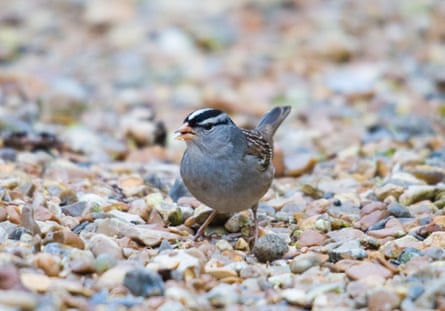
The same phenomenon has also been spotted in reverse, with native American birds arriving in Europe. In 2008, a white-crowned sparrow native to North America drew crowds of birdwatchers in North Norfolk in England.
Other recent celebrity vagrants in Canada include a taiga flycatcher identified in Vancouver in December, another first for the country, and a Steller’s sea eagle, first spotted in December 2024, which made its home in a Newfoundland park.
MacPherson thinks this robin is a young adult of about two years old; the species has a lifespan of five to eight years. It is not impossible it will spend the remainder of its life in the Montréal area.
“We always feel kinda bad when a solo bird of a species shows up,” says Harvey. “Other birds that have shown up like this robin, they tend to suddenly disappear. We don’t know where they go or what happens to them.”
There are more birds new to Quebec as they adapt their range to the climate crisis, he adds. “But when something really bizarre like this happens, you just go out, you enjoy it and you know that’s all you can do.”
Vandebeek now has another bird to add to his list of 5,000 sightings, and considers this a morning well spent. “It’s neat to see a bird totally out of its environment,” he says.
Find more age of extinction coverage here, and follow the biodiversity reporters Phoebe Weston and Patrick Greenfield in the Guardian app for more nature coverage