4 weeks ago
41
4 weeks ago
41
Back in June, a cut-and-paste photocopied flyer began appearing on telegraph poles around Portland, Oregon, promoting a DIY show by an apparently defunct band at an intimate community space. The band hadn’t mentioned it online, but hopeful fans bought every ticket anyway. Their bet paid off: the gig really was the first in 32 years for Heavens to Betsy, the pioneering feminist punk duo of drummer Tracy Sawyer and singer-guitarist Corin Tucker – the latter’s band before Sleater-Kinney unleashed her visceral vibrato unto the world. Tucker proudly made the flyer herself.
Heavens to Betsy were barely out of high school when they played their very first show, 35 years ago this week, in Olympia, Washington, a two-song set as part of a now-mythical indie fest dubbed the International Pop Underground Convention. The festival also featured the likes of Fugazi, Bikini Kill and Melvins; meanwhile Heavens to Betsy had practised only a couple times. Before an audience of about 100, Sawyer was so terrified that all she could think was, “This has to be over soon.”
This summer’s gig was less frightening, looking out on kids the same age that Tucker and Sawyer were when they started the band. “They were singing along to a lot of the songs,” Tucker, now 53, says on a video call from her home in Portland. “They knew all the words and were screaming them at the top of their lungs.” After the gig, Sawyer, 52, recalls from her yard in Oakland, California, “20-year-old kids came up to me and said, ‘I’m learning to play drums by listening to Heavens to Betsy records.’”
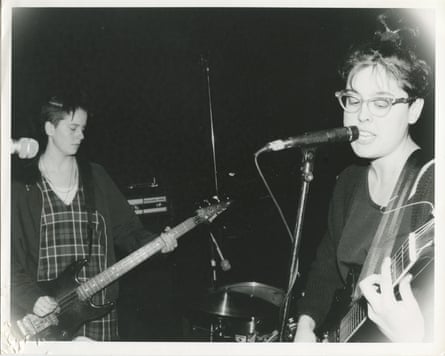
Those early-90s feminist-revenge songs – about body image, sexual abuse, abortion, periods, worker exploitation, defying a world that conditions women to be small – will underpin the band’s upcoming tour of the US, as well as Baby’s Gone, a new LP collecting a 1992 rare demo tape and two 7in EPs. That inventive eight-song demo was recorded by Molly Neuman of Bratmobile with a four-track she checked out of the media library from Evergreen State College in Olympia, and only circulated on around 100 cassettes dubbed by the band.
Active from 1991 to 1994, Heavens to Betsy released one album, Calculated, and rounded out riot grrrl’s OG trifecta alongside Bikini Kill and Bratmobile (who have both reunited in recent years to rapturous crowds). Turning their spare setup into an extreme sound, Heavens to Betsy made songs that were emotional, fearsome and dead serious. “I will decide my life / No man is gonna rule my life,” they declared on Decide.
Riot grrrl records and zines – which, in Tucker’s words, put academic feminist ideas into a teen-girl vernacular – have struck a chord with every subsequent generation, echoing through the DIY underground on to the 2010s defined by Tavi Gevinson’s Rookie magazine. Olivia Rodrigo claims it as an influence; Bikini Kill will play her women-led Daisy Chain Fields festival in California this month. But the enduring power of this incendiary music has always been how its rawness leaves the door open, telling fans that they could do this, too.
Heavens to Betsy were originally signed to Kill Rock Stars. Last autumn, the label approached Tucker and Sawyer about a long-overdue wide release for the demo. “The whole thing felt like an impossible dream,” Tucker says. “I thought I had lost the physical master a long time ago.” But the label was able to make a new master from the cassette, and as they emailed back and forth, they slyly floated another idea: “And you guys could do a show, maybe?”
“I think both of us were like, I don’t know!” Tucker laughs nervously.
The duo had only kept in touch “a little bit”, Sawyer says, in the decades since their breakup; both are mothers of two. “I was apprehensive about the thought of playing these songs from when we were so young,” Sawyer admits. “Playing them now in our 50s felt daunting, like, does that even make sense? A whole lifetime has passed. But the more we talked, and the more I started listening to the songs again, it absolutely made sense.”
Tucker hadn’t listened to some of those spartan demo recordings since the tape came out. “There’s a really particular voice with Heavens to Betsy, a way of writing a song that speaks to the clarity you have as a young person: This is wrong. This is not OK. I felt really energised and empowered by that voice coming back into my life,” she says. That invigorating clarity pierces Heavens to Betsy songs in bloodcurdling, teen-girl screams – which, Tucker concedes, she could not realistically pull off in 2026 and make it through a whole show. But she hopes her conviction will communicate that anger. “It’s really important to me that that comes across in a way that’s absolutely not softened for people,” Tucker says. “The voice of Heavens to Betsy was uncompromising, unfiltered and it never apologised for its rage and revenge-seeking.”
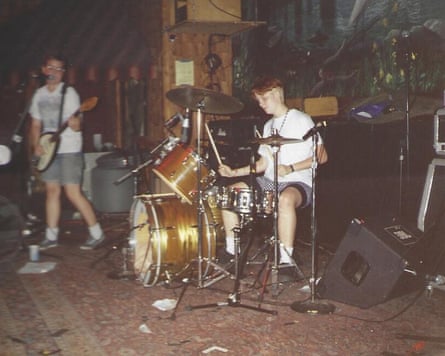
Tucker and Sawyer first met as middle schoolers in Eugene, Oregon, bonding over REM, the Cure, and Depeche Mode at sleepovers. They saw shows constantly – the Replacements, Firehose – and watched the music documentary Athens, GA: Inside/Out relentlessly. Their fixation on the Athens scene – including REM and the likes of B-52’s and Pylon – incited what Tucker calls a “pretty bonkers” and penniless cross-country train trip in summer 1990. The pair rented an apartment for a month to “study the scene”, bought a drum kit, watched Pylon through the window of the 40 Watt Club (they were too young to enter), and dubbed themselves Heavens to Betsy.
By the time Tucker arrived at Evergreen State College in Olympia that autumn, she had already crossed paths with Bratmobile singer and Girl Germs zinemaker Allison Wolfe, who hipped Tucker to the fiercely independent Oly scene. That year, Tucker made a film about local music and closely studied the bands she saw live: Beat Happening, Mecca Normal, Calamity Jane. Heavens to Betsy was still just an idea, but Tucker wrote lyrics to a song about menstruation and societal shame she called My Red Self. “I started telling people about our band when we hadn’t played a single show,” Tucker says. “Or had a practice. No songs either,” she laughs. “We had a concept.”
That’s an instructive blueprint. “You manifest it,” Sawyer offers.
“And believe in it,” Tucker adds. “You have to create the world before anything else, and cling to it. That’s true about every creative idea: you need to commit to that world. And once you do, then you can make it real for everyone else.”
When they were asked to play “Girl Night” at the International Pop Underground Convention, they anxiously accepted and Tucker sprang into action: many of the songs on their demo were written in her childhood bedroom. Fugazi’s Ian MacKaye was so impressed by Heavens to Betsy’s live debut that he sought them out to shake their hands.
“There was an openness to my voice that I think grabbed people right away,” Tucker says. “There wasn’t much filter between my emotions and my voice, so when I sang, it was really sad and angry at the same time. We kept our music really simple and focused. I wanted people to feel what I was feeling. People cried at that show. There was this movement of girls that were like, I need to talk about these things that we’re not supposed to talk about. I think my voice was just waiting for that door to open.”
At the centre of Baby’s Gone is a taut, unflinching song called My Secret in which Tucker lucidly blasts an abuser. She had been influenced by the directness of Bikini Kill frontperson Kathleen Hanna’s writing. “I felt brave because of what was happening around us,” she says. “It made me realise that I needed to let out my own feelings about things that had happened to me. It put me in the position of power.” Sawyer’s minimal, pounding beat “created this shield and weapon”, Tucker adds. “I was able to harness that into a song about being sexually abused. It turned the tables on everything, and it let go of everything, and it also freaked everyone out. It was incredible. It changed my life in a way. I was able to open a door to how maybe the rest of my life was gonna go. I didn’t need to hold on to those feelings any more.”
Heavens to Betsy’s songs were sometimes written in character, but informed by reality. The title track of Baby’s Gone narrates a young woman’s decision to have an abortion under conditions that leave her dead. “Back then, you couldn’t even say the word ‘abortion’, so there was a lot of euphemism around it,” Tucker says. “Young women had to deal with all of the consequences of heterosexual sex, which took all of the pressure off men in our society. I find that to be incredibly unfair.” Tucker wrote the song to ask, “What if the young woman who died having an abortion came back and wrote about her experience? What if a ghost came back and wrote the song? How would that make you feel?” She lets out a self-aware laugh.
“Connecting with your rage and your anger, in a way that lets it out – it feels important,” she adds, especially in light of the current political nightmares. “The past few years have been awful, and we really don’t have a way to process it. Liking things on my phone doesn’t cut it for me.”
The Baby’s Gone songs excavate trauma – “I want you to stay dead!” Tucker fumes at a memory – allowing the band’s one album, 1994’s grungier Calculated, to more explicitly claim power. “The first songs we wrote were really personal, and they were out of sheer necessity,” Tucker says. A few seem to describe vexed mother-daughter dynamics. “That relationship is always ripe for conflict,” she says. “Part of becoming a person in the world is differentiating yourself and saying, ‘No, I’m going to do things my way.’ Being a mom myself now, I’ve been on both sides of that, and it’s complicated.”
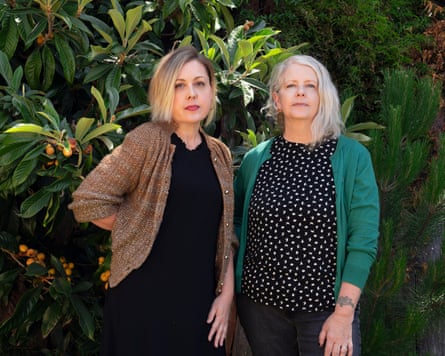
We’ve spoken for an hour and a half when Sawyer has to leave for a work meeting (she has a job at a pet supply company). Tucker and I keep chatting. The Heavens to Betsy reunion has offered an opportunity to revisit the music as well as to rekindle their friendship. “Getting a second chance feels like a real gift,” she says. “I’ve really enjoyed getting to know what Tracy’s life has been like and what we have in common.” When they drifted apart after Calculated came out, something they blame on having poor communication skills at that age, Tucker had already formed Sleater-Kinney alongside Carrie Brownstein, then guitarist in queercore band Excuse 17, who Heavens to Betsy had toured with.
Tucker sounds not especially fazed by where Heavens to Betsy might fit into modern music. But I mention Wednesday’s Karly Hartzman, and she joyfully recalls a Portugal festival where she heard her scream from stage. She also brings up Rodrigo’s Daisy Chain fest: “It’s both cool and terribly sad that we’re still holding a rock show to try and talk about our needs instead of having the kind of cultural, political, and economic power that would give us full equality.”
I ask about the lessons Tucker has gleaned from returning to this formative period of her life. “That courage you have as a young person to speak the truth and to find out what that means for you, that’s a really special thing to learn how to do, and it’s not always easy to maintain that when you’re becoming a mom and taking care of other people,” she says. “I do think there’s something really special about returning to Heavens to Betsy as my youngest goes off to college. I suddenly am rediscovering, what do I want, and who am I? There’s something very full circle about reconnecting with this voice that was like, ‘These are my feelings. This is my truth.’”