3 months ago
64
3 months ago
64
The Chilean players’ association officially became a union in December, and its president, Javiera Moreno, believes there needs to be women’s representation in players’ unions around the world.
“We want this movement to become massive,” says the former Universidad Católica captain. “Our goal is to spread this to other countries. I don’t know if in other places the path will be to have a specific union for women. This was needed here, but I think there needs to be at least representation of women’s players within every country’s footballers’ union.”
The National Women’s Football Players Association (ANJUF) has existed for nearly a decade, but in December its legal status changed. Under labour law, clubs and the federation are now obliged to engage in dialogue and negotiate contracts, benefits and other labour issues collectively.
Although Moreno believes ANJUF’s relationship with clubs and the federation was already collaborative, sporting institutions are now legally obliged to listen to them.
“That collaboration was always our main tool, and now it will still be like that,” she says. “Meaning that we continue to talk with the clubs, but our goal is also to build our role as a union, which is not only about dealing with players’ contracts, but also about the professionalisation of our league.”
In a statement about the new status, the union recalled the developments achieved by ANJUF since 2016, when a group of players – Christiane Endler, Iona Rothfeld, Camila García, Fernanda Pinilla, Romina Parraguirre and Moreno herself – decided to organise to fight for better conditions for Chile’s female footballers.
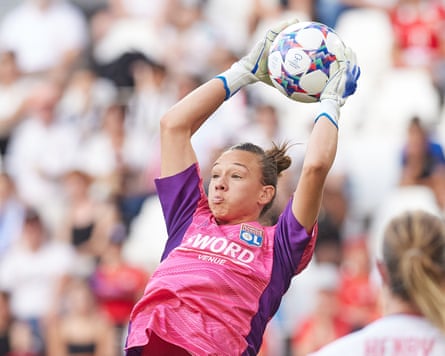
Since then, the organisation turned union has secured medical care for professional players and developed policies to tackle abuse, harassment and precarious working conditions. In 2022, the Chilean government passed a law requiring first and second division clubs to have all of their players on professional contracts, a target achieved three years later.
Moreno believes that South America could learn from the development of the women’s game in Europe and the United States, but that the South American federation, Conmebol, needs to step up. “We see how deficient Conmebol’s work has been. We now have the Nations League, which is positive, but it came in a context where, very recently, we had a disastrous Copa América,” she says. “South America’s coordination will be fundamental so that we see improvements in the Nations League, Copa América and the Copa Libertadores.”
A key figure in women’s football’s fight for better conditions is the former player Camila García. She worked for years as a board member and vice-president of Fifpro, footballers’ global union, as well as a member of the United Nations’ Football for the Goals initiative advisory board. One of ANJUF’s directors, she believes that union status is important to support players who want to take a more active role in labour negotiations.
“It can be very taxing if you’re still trying to compete and make the most of your career. You don’t want to face retaliation for your efforts,” she says. “We have been very open about that possibility, but we offer every protection we can.”
García’s role at ANJUF and Fifpro has allowed her to connect with like-minded players in other South American countries, sharing experiences and discussing improvements for the region.
“In Argentina, the professionalisation process was sparked by a player. Players in Brazil made a huge contribution to the reforms we have seen in the past five years,” she says, adding that Aline Pellegrino – who works at CBF, the Brazilian FA, as a competitions manager – has been instrumental in that. “We saw what the players in Colombia did regarding sexual and labour abuse,” she says. ”Collaboration is a matter of time, but we need to be aware that there are certain barriers in South America, so we need support and resources to help players organise.”
Moreno believes now is the time to dream bigger. “It was really utopian for us to believe in more than professionalisation 10 years ago,” she says. “We started by correcting the wrongs, like guaranteeing health insurance for all players so they wouldn’t have to cover the costs of treating injuries themselves. There was a sequence of actions that allowed us to institutionalise and solidify our work with the federation, and with other organisations in our country.”
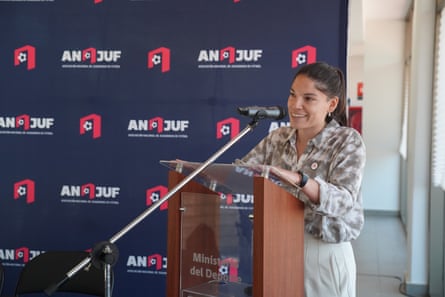
Moreno, who is also a sports psychologist, believes the lack of data and research is one of the challenges facing the sport’s growth. In 2022, ANJUF conducted a study into how professional contracts would benefit players’ mental health, confidence and motivation.
“We saw a difference in players with professional contracts, because having guarantees meant they felt more secure, and that had an impact,” Moreno says. “Now, we are aiming to start studies on players’ mental health to understand how to improve it.”
Both Moreno and García believe the 2027 Women’s World Cup in Brazil – held in South America for the first time – could serve as an incentive to develop the women’s game in the region and help players connect, organise and improve conditions collectively.
“Now the main challenge is to see how every country will take advantage of it, especially those that qualify for the World Cup,” Moreno says. “All of our hopes and efforts are that Chile will qualify too, because that would have a really positive impact in our country, for the visibility of our national team and our league.”
García adds: “I am cautiously optimistic. I saw in Chile the incredible impact of hosting the Under-20 World Cup in 2008; it really changed that generation. It changed stadium infrastructure, which was a massive benefit for the men’s game, for children and for communities in general.
“But for women, that faded for years. Even though it pushed a generation to dream about becoming Tiane Endlers, it also showed me that it can easily fade when authorities do not commit to developing the product. So I really hope Brazil and South America use this as a milestone to truly commit.”
Get in touch
If you have any questions or comments about any of our newsletters please email [email protected].
-
This is an extract from our free email about women’s football, Moving the Goalposts. To get the full edition, visit this page and follow the instructions. Moving the Goalposts is delivered to your inboxes every Tuesday and Thursday.