1 month ago
94
1 month ago
94
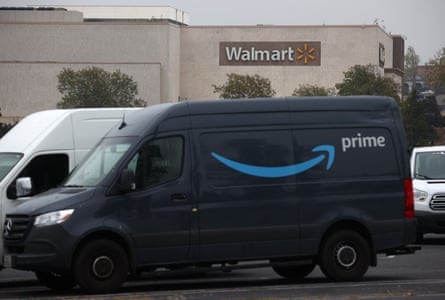
A “modern leather” table lamp, listed online at Walmart, shot up from $24.99 to $39.
The price of an air fryer on a retail site called Newegg went from $84.99 to $149.99.
An electric ice-cream maker was listed at just $17.99 at Amazon and Best Buy. Then it became unavailable at Best Buy, and more than tripled in price to $59.99 at Amazon.
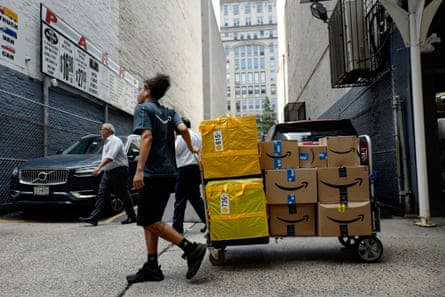
The price hikes and the product disappearances were not the blips of supply and demand – they were the results of behind-the-scenes pressure by Amazon, according to internal emails reviewed by the Guardian and court claims against the world’s largest company.
For years, as many Americans have felt squeezed by the costs of basic consumer goods, Amazon has deployed a variety of techniques that have incentivized suppliers to push for higher product prices on other retailers’ sites, California authorities claim in court.
In some internal emails, Amazon employees have flagged low product prices on rival retailers’ sites as threats to Amazon’s own profitability, and informed the products’ suppliers that their sales on Amazon.com have been cut – or might soon be cut – going forward.
Other emails describe Amazon slashing its product prices to match retail rivals like Walmart and Home Depot, then pushing suppliers to compensate it for the revenue lost due to these lower prices.
To escape this financial pressure, some suppliers have responded with a fast and cheap alternative: making sure the prices of their products are higher with Amazon’s rivals, or pulling their products from those rivals altogether, according to internal records cited in litigation.
Over the last decade, Amazon has suppressed the sales of some suppliers’ products or demanded millions of dollars in compensation from them because of the low prices of Amazon’s retail rivals, according to a trove of internal company emails, presentations and notes reviewed by the Guardian, as well as interviews with 15 current or former Amazon supplier representatives, company employees and state and federal law enforcers.
The mass of internal Amazon records were obtained from Amazon by California’s attorney general as part of a lawsuit that alleges the company has engaged in widespread price fixing, which is defined as arrangements among companies that seek to raise or otherwise control the prices of products or services.
The Guardian examined those records, as well as hundreds of pages of deposition testimony of current and former employees of Amazon and supplier companies. Most of the documents and depositions – which were partially unsealed in recent months – have never been publicly reported on.
The California attorney general, Rob Bonta, alleges that Amazon’s tactics have coerced suppliers into raising the prices of their products with its rivals.
In the case of the ice-cream maker, Bonta’s office points to emails that say Amazon temporarily took “down” the supplier’s inventory off its platform – a move that prompted its manufacturer, a firm called Maxi-Matic, to scramble to pull its inventory from Best Buy, eliminating Amazon’s price competition from the electronics retailer.
By the end of that day, Amazon had put Maxi-Matic’s product “back live” on Amazon.com and more than tripled its price, the records show.
In the case of the air fryer, Amazon “suppressed” the product’s sales on its platform and told its supplier that it would stop ordering several of its products for Amazon.com – unless the supplier agreed to reimburse Amazon for revenues the online retailer had lost due to its practice of copying competitors’ lower prices, according to emails revealed through the attorney general’s lawsuit.
This spurred the supplier, a kitchen appliance firm called Chefman, to move to secure a price increase for the air fryer at Target and an online retailer called Newegg as it hashed out an agreement to reimburse Amazon $100,000 on top of the $400,000 it had already given back, according to the emails.
Asked about the air fryer’s price jump, Mark Friedman, Chefman’s senior vice-president of global sales, told the Guardian: “I can’t talk to you because I still do business with Amazon and I don’t want to bite the hand that feeds me.”
Amazon’s written responses to the Guardian did not respond to questions about these specific incidents. The company accuses the California attorney general of “distorting a handful of emails” out of “nearly one million vendor communications” to “suggest a far-reaching conspiracy among unspecified thousands of vendors and retailers”.
Amazon says it works hard to protect customers from “paying too much” and to negotiate economic terms that allow it “to offer products at the competitive prices” that “customers expect from Amazon”. It also says the California attorney general’s suit is “asking the court to prevent Amazon from negotiating with its vendors to lower prices, likely leading to higher prices for Amazon’s customers”.
The incident involving the price hike for the leather table lamp, for example, was part of a broader exchange about dozens of products on Amazon.com sourced from a New Jersey based supplier called All The Rages.
The email exchange shows that Amazon negotiated for cost decreases for many of the supplier’s other products, ensuring lower prices for consumers on Amazon.com.
But the messages also refer to raising the prices of other items sold by Amazon’s competitors.
After Amazon reached out, an All The Rages employee named Joseph Martin replied that his company had “contacted” various unnamed retailers “to fix the retail” and had seen an increase in retail prices “for a lot of the items already”.
Two days later, Martin told Amazon that the lamp price at Walmart had increased from $24.99 to $39. “We should be good now,” he said.
Martin told the Guardian that the lamp’s price change “reflected the correction of a pricing error”.
“Any decision regarding retail pricing was made by Walmart and Amazon, so you would have to ask them about their pricing decisions,” said Martin, who added that his company believes the California attorney general’s claims “are without merit”.
Amazon and Walmart declined to provide statements about this specific incident.
‘It seemed like he knew what was happening’
While such tactics can generate savings for Amazon consumers, they can also raise prices for consumers shopping elsewhere, an effect that company employees on the ground were well aware of, according to supplier representatives as well as former Amazon employees who spoke to the Guardian on the condition of anonymity.
One former vendor manager, who worked at Amazon from 2022 to 2024 before getting laid off, said that on phone calls with suppliers he tried to be upfront about the fact that raising prices with Amazon’s competitors could help them avoid demands that they compensate Amazon for lower-than-anticipated profit margins.
“Hey, if you can make sure this product doesn’t continue to be sold at this lower price point, then we don’t have to keep revisiting this discussion about margin,” the former Amazon vendor manager recalled telling suppliers.
A former Amazon “customer success” manager said that Amazon staff had “very black-and-white conversations” with suppliers about the prospect of raising prices with Amazon’s competitors.
“They’d say, ‘You need to go to Target. You need to go talk to Walmart to get them to raise their price,’” he recalled.
The former customer success manager told the Guardian that higher ups instructed Amazon employees to have certain conversations with suppliers over the phone in order to avoid a digital trail of potential price-fixing allegations.
“The only rule was, ‘Do not have this in writing’,” he recalled.
The former employees’ accounts echo several Amazon emails and presentations relied on in court by California’s attorney general. One from 2022 reminds staff to “not use email” for certain conversations with suppliers. Another email from 2020 reminds staff to “keep in mind it is often best to have these conversations over the phone”.
Amazon did not directly respond to questions about these sources’ statements and those presentations cited in court by the attorney general. But in legal filings, the company has pointed to other instructions it disseminated to staff barring them from making agreements with vendors or competitors on pricing.
Ryan Turano, chief technology officer of a fertilizer company called AgroThrive, told the Guardian that when Amazon’s profitability was threatened due to its price matching, an Amazon vendor manager would reach out to him and sometimes list off businesses like Walmart or Home Depot for him to contact.
“He’d go, ‘Home Depot is probably causing the problem, talk to your vendor manager there to see what you could do,’” recalled Turano. “It seemed like he knew what was happening.”
In one internal email, that Amazon manager asked Turano for an “update on the price match issue we discussed”. Turano told him that he had “just got out of a meeting with the Home Depot manager,” who had “agreed to raise the prices this time”.
Home Depot declined to comment on the email.
Turano blamed Amazon for the pressure that resulted in price increases like the one he negotiated for with the home improvement retailer.
“We were at their mercy. Because we didn’t have the resources to push back,” Turano said.
“It was just a nightmare. It didn’t feel good,” he added. “It’s almost understandable. Because they’re so big they can do whatever they want.”
Amazon – which recently surpassed Walmart as the world’s biggest company by revenue – is currently facing multiple court cases alleging price-fixing.
Price-fixing lawsuits against Amazon being pursued by the California attorney general and the Federal Trade Commission (FTC) are both slated to go to trial in early 2027. The company is also battling similar claims in a private class action lawsuit in federal court in Seattle and a legal action pursued by Washington DC’s attorney general, which was initially dismissed but revived on appeal.
Amazon denies the claims in the various court actions and says its practices encourage lower prices, incentivize competition and create greater product selection for consumers.
In the California case, Amazon told the Guardian that the price fixing theory asserted by the attorney general is “legally untenable, with the state offering no evidence of any communication between Amazon and any other retailer, much less an agreement among them to fix prices. The practices California challenges are common in the retail industry and part of the pro-competitive give-and-take between Amazon and its vendors.”
In 2022 Amazon agreed to pay $2.25m to resolve claims by Washington state’s attorney general that it forced some merchants to raise prices for products they sold through the company’s “Sold by Amazon” plan. The company made no admission of liability and said it strongly believed the program was legal.
The power of algorithms
Amazon has long prided itself on offering Americans the lowest prices online.
The company points to studies showing that over the last nine years, Amazon has consistently offered consumers the lowest prices among major American retailers and academic research suggesting that the competition between online and traditional retailers has driven down product prices and might have actually tamped down on inflation in years past. According to a 2025 study from the analytics firm Profitero+, Amazon’s prices were on average 14% lower than its leading competitors.
But the FTC and California lawsuits allege the company’s vaunted price floor is a mirage, obscuring its behind-the-scenes efforts to drive up its competitors’ prices.
Throughout the 2010s, Amazon systematically mapped the prices of its main retail rivals across the internet, according to testimony of current and former Amazon employees in depositions conducted by the FTC and California authorities.
In 2011, Amazon had a team of about 200 to 250 people using a hybrid mix of manual and automated methods to surveil competitors’ prices, Karthik Mitta, a former Amazon director, testified last year in a deposition in the FTC case. By 2019, Mitta testified, that team had grown to nearly 2,000 people, enabling the company to use web crawlers to collect pricing information and monitor tens of thousands of competitor sites.
Harnessing this knowledge of pricing data across the internet, Amazon adopted what one executive called a “game theory” approach to pricing which could help it evade the costs of a “perfectly competitive market”, according to the FTC’s lawsuit.
Amazon developed an algorithm that rapidly copied rivals’ price changes “to the penny”, according to the FTC. If retail rivals raised or lowered its price, the FTC claimed, Amazon would do the same.
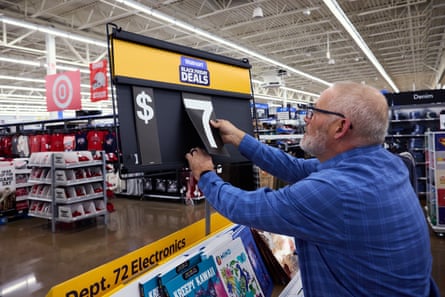
The company did not respond directly to questions regarding allegations about its algorithm, but pointed the Guardian to academic literature and industry reports noting how common it is for retailers to track prices and for suppliers to try to enforce minimum prices for their products.
Arjun Narayan, a former general manager for Amazon’s vendor program, told the Guardian that the company’s price-following tactics were designed to ensure that the company continued to fulfill founder Jeff Bezos’s original mission: that it strive to help customers find “anything they might want to buy online” at “the lowest possible prices”.
“If I figure out that you’re actually selling at a lower price elsewhere, the very promise is defeated, right?” noted Narayan, who now advises brands with his own firm, SalesDuo.
The FTC argues the algorithm sought to instill another lesson among Amazon’s competitors: they could not compete with Amazon by offering lower prices, so with no better options left, they may as well raise their prices – increases that Amazon’s algorithm would then happily follow.
‘We will discontinue from your problematic competition’
In 2020, three days before Black Friday, Amazon informed Armen Living, a California based furniture supplier, that it “had to suppress and remove” one of its office chairs from its platform, according to emails released in the California lawsuit.
Amazon had bought the chair, a minimalist curvy unit with a walnut wood exterior and a chrome-plated steel base, for $79 a pop, and had planned to sell them on its site for $116.45.
But another retailer in the market happened to be selling the same chair for just $58.62, and Amazon had matched that price, which was so low that Amazon was losing money on every sale.
Following the price reduction, Amazon made clear to Armen Living that if it wanted to have the chair “back” up on “the website soon”, it was up to the furniture brand to do something about the financial squeeze caused by Amazon’s own programmatic price matching.
In an email, Paige Nguyen, an Amazon vendor manager, laid out three options that the furniture company could choose from to “help address” the issue:
It could compensate Amazon for the revenue loss – paying Amazon $57.83 for every chair sold on the site.
It could slash the amount it was selling the chairs to Amazon, a future giveaway to the retail colossus.
Or – likely the least costly option – it could “manage” the “other channels” where it sold the chair, a euphemism pointing to the Amazon competitors who were selling the chair for less, according to the California lawsuit.
Nguyen didn’t elaborate on what managing these other “channels” meant, sticking to the kind of language that Amazon uses when training staff on how to talk with suppliers. The California attorney general alleges terms like “channel optimization” are a “naming gloss” for Amazon’s push to get suppliers to enforce minimum prices with or pull inventory from Amazon’s competitors.
Rather than paying compensation or offering a cost decrease to Amazon, Armen Living made clear it understood just how it could manage its channels to appease the online retailer.
The company promised it would “look further into the potential offenders” in the market offering low prices and pull its inventory from those Amazon competitors if need be.
“Amazon is always our top priority,” noted an Armen Living marketing analyst: “… If the problematic retail does not fix by the end of the week, we will discontinue from your problematic competition to ensure that Amazon can return to a healthy state with these items.”
In the end, Armen Living confirmed in an email to Amazon that it had removed its inventory from the “offenders sites”.
Nguyen, the Amazon employee, thanked her for her action, but complained that the prices of two other chairs, which she had also flagged, had “dropped” and “still” not recovered “to the original price”.
“Let me know if you need more time to adjust this,” Nguyen said.
Nguyen did not respond to requests for comment. Amazon and Armen Living did not respond to specific questions about this incident.
Martin Heubel, a consultant for e-commerce brands who previously worked as an Amazon vendor manager, said Amazon’s compensation demands help entrench its power in the market.
“It’s not so much about the money that you recover. It’s more about the education of your suppliers,” said Heubel, who said he was speaking as a consultant who advises brands negotiating with Amazon and not from his experience as a former Amazon employee.
“If you go elsewhere, you will get punished … so think twice about it whether you really do.”
Amazon has said in legal pleadings that the incidents cited in the California case are “alleged to have occurred many years in the past” and involve “employees who lack pricing authority” and “a microscopic portion of Amazon’s catalog of millions of products”.
Confidential presentations
The pressure Amazon exerts on its suppliers may only be partially visible in internal company emails like these because of Amazon’s efforts to train staff on how to avoid putting certain messages in writing, according to a recent court filing by the California attorney general.
The internal records obtained in the California lawsuit include an in-house presentation from 2019. It instructs staff to send screenshots of rivals’ product listings to suppliers when making compensation requests, but to avoid mentioning the companies’ names.
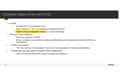
Avoid using competitor name
The former Amazon vendor manager, who asked to speak anonymously, said that he would avoid explicitly telling a supplier that Walmart had caused a price-drop, which Amazon’s algorithm had followed. Instead, he recalled, he would say, “There’s a retailer in blue that sells this product” – a reference to Walmart’s blue, yellow and white color palette.
An Amazon presentation from 2022, also revealed in litigation, instructs staff that it is “not ok” to talk with suppliers about “channel pricing”, an industry term referring to a supplier’s varying prices with different retailers.
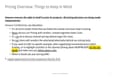
do not use email
The same slideshow, however, also gives staff a seemingly contradictory instruction, noting that if they need to highlight “activities in the channel” affecting Amazon’s profitability or if they need to negotiate compensation payments with suppliers, they should “not use email”. It then reminds employees to follow the previously mentioned rules against discussing “channel pricing”.
In an interview with the Guardian, the California attorney general, Bonta, said Amazon’s use of “code” words would not be an adequate defense in court.
“Whatever euphemism it is, whether it be ‘update pricing’ or ‘resolve an issue’ or ‘address a concern’ in the market, all that means is: ‘Fix prices. Get your lower price up to Amazon’s higher price or suffer the consequences,’ and that’s illegal.”
The company rejects that claim. It says the conduct the state of California challenges consists of routine retail contracting and negotiating that “drives down prices for consumers”.
In court, Amazon has pointed to emails and staff presentations showing its compliance with laws protecting free market competition.
In one staff presentation from 2021, for example, the company instructed staff that they should not “permit vendors to share competitor pricing intentions with us”.
Likewise, an email from 2023 shows an Amazon employee telling a vendor representative that Amazon has “no interest in being part” of discussions, “directly or indirectly” with other retailers about their prices.
Despite Amazon’s guidance to staff, representatives for the suppliers themselves said in some email exchanges that they would help raise prices with Amazon’s competitors.
Documents disclosed in litigation show that on the afternoon of 17 February 2023, an Amazon vendor manager named Kara King emailed Andrew Newell, then a manager for an e-commerce company that helped brands interface with Amazon. The Amazon employee wanted Newell to get an appliance company he was representing called RugDoctor to sign a “guaranteed minimum margin” agreement.
The guarantee would ensure it compensated Amazon for a pet-focused vacuum cleaner whose profitability had “been challenged” due to “sales price compression/competitive matching” – a reference to Amazon’s practice of matching its competitors’ prices via algorithm.
But Newell responded that the guarantee wouldn’t be “necessary”. He said he was confident he could “get Walmart to raise the price back up” so that Amazon could then match it. “This would resolve the margin issues,” he wrote.
In response, King, Newell’s counterpart at Amazon, continued to float the possibility of compensation funding, but suggested they not discuss the matter further over email. “This is a delicate conversation for numerous reasons and probably best suited for a phone call/virtual meeting,” she said.
In an interview with the Guardian, Newell said he did not recall the particulars of the incident but said the incentives that Amazon had created for brands made raising prices with competitors an obvious solution.
“It’s kind of like basic marketing understanding and math,” he said.
King did not answer questions from the Guardian about the exchange.
Newell noted that Amazon vendor managers would tell him to schedule price increases with Walmart then reach back out to them, so they could “flip” the price back up “on the same day”. Amazon staffers avoided putting such messages in email, he said.
“They know exactly what they’re doing,” he said, adding, “They’re really well coached. They wanna get you on the phone.”
Show more