3 weeks ago
58
3 weeks ago
58
In March 2023, the model, activist and writer Tess Holliday announced that she had been working as a size and inclusivity consultant for H&M. The fruits of their partnership felt like “one of the most meaningful things that I’ve done in my career”, she told US Vogue at the time. The fashion juggernaut had committed to an expansion of its sizes, from XL to 4XL, and to increased body diversity of its models.
This bucked a trend, coming at an otherwise gloomy time for plus-sized fashion. By 2023, the fashion industry was in the grips of an Ozempic-fuelled celebration of skinny bodies, after its brief flirtation with curves during the body positivity movement of the late 2010s.
But by 2026, just three years after the H&M partnership was announced, the fruits of the project had vanished. Research firm Edited, which tracks items as they launch on retailers’ websites, analysed H&M’s offerings for spring/summer 2026, recording all new women’s dresses landing on the site from January to May and compared it with the same period in 2025. Last year, 3XL and 4XL made up 2% of the new inventory. This year those sizes were entirely absent. Other large sizes fell too: XXL, which had accounted for 13.3% of inventory in 2025, was down 3%, while XL was down 2%, and smaller sizes, XS to large, rose by 3% on average.
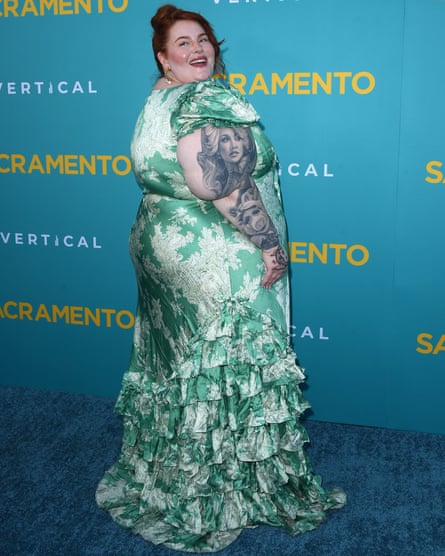
Holliday no longer works with H&M. Even when she went into the collaboration she was, “a little pessimistic”, she says. “I’ve been plus-sized my entire life. I’ve worked in the industry for over 15 years, I’ve seen the rise and fall of a lot of brands. I’m always worried whether something is genuine.” Once she began working with the brand, though, “I became very optimistic because a lot of the changes that I wanted to implement were being implemented. Unfortunately, I don’t think that maybe it was as genuine as I hoped.”
In a statement to the Guardian, H&M said that it continually monitors fit and sizing demand and confirmed that “we have chosen to discontinue sizes 3XL and 4XL, as we have seen lower demand for these sizes.”
H&M is not the only brand scaling back plus-sized garments this season. Mango, too, reduced its inventory of new dresses in sizes 16 to 20, from 6.6% in spring/summer 2025 to 0.5% in spring/summer 2026, according to Edited. Meanwhile, an analysis of dresses for sale at Anthropology during July 2026 revealed a year-on-year reduction from 10.5% to 9% in plus-sized offerings. This latest size shrinkage comes after years of other rollbacks, from closures of extended sizes ranges (Loft closed its plus-size range in 2021 after three years; Old Navy scaled back its offerings in May 2022, only nine months after launching a new plus-sized initiative). Last year, 151 locations – nearly a third of all stores – closed at the plus-sized chain Torrid. The options are so limited for plus-sized people now, says influencer Nikki Apostolou, that “I’ve given up entirely trying to go into a store or going into a mall hoping to find clothes.” Reddit is full of threads of plus-sized shoppers talking about their lack of options; some are so over it they have started sewing their own garments.
Holliday, who co-founded the #EffYourBeautyStandards campaign in 2013 seeking to foster self-love and acceptance of all body types, says she noticed the reduction first during Covid. Then, from 2022 on, she says: “There has been a rapid decline in plus-size offerings. Diversity, as a whole, is no longer a priority for a lot of brands.”
Many analysts, such as Impact Analytics’ CEO, Prashant Agrawal, pin the most recent changes in sizing to GLP-1s, which Agrawal describes as the “number one reason” apparel retailers are anxious about sizes at the moment.
Mintel’s latest research says that 18% of US adults reported using GLP-1 drugs as of June 2025, up from 12% in 2024. The impact on the average American body size has already been significant: the rate of US adult obesity appeared to peak, after rising for decades, at 39.9% in 2022, and it dropped to 36.4% this year, according to Gallup.
“It’s like nothing that anybody’s ever experienced,” says Agrawal. Before now, “each year, over the last 50 years, the US has grown bigger. This is the first time the US has gone the other way.” His company’s data, which draws from sales figures from an undisclosed number of large US apparel retailers, shows two years of rising sales of small garments (size XS up 0.45% between 2023 and 2024 and 0.43% between 2024 and 2025), and minor declines in medium (down 0.05% and 0.02%), large (down 0.31% and 0.30%) and sizes XL and larger (down 0.38% and 0.39%). In brands that order billions of units of garments in advance of each season, such small percentage points could represent a big financial, and environmental, liability.
Drill down into the figures, though, and the reasons for the abandonment of plus-sized shoppers by mainstream fashion brands are more complex. Even in the GLP-1 era, after all, the majority of Americans are still plus-sized, including those who have lost weight on GLP-1s. The latest research suggests that most GLP1 users lose between 10% and 20% of their body weight; last year Jack Plunkett, CEO of Plunkett Research, estimated that 66% of US women still wear size 14 or above, which most brands classify as plus-sized. Even now – and despite all evidence to the contrary in visual culture – plus-sized shoppers are fashion’s vastly underserved majority.
Many plus-sized customers have given up on new clothes and are turning to the secondhand market. ThredUp, like many other used clothing platforms, reports a surge in donations of larger garments in recent years (listings were up 32% year over year in the first half of 2026, and have doubled since the first half of 2023.) But they have also seen a remarkable uptick in demand. So far this year, purchase volume for large, XL and plus-sized items in women’s apparel grew 17.4% – more than double the 6.8% growth rate for small and medium.
“Demand for larger sizes isn’t fading, it’s one of the fastest-growing parts of our marketplace,” says Kristen Brophy, senior vice-president of marketing at ThredUp. The company has no data on whether this is related to GLP-1 usage, but Brophy says that resale has long played a part in shopping when people’s bodies are changing. “We’ve also heard from customers that many brick-and-mortar thrift stores don’t accept or stock plus-size items in the first place, which pushes even more of that shopping behavior online.”
Brittany Steiger, associate principal of retail and e-commerce at Mintel, says that GLP-1s are affecting the market – but that impact should be kept in perspective. “GLP-1s are changing the size curve, but they’re not eliminating the need for size inclusivity. Sixty-nine percent of shoppers say brands need to offer more size and length options. The bigger story isn’t shrinking bodies – it’s the ongoing challenge of fit.” In her view, the opportunity for brands is to concentrate on size flexibility and adjustability – and more brands are indeed incorporating elements such as hidden drawstrings, according to Edited – rather than offering fewer sizes.
Edited senior retail analyst Krista Corrigan says that the flow of traffic isn’t all going the same way. Anthropology, for example, which typically serves an affluent customer base, “is showing a pronounced ‘GLP-1 effect” not only in pruning larger garments but in switching many of its garments from numeric to alpha sizes. Corrigan says it’s because alpha sizes – size medium rather than size 14, for example – are deemed more likely to “absorb minor body fluctuations better than tailored numeric fits”, making them less prone to fit issues “for consumers undergoing body transitions”. Anthropology customers, she says, “are probably the demographic that would be adopting these GLP-1 most”.
Walmart, meanwhile, which typically serves budget-conscious shoppers, was a rare example of a brand adding inventory for larger customers this season. “That makes a lot of sense,” says Corrigan, “they’re doing something very smart and continuing to keep that thread of inclusion throughout most of their assortment, capitalizing on some of that white space.”
What this suggests, though, is that plus-sized people are being ejected from the affluent and trend-led part of the market more quickly than elsewhere. A correlation which tracks with hundreds of years of celebrity culture (Wallis Simpson, who reportedly coined the phrase “you can never be too rich or too thin”, would have loved Mounjaro) and economic reality – the inverse association between economic advantage and body mass index within western societies has been established by multiple studies. Semaglutide, which is unaffordable for many, only deepens this divide (one recent study of 4.5 million adults in Denmark showed that the proportion of individuals with a redeemed semaglutide prescription increased with income, even though the proportion living with obesity decreased.)
Despite that correlation, the US size 14-plus market is so substantial – literally tens of millions of people – that the assumption Holliday feels retailers make, all-too-readily, that all plus-sized people “can’t afford to shop anyway” is clearly untrue. For Holliday, it ties into other stereotypes she is sick of hearing. People “assume that we’re lazy or that we’re uneducated or a lot of other things”, she says. “There’s a really big disconnect, and it just boils down to the fact that plus-size people are seen as less than. Until we fix that issue in society we’re always going to keep having the same conversations over and over, because they don’t see us as worthy customers.”
Some cherished brands remain. Holliday recommends Lazy Oaf, a British brand she buys whenever she is in the UK, as well as Eloquii and Torrid, even if the latter can be frustrating on price, she says. Apostolou goes to Lane Bryant for bras and likes Target’s Wild Fable line for on-trend clothes, as well as Eloquii – though she feels they have gone downhill – for special occasion dresses. Steiger says plus-sized shoppers speak highly of Walmart at the budget end and praises Universal Standard as a higher-end brand “founded on size inclusivity”. Also at the higher end, Apostolou is into RCA Public Label, and says she wants to try to support small, plus-sized designers when she can, “designers who are working for themselves, not part of corporations who will swing wherever the wind blows them”.
For Apostolou, it is a lack of care and investment that lead so many plus-sized ranges to fail. “So many of the brands that do exist are giving us versions of things they’ve been offering since 2010. They feel like, OK, you have to hide your stomach, wear these jeans that are gonna squish you in. Wear this cold shoulder top – it’s like the plus-sized uniform – because your shoulder is the only skin that you should be allowed to show. Or it’s the same dress – here’s the cleavage and the rest is a tent.”
The narrative around Ozempic, she argues, is an excuse for fashion brands to cut back and not have to think about plus sizes. “They’ve been using every excuse that they possibly could think of for years now – ‘oh well, people aren’t shopping’ – when they’re offering the ugliest, most hideous styles ever.”