2 months ago
68
2 months ago
68
“Twelve of the 18 Bundesliga teams have a negative goal difference,” notes Damian Cerase. “I suppose this is down to Bayern handing out weekly drubbings, given that their GD is +57 after only 18 games. What’s the greatest disparity in a full season between the number of teams registering positive or negative GDs?”
“At the time of writing in the Bundesliga, all teams haven’t quite played the same number of games but nevertheless 66.6% of the teams have a negative goal difference,” begins Chris Roe. “For a complete season, the highest percentage in the English league system is from tier two in 2005-06 when 17 of the 24 teams (70.83%) had a negative goal difference; no doubt this was in part due to champions Reading, who had a +67 goal difference for the season. This example is narrowly ahead of two Premier League seasons (1998-99 and 2017-18) when six of the 14 (or 70%) had negative GD at the end of the season.
“During a season, the highest percentage of teams with a negative goal difference in the English league is 75%, and for that we have to go back to Division Three South in 1952-53. For a few rounds of matches from March 1953, 18 of the 24 teams had a negative GD, as shown in this table after the fixtures on the 3 April 1953.”
Vasco Wackrill takes us into Europe for a higher percentage of negative clubs: “A large number of teams within a league having a negative GD (or very few having a positive one) is a fairly regular occurrence in the Portuguese top flight. For example, in the 2022-23 season, only four sides out of 18 (22.2%) had a positive GD (so 77.8% negative GD): Benfica, Porto, Braga and Sporting. The same happened in 2017-18, with the same four sides being the only ones not to record negative goal differences. Four again in 2009-10. Guess which four teams managed it?
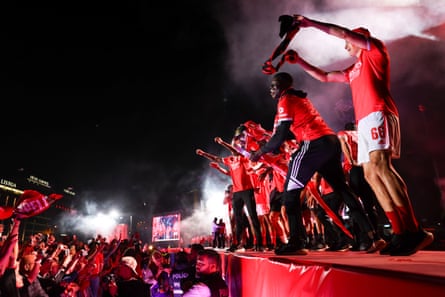
“But the fewest percentage of positive GD teams may well be won by the 1990-91 season. Benfica won the league with a goal difference of +71, Porto a close second (although their goal difference of +55 was not too shabby, it was a long way off Benfica’s), while the top four were rounded off by Sporting (+35) and Boavista (+7). The league had 20 teams that season, meaning that only 20% had a positive goal difference. A caveat, though: Vitória de Setúbal finished 17th and were relegated, but actually had a goal difference of 0 – scored and conceded 53 – so “only” 15 out of 20 (75%) had a negative GD.”
Dirk Maas also found an example of an 18-team league with only four teams finishing with a positive GD, the 1988-89 Divizia A in Romania, but the fifth-placed team had a a goal difference of 0 so the percentage is 75%, just a little down from the examples in Portugal’s top flight.
Fathers and sons x2
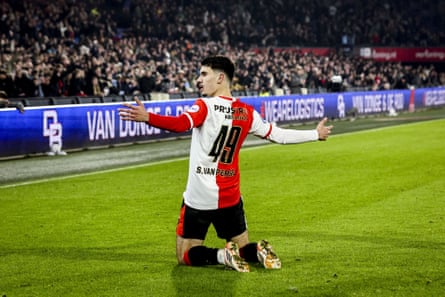
“Last weekend’s Eredivisie game between Feyenoord and Sparta Rotterdam featured two fathers and their sons: Sparta manager Maurice Steijn and his son, Sem (playing for Feyenoord), and Feyenoord manager Robin van Persie and his son, Shaqueel (also playing for Feyenoord and scoring a fabulous bicycle kick). Has there ever been a game before in which both managers had their sons playing?” asks Fausto van Bronckhorst.
Let’s just start by mentioning what a brilliant game that was, a 4-3 win for Sparta Rotterdam at the home of their more illustrious city rivals in which Shaqueel van Persie scored two late goals to bring the score level, only for Joshua Kitolano to score an added-time winner so that Maurice Steijn got one over his own son’s team.
Back to the question and we have received only one other example of this happening. But it’s a good one that at least involves fathers and sons on the same teams. Mark Rae writes: “Nottingham Forest v Manchester United on 28 August 1992 featured Darren Ferguson, son of Alex, for the visitors and Nigel Clough, son of Brian, for the hosts. It was Brian Clough’s final season in the Forest dugout. United won 2-0 en route to the title; Forest finished bottom.”
Record wins and losses (south coast edition)
Last week we looked at record wins and losses in recent times. Dean Whearty has a couple more one-sided examples to add to the mix.
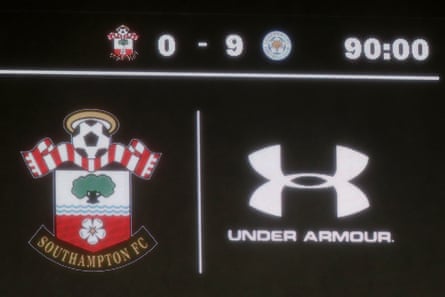
“Southampton recorded their highest Premier League win against Sunderland in 2024 (8-0), before succumbing to a 9-0 loss against Leicester five years later – they followed that up with another 9-0 loss against Manchester United two years later. Bournemouth enjoyed their biggest league win in 2014 also. They beat Birmingham 8-0 but then suffered a 9-0 turnaround at Liverpool in 2022 for their highest league loss.
Knowledge archive
“During highlights of Bologna v Celtic in the Europa League, the commentator described Bologna as being at ‘sixes and sevens’ in the opening minutes,” says Chris Whearty. “What is the origin of said phrase?”
We had this question back in 2005, when we answered thus:
Off to www.wordorigins.org to answer this one, Eric, which states: ‘At sixes and sevens is a very old catchphrase and relates to gambling. It first appears c.1374 in Chaucer’s Troylus. The original phrasing was “set upon six and seven”. It referred to betting one’s entire fortune on one throw of the dice [this, it transpires, being a game called “hazard”, more commonly known as craps]. It connoted carelessness, and over time the phrase came to mean confusion, disorder, and disagreement. Apparently a plural form, “to leave at sixes and sevens”, was developed in the 1800s; it was still based on the same gambling metaphor, but the idiom was now used to signify a kind of confusion or neglect, rather than pure risktaking.’
Can you help?
“The small town of Atalanta in the Brazilian state of Santa Catarina is named after the Italian club, despite that not being a place name (Atalanta is located in Bergamo, and itself named after the Greek heroine). Are there any other locations named directly after a football club?” asks Ben.
“Six permanent managers have been sacked in the Bundesliga this season – four of them after playing Werder Bremen,” notes Ben. “Has any team anywhere ‘caused’ more managerial sackings in a season?”
“The terminal demise of Slovenian top-flight club NK Domzale this week led me to a curio – the club on foundation was known as SK Disk, whose club badge featured sausages, due to the club having initially paid players in sausages as salary on launch,” explains Richard Wilson. “I can’t think of any other culinary crests in football – do any exist?”
“Ian Muir played 95% of his games for Tranmere,” writes Robert Abushal. “One club players aside, who’s the closest to 100% without being 100%?”
“Which team in Europe’s top five leagues has changed their stadium the most?” asks Masai Graham.
“Your question about footballers’ funerals on TV reminded me that when the Turkey striker Hakan Sukur got married, that this was broadcast on live television. Have any other footballing nuptials been broadcast for any reason?” asks Andrew Miles.
-
Mail us with your questions and answers