3 months ago
67
3 months ago
67
After a year of Donald Trump’s second term and two Munich Security Conferences, we now know that Europe will have to defend itself in future with less US support; probably with much less US support; and possibly – gulp – with no US support at all.
European leaders recognise that they need to reduce overdependence on the US. Yet many, including Keir Starmer and to an extent Friedrich Merz, are still clinging to the wreckage of the transatlantic relationship. They do so in hope, rather than certainty, that the US will come to Europe’s aid if Russia attacks Nato territory. Who truly believes that Trump, who prefers one-day displays of US power, would commit US forces to an open-ended war in Europe – with potential nuclear risks – if Vladimir Putin suddenly grabbed a Russian-speaking border town in Estonia, or the Norwegian Arctic archipelago of Svalbard?
All European governments now realise they will have to take responsibility for the defence of Europe, potentially on their own. This will require a decade of substantially increased military spending, something that polls show public opinion broadly supports, so far. Yet several European states – including the UK, France and Italy – are in too fragile a fiscal position to finance a defence surge without massive joint borrowing, something that Germany is unwilling to countenance.
Buying more weapons is only one part of building a credible, more independent European defence. It requires capabilities that politicians love to show off, such as satellites, fighters and frigates. But it also takes lots of unsexy things they don’t like to spend money on, such as ammunition and spare parts, as well as boring logistics, training and exercising, and a big increase in the size of the armed forces, potentially involving selective conscription.
Just as important, Europe needs a new leadership structure to take timely decisions to counter aggression. Four years of Russia’s full-scale invasion of Ukraine have shown that neither Nato nor the EU can be relied upon to respond swiftly and adequately.
Nato is dominated by the US and cannot act when Washington does not want it involved. It did its utmost to stay out of direct support for Kyiv in 2022, rejecting Volodymyr Zelenskyy’s pleas to enforce a no-fly zone over Ukraine. And Nato only took over coordinating military supplies for Ukraine from the US last year. The EU, for its part, imposed swift financial and economic sanctions on Moscow, and helped manage a shift away from dependence on Russian gas. But it is not a defence organisation, and pro-Russian outlier Hungary slowed subsequent sanctions packages and financial assistance to Kyiv.
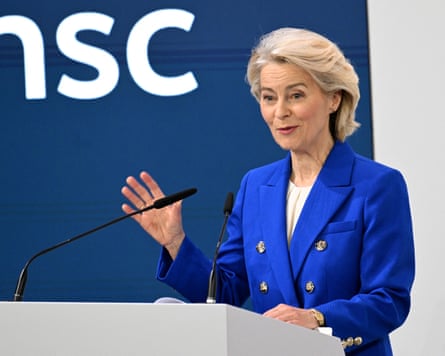
At last weekend’s Munich Security Conference, the European Commission president, Ursula von der Leyen, and Friedrich Merz both spoke of the need to bring to life the EU’s mutual defence pact (article 42.7), which is on paper a more binding commitment than Nato’s equivalent, article 5. Yet the EU has scant military expertise, and as yet no operational command. No serving European general has commanded more than a brigade in action since the end of the cold war, with only small forces dispatched for expeditionary warfare or peacekeeping in Afghanistan, Iraq, Mali, Bosnia and Kosovo.
The EU and Nato are shackled by the unanimity principle, and both contain awkward members – four militarily non-aligned countries in the EU, and above all the pro-Russian governments of Hungary and Slovakia. Moreover, the EU does not include three countries crucial for the defence of Europe: the UK, Norway and Turkey.
Neither organisation was used when it came to designing potential security guarantees for Ukraine, in case of a ceasefire agreement. The US did not want Nato involved, to avoid upsetting its negotiations with Russia.
Instead, France and the UK, Europe’s two nuclear powers and UN security council members, put together a “coalition of the willing” grouping of roughly 35 nations, including all the continent’s main military powers, but also Canada, Japan, New Zealand and Australia. Whether or not they will actually deploy forces in and around Ukraine is far from clear. That depends on Putin’s willingness to end the war, and on European countries’ still-uncertain resolve to commit boots on the ground, planes in the air and ships in the Black Sea.
However, the coalition of the willing shows some promise as a plausible framework for future European security leadership without guaranteed US support. With a fledgling operational headquarters in Paris, the grouping brings together all the key countries and organisations (including Nato and the EU), without the obstructive ones. An inner core of the so-called E3 – France, Germany and the UK – exercises the most influence, widened to the so-called E6 – adding Italy, Spain and Poland – to involve other big European powers. Nordic and Baltic countries, usually represented by Denmark or Finland, are also influential in the grouping.
For the moment, the coalition of the willing has no legal status, no decision-making authority and no secretariat. It is an ad hoc body for which the UK and France have detached a few officials and officers. However, it could grow into the nucleus of a future European defence union, acting where possible through Nato structures, but if necessary under coalition command.
One possibility would be to revive the 1955 western European union treaty, which was finally absorbed into the EU in 2010, to give a European defence union a legal basis, incorporating willing EU countries, the UK and Norway. That might take too long for current needs, but if Europe is to defend itself with much less US assistance, a nimble body that can shape and take quick decisions in a crisis is needed. This de facto European security council looks like the best option.
-
Paul Taylor is a senior visiting fellow at the European Policy Centre