3 months ago
62
3 months ago
62
Researchers have shed light on the final centuries of the woolly rhinoceros after studying a hairy lump of meat from the stomach of an ancient wolf cub that became mummified in the Siberian permafrost.
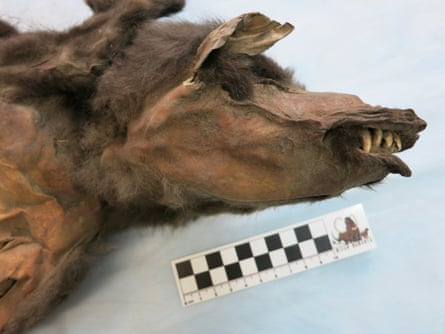
The beautifully preserved remains of a two-month-old female wolf cub were discovered in 2011 near the village of Tumat in northeastern Siberia. The animal is thought to have died 14,400 years ago when a landslide collapsed its den, trapping the cub and others inside.
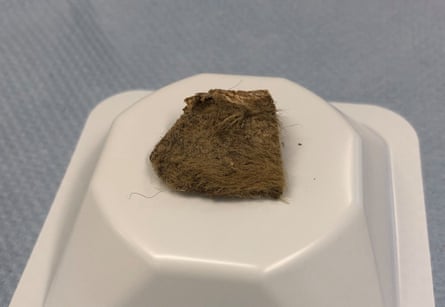
The frigid conditions preserved the wolf for millennia and on examining the remains, scientists found its stomach contents were also intact. Part of the wolf’s last meal was a chunk of woolly rhino, a hefty herbivore that died out about 14,000 years ago.
The discovery marked a rare opportunity, said Dr Camilo Chacón-Duque, who until recently was a researcher at the Centre for Palaeogenetics, a collaboration between Stockholm University and the Swedish Museum of Natural History. If they could obtain the rhino’s genetic makeup from the partially digested meat, it might reveal the state of the species as it headed for extinction.
While there is a paucity of well-preserved specimens from the dying days of many species, recovering genomes from animals that lived right before extinction is “challenging”, Chacón-Duque said. But in principle the genetic code could provide valuable clues about the events that caused the animals to die out.
Writing in Genome Biology and Evolution, the researchers describe how they decoded the woolly rhino’s genome from the matted piece of meat. It is the first time the feat has been achieved for an ice age beast found in the stomach of another animal. “To our knowledge this is the youngest woolly rhinoceros for which we have the genome,” Chacón-Duque said.
The scientists expected to see signs of “genomic erosion”, where a species in decline loses genetic diversity, often through population bottlenecks, inbreeding and environmental pressures. This, combined with an accumulation of harmful mutations, makes species more vulnerable to extinction. But it was not what the researchers saw.
“What we found was nothing like that,” Chacón-Duque said. After comparing the woolly rhino’s DNA with genomes from two older specimens dated to 18,000 and 49,000 years ago, the researchers concluded that the population remained fairly large and stable before dying out quite rapidly. “Whatever killed the species was relatively fast,” Chacón-Duque added, and probably struck in the 300 to 400 years before the woolly rhino was lost.
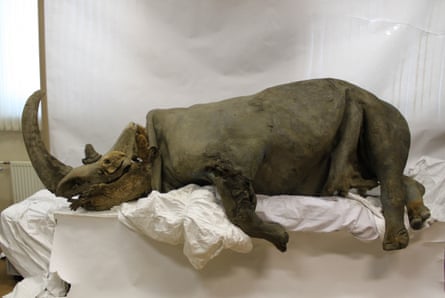
Love Dalén, professor of evolutionary genomics at the Centre for Palaeogenetics, said woolly rhinos appeared to have had a viable population for 15,000 years after the first humans arrived in the region, suggesting that a warming climate rather than hunting wiped them out. The main culprit was an abrupt period of warming in the last ice age, known as the Bølling-Allerød Interstadial, which transformed the landscape between 14,700 and 12,900 years ago.
How the wolf cub came to be feeding on woolly rhino is unclear, but it may have scavenged on the carcass after it was killed by the pack, or received the treat from a pack member that regurgitated the hairy morsel.
The remains of a second wolf cub, thought to be the sister of the first, were found at the same site in 2015. Tests showed that both had begun to eat solids but were still taking milk from their mother.