3 months ago
51
3 months ago
51
Global websites down as Cloudflare investigates fresh issues
Technical problems at internet infrastructure provider Cloudflare today have taken a host of websites offline this morning.
Cloudflare said shortly after 9am UK time that it is “is investigating issues with Cloudflare Dashboard and related APIs [application programming interfaces – used when apps exchange data with each other].
Cloudflare has also reported it has implemented a potential fix to the issue and is monitoring the results.
But the outage has affected a number of websites and platforms, with reports of problems accessing LinkedIn, X, Canva – and even the DownDetector site used to monitor online service issues.
Last month, an outage at Cloudflare made many websites inaccessible for about three hours.
Key events Show key events only Please turn on JavaScript to use this feature
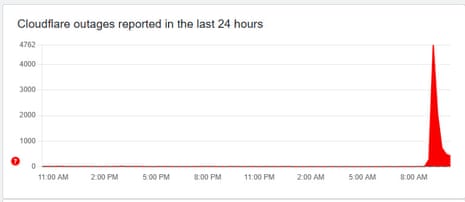
Reports of problems at Cloudflare peaked at just after 9am UK time:
Online video conferencing service Zoom, and Transport for London’s website (used for travel information in the capital), are among the sites hit by the Cloudflare outage.
Global websites down as Cloudflare investigates fresh issues
Technical problems at internet infrastructure provider Cloudflare today have taken a host of websites offline this morning.
Cloudflare said shortly after 9am UK time that it is “is investigating issues with Cloudflare Dashboard and related APIs [application programming interfaces – used when apps exchange data with each other].
Cloudflare has also reported it has implemented a potential fix to the issue and is monitoring the results.
But the outage has affected a number of websites and platforms, with reports of problems accessing LinkedIn, X, Canva – and even the DownDetector site used to monitor online service issues.
Last month, an outage at Cloudflare made many websites inaccessible for about three hours.
In a separate cereal supply and demand report, the FAO raised its global cereal production forecast for 2025 to a record 3.003 billion metric tons.
That’s up from 2.990 billion tons projected last month, mainly due to increased estimates for wheat output.
The FAO’s forecast for world cereal stocks at the end of the 2025/26 season has also been revised up to a record 925.5 million tons, reflecting expectations of expanded wheat stocks in China and India as well as higher coarse grain stocks in exporting countries.
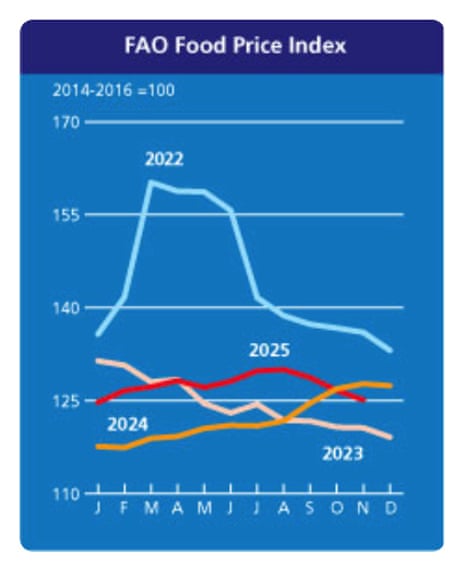
World food prices fall for third month in a row
Global food prices have fallen for the third month running.
The UN’s Food Price Index, which tracks a basket of food commodities, dropped by 1.2% in November, thanks to a drop in the cost of dairy products, meat, sugar and vegetable oils.
That could help to push down inflation, if these reductions are passed onto consumers.
However, cereal prices rose by 1.8% last month, due to “potential Chinese interest in supplies from the United States of America, concerns over continuing hostilities in the Black Sea region, and expectations of reduced plantings in the Russian Federation”, the UN’s Food and Agriculture Organisation reports.
Vegetable oil prices fell by 2.6% in the month, to a five-month low, due to prices of palm, rapeseed and sunflower oils.
Meat prices dropped by 0.8%, driven by lower pig and poultry meat prices and the the removal of tariffs on beef imports into the US.
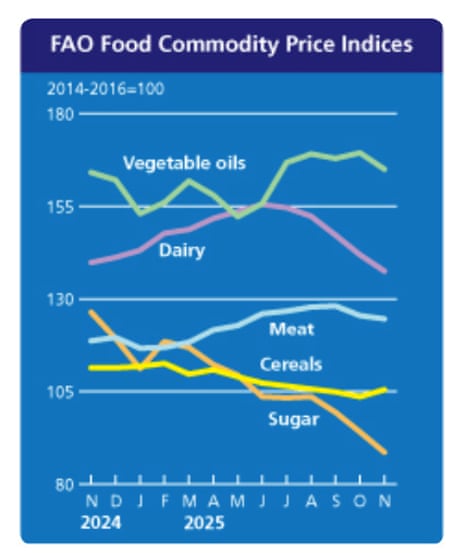
Dairy prices fell by 3.1% in November, thanks to rising milk production and abundant export supplies in key producing regions, supported by ample butter and skim milk powder inventories in the European Union and seasonally higher output in New Zealand.
Sugar prices dropped by 5.9% in the month, and were almost 30% lower than a year ago., as expectations of ample global sugar supplies in the current season pushed down prices. Strong production in Brazil’s key southern growing regions, a good early season start to India’s harvest and favourable crop prospects in Thailand all contributed.
European shares higher ahead of US PCE inflation report
European stock markets are ending the week on the front foot.
The main European indices are a little higher this morning; Germany’s DAX is up 0.55%, France’s CAC 40 is 0.3% higher, and the UK’s FTSE 100 has risen by 0.14%.
Investors are waiting for new US inflation data later today (1.30pm UK time), which could influence interest rate expectations ahead of next week’s US Federal Reserve meeting.
Kyle Rodda, senior financial market analyst at capital.com, says:
Risk assets are cautiously edging higher to round out the week, with US PCE Index data in focus this afternoon.
Ultimately, the markets appear to be looking for a signal that it’s all clear to keep moving higher again. That signal could come from data. But given the lack of it between now and the middle of next week, it’s more likely to come from the FOMC decision.
The current implied probabilities of a cut are 87%, according to FedWatch – swaps markets suggest a little higher. The markets won’t just want to see a cut delivered but also some dovish enough language and forecasts about the prospect of future cuts. Another hawkish cut, like that which was seen in October, could upset the apple cart, if it were to occur.
Nevertheless, European stocks have run with a broadly positive lead-in from Asian markets, with US futures also pointing higher

Mark Sweney
Warner Bros Discovery has entered exclusive talks to sell its streaming and Hollywood studio business to Netflix, a move that would dramatically change the established film and TV landscape.
Netflix is in competition with Paramount Skydance and Comcast, which owns assets including Universal Studios and Sky, to buy the owner of the Hollywood studio Warner Bros, HBO and the HBO Max streaming service.
Netflix is offering a $5bn (£3.7bn) breakup fee if the deal fails to gain regulatory approval in the US, according to Bloomberg, which first reported the exclusive talks.
Ocado shares jump 11% after agreeing $350m payment from Kroger
Shares in Ocado have jumped by over 10% at the start of trading, after it agreed a compensation deal with US grocer Kroger.
Ocado is to receive a one-off $350m cash payment from Kroger, which decided last month to close three robotic warehouses which use the UK company’s high-tech equipment, in Maryland, Wisconsin, and Florida.
That decision, announced in mid-November, had knocked 17% off Ocado’s shares.
This morning, though, they’ve jumped to the top of the FTSE 250 index, up 11.5% to 206p.
Ocado had previously said it expected to receive more than $250m in compensation from Kroger.
But it has also revealed today that Kroger has decided to cancel another tie-up with Ocado – a planned automated distribution centre run on the UK group’s technology in Charlotte, North Carolina.
Last month, retail analyst Clive Black of Shore Capital said Ocado was “being marginalised as most of its customer fulfilment centres do not work economically in the USA”.
Ocado says it continues to “work closely” with Kroger on five other customer fulfillment centres in US states such as Texas and Michigan.
Tim Steiner, CEO of Ocado Group, has said:
“We continue to invest significant resources to support our partners at Kroger, and to help them build on our longstanding partnership. Ocado’s technology has evolved significantly to include both the new technologies that Kroger is currently deploying in its CFC network, as well as new fulfilment products that bring Ocado’s technology to a wider range of applications, including Store Based Automation to support ‘pick up’ and immediacy.”
Our partners around the world have already deployed a wide range of these fulfilment technologies to great effect, enabling them to address a wide spectrum of geographies, population densities and online shopping missions, underpinned by Ocado’s world leading expertise and R&D capabilities. We remain excited about the opportunity for Ocado’s evolving products in the US market.”
House prices predicted to rise in 2026, after budget uncertainty
Halifax’s Amanda Bryden reckons UK house prices will rise “gradually” next year, saying:
“Looking ahead, with market activity steady and expectations of further interest rate reductions to come, we anticipate property prices will continue to grow gradually into 2026.”
Karen Noye, mortgage expert at Quilter, says affordability remains the biggest hurdle, even though inflation has eased and another interest rate cut is expected later this month, adding:
The outlook for 2026 rests on the path of mortgage rates and the resilience of household incomes. Greater clarity post budget and the prospect of lower borrowing costs give the market a firmer footing, but affordability will remain the defining constraint.”
Tom Bill, head of UK residential research at Knight Frank, blames pre-Budget uncertainty pushed house price growth close to zero, adding:
Clarity has now returned, but an array of tax rises, which include an income tax threshold freeze, will increasingly squeeze demand and prices. Offsetting that is the fact that mortgage rates are expected to drift lower next year as the base rate bottoms out at around 3.25%.”
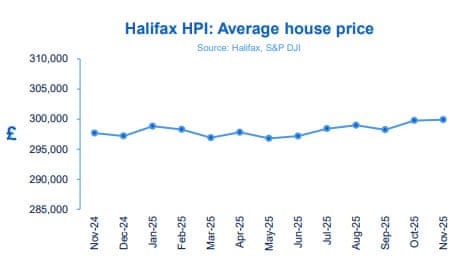
Technically, UK house prices did rise slightly last month. On Halifax’s data, the average price was £299,892, marginally up from £299,754 in October. That’s a new record high on this index.
Halifax: a clear North/South divide on house price changes
Halifax’s regional data continues to show a clear North/South divide – prices fell in the south of the UK last month, but were stronger elsewhere.
-
Northern Ireland remains the strongest performing nation or region in the UK, with average property prices rising by +8.9% over the past year (up from +7.9% last month). The typical home now costs £220,716.
-
Scotland recorded annual price growth of +3.7% in November, up to an average of £216,781. In Wales property values rose +1.9% year-on-year to £229,430.
-
In England, the North West recorded the highest annual growth rate, with property prices rising by +3.2% to £245,070, followed by the North East with growth of +2.9% to £180,939. Further south, three regions saw prices decrease in November.
-
In London prices fell by -1.0%, the South East by -0.3% and Eastern England by -0.1%. The capital remains the most expensive part of the UK, with an average property now costing £539,766.
Introduction: UK house prices stagnated in November, weak retail spending too
Good morning, and welcome to our rolling coverage of business, the financial markets and the world economy.
As the first week of December draws to a close, we have fresh evidence that the economy cooled in the run-up to last month’s budget.
UK house prices were broadly unchanged in November, lender Halifax reports, with that average property changing hands for £299,892. That stagnation follows a 0.5% rise in October, and makes houses slightly more affordable to new buyers.
On an annual basis, prices were 0.7% higher – down from +1.9% house price inflation in October.
Amanda Bryden, head of mortgages at Halifax, explains:
“This consistency in average prices reflects what has been one of the most stable years for the housing market over the last decade. Even with the changes to Stamp Duty back in spring and some uncertainty ahead of the Autumn Budget, property values have remained steady.
While slower growth may disappoint some existing homeowners, it’s welcome news for first-time buyers. Comparing property prices to average incomes, affordability is now at its strongest since late 2015. Taking into account today’s higher interest rates, mortgage costs as a share of income are at their lowest level in around three years.
Shoppers also reined in their spending in the shops last month.
A survey by business advisory service BDO has found that in-store sales grew by just +1.3% in November, despite the potential sales boost from Black Friday.
That is well below the rate of inflation which means that sales volumes are significantly down, BDO says.
The agenda
-
7am GMT: Halifax house price index for November
-
7am GMT: German factory orders data for October
-
8.30am GMT: UN food commodities price index
-
3pm GMT: US PCE inflation report
-
3pm GMT: University of Michigan consumer confidence report