3 months ago
77
3 months ago
77
Pep Guardiola sat in the press room at the Santiago Bernabéu and told Xabi Alonso to do it his way but around here, he knows, it tends not to work out like that, which is precisely why he said so. Saying it is one thing, doing it another, doing it successfully something else entirely, and a month and day after being offered that advice, handed that defence, Alonso was gone. On Monday afternoon, not long after landing from Saudi Arabia, a meeting was held at Valdebebas and then came the statement, short and unsentimental. He was a “legend” as a player, but no longer coach at Real Madrid.
Alonso is the 11th manager to last less than a year in two decades under the president, Florentino Pérez. He had begun work only seven months before, and that was earlier than he intended. It had started with the Club World Cup in the US, his first big decision to accept the demand to take over sooner than he wanted, and it ended with the Spanish Super Cup in Jeddah, where it was an open secret that final judgment awaited. For a month it had been impossible to avoid the feeling of a manager on borrowed time, especially for the manager himself, exposed and undermined, and you cannot go on like that. There will be hurt pride, regret, but release too.
To become Real Madrid manager two things have to happen, Alonso said at his presentation in May: “First they have to want you, then you have to want to … and the latter normally does happen.” Even then, neither position was held quite as enthusiastically as it should have been; even the courtship had been unusually cold. “The challenge now is to build a team, to get the potential out of all those players and ensure that we all work together as one,” Alonso said. “Because if we do we will have a strength that is … I’m not going to say unstoppable, but very powerful.”
Presented as a systems coach, what Madrid supposedly needed after a season of laissez-faire failure, Alonso was countercultural at a players’ club. At, above all, a president’s club where you must manage upwards too. Álvaro Carreras and Dean Huijsen arrived, but Alonso’s requests for Martín Zubimendi were rejected. He would have to find a No 5 in the squad, to attempt an evolution with Arda Guler. Alonso came with a consciously collective discourse: it didn’t matter who you were, you were going to run. Briefly, very briefly, there were glimpses of that in the US: a structure, pressure, an idea forming, a new identity. But then came Paris Saint-Germain to reveal the size of his task and, in the final analysis, it didn’t happen. The team Alonso envisaged didn’t exist, leaving him frustrated at their failure to learn.
PSG scored four past them, Atlético five. They had been taken apart by Celta de Vigo at home; there had been an urge to sack Alonso that night. The semi-final victory against Atlético in the Super Cup came with an asterisk: Diego Simeone’s side had been far superior. In the final on Sunday night Barcelona scored three – although many saw dignity in defeat, maybe even survival, some reason to carry on. The timing of his sacking caught almost everyone by surprise, even if the underlying fact did not.
The best moment had been in the league clásico against Barcelona in October. And yet that became the worst too, fault lines appearing in front of 80,000 people. When Alonso removed Vinícius Júnior late on, the Brazilian stormed straight down the tunnel, his fury there for all to see, shouting that he would walk straight out on the team too. “We’ll talk about it, of course,” Alonso said. “But I don’t want to lose focus of what’s truly important: a lot of the things we wanted to do have happened.”
Arbeloa in hot seat
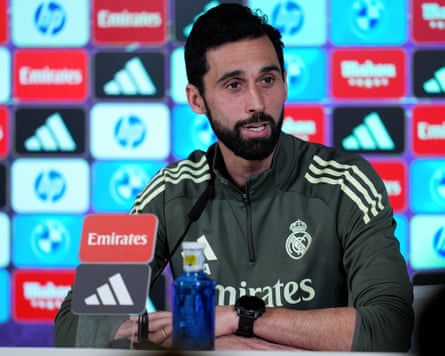
ShowEight minutes passed between Real Madrid announcing the sacking of Xabi Alonso revealing the man who would replace him: the new coach at the Santiago Bernabéu would be his friend and former teammate, Alvaro Arbeloa.
“We spoke for a good while yesterday,” Arbeloa said on Tuesday lunchtime. “What we said stays between us. He wished me the best and I wished him the best, too. You all know the relationship, the friendship, that unites us, how much I love and appreciate him. That is mutual and will continue to be mutual. We’ll be close as we have been all these years.”
The other former Liverpool and Real Madrid player follows Alonso on to the Bernabéu bench having been promoted from the B team, Castilla. Seen as a club man, close to the president, and from the José Mourinho mould, during his first press conference Arbeloa avoided answering questions about whether this is a permanent role or an interim post after which he could remain within the structure. “I will be Real Madrid for as long as Real Madrid want me to,” he said. “I am conscious of the responsibility I have.
“For me it was an honour and a privilege to be coached by José Mourinho. He was someone who influenced me a lot, I carry a lot of him in me. I don’t fear failure at all, but if I tried to be Jose Mourinho I would be a resounding failure.”
Aware of his audience, Arbeloa made much of Madrid’s status as the “best club in the world and in history", said that the youth structure is the best in football.
When asked to define “play well”, he said that Madrid’s mission was just “to win, win, win, and win again”, and later said that the players had to “enjoy” playing. He claimed that often people are reluctant to give the credit they deserve. “There are players here who have won six European Cups, which seems to be forgotten,” he said.
“Helping those trophy cabinets to fill: that’s my mission and my obsession, what I am going to live for every day.”
Sid Lowe
Yet it soon became clear that Vinícius’s huff was the truly important thing, not the victory. His anger, deeper than just one game, eclipsed all else and he was not the only fire. Fede Valverde’s complaints about playing at full-back were also made publicly, while details filtered out about a disconnect, discontent: a familiar lament about all the instructions, the videos, the long sessions. Who did he think he was? The manager? The dismissal of Carlo Ancelotti as “only” a man manager, the idea that is easy amid these egos, needs some revising. It hasn’t gone unnoticed that seven players have stayed silent Alonso’s sacking, not offering the usual social media platitudes, Jude Bellingham and Vinícius among them.
The reaction, or lack of it, to Vinícius’s outburst only deepened the problem. Or, perhaps more accurately, revealed it. Rather than censoring the Brazilian’s behaviour, backing their manager, the private response from the club was blunt: well, he shouldn’t have taken Vini off. Publicly there was nothing, the manager’s authority vanishing. Vinícius posted an apology in which he pointedly mentioned everyone except Alonso. Stories soon emerged that he would not renew his contract for as long as Alonso was around; that he had allowed it to run towards the final 18 month, unable to reach an agreement independently of any issues with the coach, went unsaid.
And all this when things were going well, or sort of. Madrid’s performances had not been especially inspiring and their destruction in the derby had hurt, but they came out of el clásico top of the table, five points clear of Barcelona with nine wins from 10. Something, though, had been broken. There was a victory over Valencia, then defeat in Liverpool, three successive draws in La Liga, at Rayo Vallecano, Elche and Girona, and a chaotic and concerning 3-4 win at Olympiakos, the tension palpable.

Efforts were made to bring the squad together, to improve relationships. Discussions held in team hotels in Athens then Bilbao sought common ground and appeared reasonably successful. On the night Madrid beat Athletic, Vinícius publicly embraced Alonso. The fix, though, was fleeting and the most basic thing of all still wasn’t good: the football. Four days later, they lost to Celta, the threat of the sack made explicit that night. From five ahead of Barcelona, they are now four behind.
Three days later came Manchester City led by Guardiola, with whom Alonso had first started to fully embrace the idea of being a coach. Madrid competed, which was something, no complaints about the effort this time. And when Rodrygo scored, he ran to embrace Alonso, but City won 2-1. There was a stay of execution, not least because there appeared little alternative. But, still, they had been beaten. And another defeat would be definitive.
Before that game, Guardiola had been asked whether he had any advice for Alonso. “Yes,” the City coach said, offering a response that served as a defence of his friend too: “que mee con la suya.” Alonso should piss with his own penis. In other words, do it your way: the decisions should be his, not imposed by dressing room or boardroom. His team should be built on conviction, not accommodation. If he were to die, die with his own boots on. When that was put to Alonso, he allowed that idea to hang, for those listening to conclude that Guardiola’s implicit criticism of Madrid was not entirely misplaced by replying: “I have a good relationship with Pep, we know each other well and he knows what he is saying.”
And yet doing it entirely your own way is impossible. Here especially. Better not to die at all. “Being Madrid manager is not about changing [the culture], it is about adapting,” Alonso said. “We know the culture of Real Madrid pretty well; that is why it is the biggest club in the world. You have to adapt, learn a lot, interact with the players. Some days are good, some not so good. We have to face that with energy and positivity, that is the only way to turn things around.”
It wasn’t easy, and his ideas were rarely apparent. He had started with Valverde leading the pressure. At least partly obliged by absences, now he had him at full-back. With Vinícius and Kylian Mbappé up front, nor did Madrid press as Alonso had planned. Dani Carvajal was their only real leader, and he was injured. Vinícius went 16 games until Sunday without a goal. There was no one to run the game from the middle, that No 5, the fundamental piece that Alonso had been and had asked for.
For all the talk of a collective, it was still individual players doing their thing that won them games. Mbappé has 29 goals in all competitions, almost half of all Madrid’s. It’s a process, Alonso said from time to time, but six months had passed and patience was thin. Project? The project at Madrid, as Álvaro Arbeloa put it on Tuesday after succeeding Alonso, is to “win, win, win, and win again”.
The injuries seemed endless, especially defensively, and the club’s criticism about the physical preparation filtered out through familiar channels. Antonio Pintus, the fitness coach still there in an advisory role but not on Alonso’s staff – a man sidelined under Ancelotti – travelled with them to Saudi Arabia. The former doctor Niko Mihic had returned, now there was pressure to integrate Pintus again, but this time the manager did resist, a red line crossed. On Monday afternoon, the statement came out. Alonso had gone. By “mutual consent”, they said.
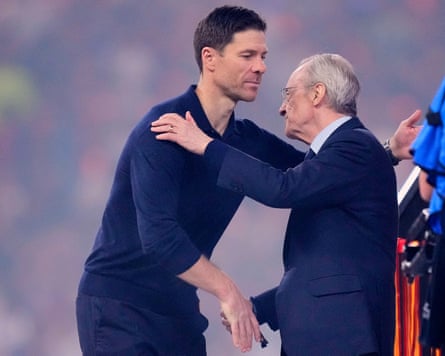
One more defeat was always likely to be definitive, and in a clásico more. At the end of the Super Cup final, Alonso tried to get his players to line up and give Barcelona a guard of honour but Mbappé refused, waving them away from there. Alonso gave up, another damaging portrait of what they had become. During the medal ceremony, the manager’s hand shake with Pérez looked like too men trying to avoid catching something, still less each other’s eye. At the end of what would be his 34th and last game as manager of Real Madrid, Alonso was asked about their encounter, whether he had been able to talk to the president about everything, about his future and theirs. “Nah, it was brief,” he said. And it had been.