3 months ago
61
3 months ago
61
When I asked Nordine Nid Hsain, the owner of my favourite Parisian bistro, why he sold up and left the capital to join the arty diaspora living in the Mediterranean port of Sète, he said: “What really drew me here was not Sète itself, but the natural paradise of the adjoining Thau lagoon. I love cycling and, after 10 years here, I am still excited to go out every day to explore the bike paths that run around the lagoon.”
He added: “There’s always something new to discover – beaches; wetland landscapes; enjoying a plate of freshly harvested oysters at the water’s edge; riding through the vineyards then tasting the wine in the vigneron’s cellar.”
It sounded irresistible, and even though I have no plans to up sticks from Paris, I bought a train ticket and arrived in Sète three and half hours later to explore this hidden corner of the Mediterranean.
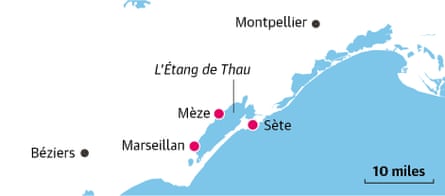
Although officially classed an étang (a lake), Thau is actually a sprawling lagoon, separated from the Mediterranean by the Lido, a narrow 9-mile-long beach. I based myself on the lagoon side, in the quiet port of Mèze, where my no-frills room in the affordable Hôtel du Port had a balcony overlooking a tiny harbour lined with fishing smacks and pleasure boats.
The biggest surprise about Mèze is that there are two beaches tucked away in the centre of town, perfect for an undisturbed early dip. Two minutes from the hotel, La Plagette sits beneath the medieval Chapelle des Pénitents, which glows yellow in the morning sun. On the other side of the harbour, La Pinède is a pine-clad stretch of sand, part of La Conque wetlands reserve, that hugs the banks of the lagoon, and is on the walking and cycle route that offers opportunities to spot flamingos.
Most of the countryside surrounding Thau is covered with vineyards, the lagoon waters glinting in the background. The most famous wine is Picpoul de Pinet, a crisp white that’s become popular in the UK. Pinet itself is a sleepy hamlet of wineries, and at historic Domaine Gaujal, the fifth-generation owners, Audrey and Laurent Gaujal, welcome visitors like family friends. They offer an extensive tasting, including an organic Picpoul aged in ceramic amphora, followed by a tour of the cellar, free of charge.
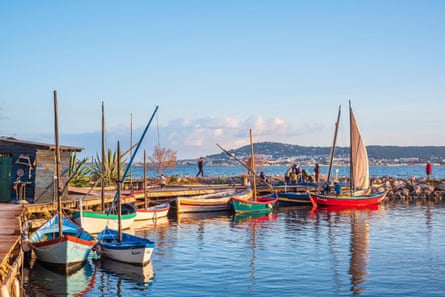
My last stop for the day was the ancient Roman port of Marseillan at the tip of the lagoon. Between the grand mansions and fishers’ cottages, the cobbled alleys remain untouched by modernity – a testament to the preservation of the lagoon’s natural beauty. Just by the old port stands the grand stone warehouse of Noilly Prat, where France’s famous vermouth has been produced since 1813.
Recently refurbished, it has an elegant tasting room in the cellar and a bar where locals go for after-work cocktails. An immense courtyard at the back is filled with hundreds of wooden barrels left to age their secret recipe of botanicals. Outside, the bustling quay is lined with reasonably priced seafood restaurants, such as Brasserie Galinette (mains from about €20), specialising in sea bream and cuttlefish, a perfect alfresco dinner as the sun sets over the lagoon.
The next day I headed out to Bouzigues, a fishing village that gives its name to the lagoon’s most famous oysters. The oyster fields are what mark Thau out from other wetlands – an Escher-like maze of hundreds of “tables” opposite the shore, where thousands of oysters grow.
The ostréiculteurs operate from ramshackle huts on the water’s edge, zipping back and forth in boats to their wooden cabins, many of which double up as waterside eateries.
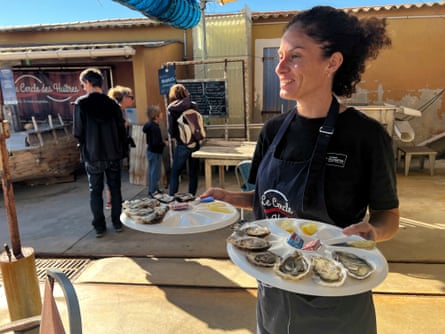
At Le Cercle des Huîtres, Irene Salas Fernandez served some of the best oysters I have ever eaten: freshly shucked, made into a tangy ceviche, deep-fried tempura style, or baked with delicious sauces such as bourbon and smoked paprika. Fernandez and her partner Sebastian moved here from Barcelona and started farming only three years ago. I was shocked when Sebastian told me: “We only cultivate oysters today since the farming of mussels, which Bouzigues was also famous for, has almost disappeared due to global warming. The lagoon’s water is becoming too hot in summer for these fragile molluscs to survive.”
I resisted the temptation of a dip in the azure waters off Bouzigues’s beach, Plage de la Pyramide, and headed inland to Valmagne Abbey. This magnificent 11th-century monastery was deconsecrated during the French Revolution and the gothic church was transformed into a wine cellar. Today, the owners still run a vineyard, operate a farm-to-table organic restaurant and store their immense barrels of wine inside the church itself.
Before heading back to Sète station, I drove the length of the Lido’s sand dunes, which are almost deserted out of season. Parisian photographer Pierre-Emmanuel Rastoin was taking a late afternoon dip with his brother, who lives in the nearby winemaking village of Frontignan. “This is the perfect place to escape to,” he said, “as long as you avoid the summer months.”
But one of the biggest attractions of this corner of the south of France is that even in peak season – when holidaymakers descend on the campsites and caravan parks, unpacking deckchairs, cabanas and sun umbrellas – it is always possible to find a quiet, spot along this beach.
The trip was provided by the Archipel de Thau tourism office. Hôtel du Port has doubles from €65 B&B