3 months ago
68
3 months ago
68
For more than 170 years the Cirque d’Hiver, the world’s oldest circus, has been the scene of many a breathtaking act.
In 1859, gymnast Jules Léotard – whose name would become synonymous with the one-piece – captivated audiences by launching himself from one swinging trapeze to another without a safety net for the first time in public.
Half a century later, when the circus artist Rosa Van Been married the animal trainer Joseph Bouglione, the blessing was held inside the circus’s lion cage; in 1955, the film Trapeze starring Gina Lollobrigida, Tony Curtis and Burt Lancaster was shot inside the imposing 20-sided building in Paris’s 11th arrondissement.
Today, however, the wow factor has come not from the daring acts or smoke and mirrors in the ring but from the uncovering of an extraordinary panorama of painted canvas panels that were hidden for more than 70 years.
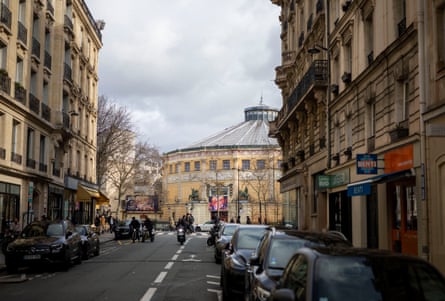
After the discovery, Cirque d’Hiver, whose name means Winter Circus, is to undergo a complete restoration, taking it back to its original 19th-century glory.
Louis-Sampion Bouglione, whose family has owned the circus since 1934, said: “It’s marvellous to see them and an important part of our history. We knew they once existed because my father remembers seeing them, and we always hoped to be able to rediscover them one day. But we were afraid what condition they would be in or even if they were still there.”
As the circus’s co-director and historian, Bouglione has spent decades delving into the archives and has admitted to often lying awake at night wondering what the building looked like when Napoléon III officially opened it on 11 December 1852.
“We’ve only seen two [panels] so far, but we’re going to open everything up to find out what’s there,” he said. “What’s really exciting and important is it’s one of the few legacies of the circus from that era in painting.”
After the Cirque d’Hiver, listed as a heritage building, underwent a €2.2m exterior facelift in 2007, the initial plan was to replace the tiers of red seats around the ring. The architect Stéphane Millet, who is also renovating the stage at the Opéra Garnier, suggested a more ambitious project.

“One of my tasks is to raise awareness of the importance of heritage and to seek government assistance for projects, so I convinced the family to go a little further than their initial ambitions,” Millet said.
“What started with seats has become a global project that includes everything; a renovation from bottom to top. When you have heritage like this you have to showcase it.”
Millet has brought in the culture ministry and other authorities to fund much of the project, which he says will cost “several million euros”.
The Cirque d’Hiver, initially called the Cirque Napoléon, was built in just eight months under the direction of the architect Jacques Hittorff, responsible for the Gare du Nord. The original polygonal structure had a diameter of 42 metres, 40 stained-glass windows and a wooden roof covered in decorated canvas designed to look like a tent, complete with fake poles and handmade gold-painted mouldings resembling ropes and ties.
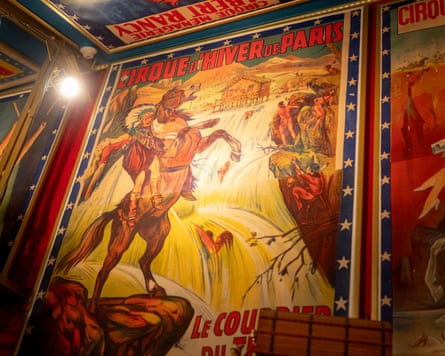
The original 20 paintings, 6 metres wide and almost two metres high and attached to wooden frames, depict warriors on horseback and scenes dedicated to the equestrian arts. They were created by Nicolas Gosse and Félix-Joseph Barrias, highly sought-after painters in their day and mirror the bas-reliefs panels on the outside the building that were renovated in 2007.
The first performers were former cavalry officers but the acts soon diversified. Léotard would later inspire the popular English song, The Daring Young Man on the Flying Trapeze who flew “through the air with the greatest of ease”, written three years before his death in 1870 aged 32. Alexandre Dumas, the author of The Three Musketeers, was said to have been inspired by the beauty of the interior and wrote that the spectacles were so popular crowds had to be turned away.
Today, the shows no longer use wild animals in performances – they were stopped in 2017 – and are still hugely popular with Parisians. The building is a city landmark.
The renovation, expected to take four years, will begin in July when the paintings are removed for restoration. They were covered with blue-painted wooden boards in the 1950s after being dulled by smoke from the original oil lamps and are thought to have been further damaged by leaking windows and several layers of successive decoration.

“It’s like wallpaper in old houses. Until we remove everything we won’t know exactly what is there and how much damage there is,” Millet said. “The canvas is very fragile but from what we have seen, it is wonderful work. That the panels have survived at all is testament to the quality of the painting.”
For Bouglione, the circus is very much a family affair. When Rosa Bouglione died in 2018, aged 107, she left 55 descendants, including her children, grandchildren and great-grandchildren. There have been several additions since. Of the 20 family members still involved in the Cirque d’Hiver, Louis-Sampion’s father, Émilien, is the oldest at 91, while the two youngest are three.

“It’s family and everyone is involved in one way or another, even if just with small things. It’s work and we have found a way to make sure both succeed,” Bouglione said.
In recent years, outside the winter circus spectacular, which features a nine-musician orchestra, the building has been used for private events and political rallies.
The next few years will be a juggling act to ensure the circus show goes on each winter while carrying out renovations during the two-month summer holidays, but Bouglione is confident they can keep all balls in the air.
“We will do the work during what we call the dead season,” he said. “It will take longer but we can’t close down. It’s a business and so it has to work. Besides, people are passionate about the circus. They come when they’re children, then come with their own children and grandchildren. It’s a tradition.”