3 months ago
63
3 months ago
63
Preston, Lancashire is no stranger to trailblazing architecture. The city’s bus station, the largest in Europe when it opened in 1969, is a brutalist masterpiece. Next month, a new public building opens opposite the bus station built with similar aspirations to transform local lives: a youth centre.
To a generation raised when cuts had gutted services – between 2010-11 and 2023-24, local government spending on youth services fell by 73% and more than 1,000 youth centres closed – the idea of a place designed just for young people may seem as anachronistic as coach travel, but 2026 brings big changes to youth services in the UK.
The government’s Youth Matters strategy, launched in December 2025, is the first national youth strategy in 15 years. It promised £500m investment over a decade to rebuild the service with a priority of creating 50 Young Futures (YF) hubs, with eight pilot schemes in Nottingham, Manchester, Birmingham, Brighton and Hove, Bristol, Leeds, Tower Hamlets in London and Newton Aycliffe in County Durham.
It’s hoped that YF hubs will provide integrated support for mental health and employment skills in one place, room for sports and arts activities and a digital and physical safe space where young people “feel like they belong”. It’s a utopian check list that forces the question: what will these specialist places for young people look like?
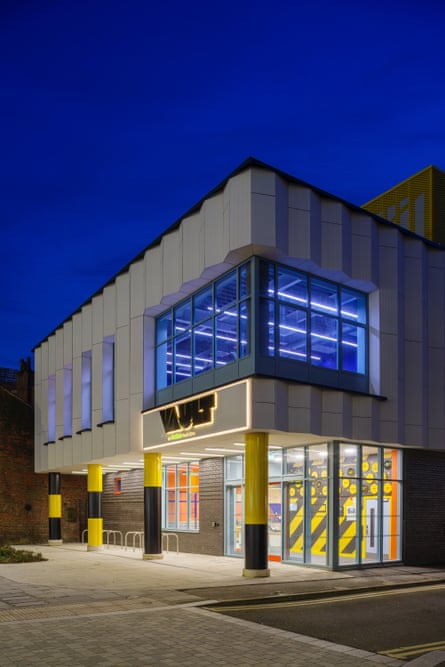
For John Puttick, the architect behind Preston’s Youth Zone (now called Vault, a name chosen by local people), that space has to be something that young people are proud of. Puttick hasn’t worked on the YF hubs, but his practice has created community buildings throughout the UK, including youth centres in Grimsby and Blackburn with another slated for Thurrock. He works with the charity OnSide which creates centres for people between eight and 18 years old (or up to 25 with additional needs), in economically disadvantaged areas.
“In Preston, we wanted the Vault to feel like a new civic presence, prominent, something that young people identify with. We spent a long time thinking about how to make the building playful and welcoming, but aspirational,” says Puttick.
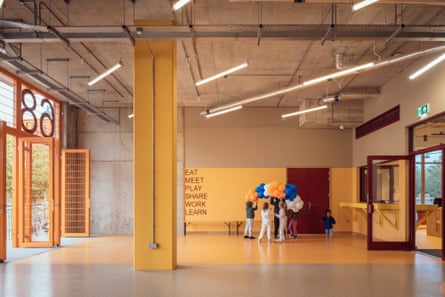
Externally this means yellow and black columns under a folded concrete facade, which mirrors the lauded bus station. Inside, Vault feels swaggeringly aspirational. A double-height, open-plan central space houses a cafe and a gaming area with clear sightlines to a football pitch, kitchen, music rooms, climbing wall and sports hall – fostering a sense of community and flooding the space with as much natural light as Preston has to offer in February.
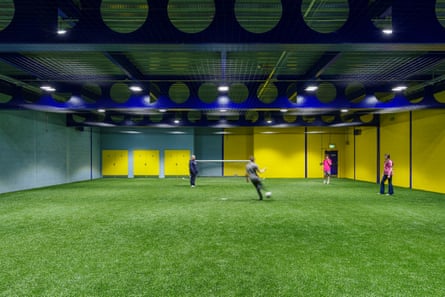
And if the interiors zoned by colour, columns and diagonal striped fittings bring a flicker of nostalgia to some of the parents and grandparents dropping off their children, there’s a reason: the scheme was created by Ben Kelly, designer of Manchester’s fabled Haçienda nightclub. It’s not such an archaic reference as you might think. Preston’s younger people are familiar with Kelly thanks to the late fashion designer Virgil Abloh’s fascination with Factory Records.
Emma Warren, author of the 2025 book Up the Youth Club, a history of UK youth services, says that the UK has periodically bestowed beautiful buildings on the young. While the philanthropic desire to help young people goes back centuries, the 1960 Albemarle report founded the modern understanding of youth provision, leading to the construction of 300 purpose-built centres between 1960 and 1968.
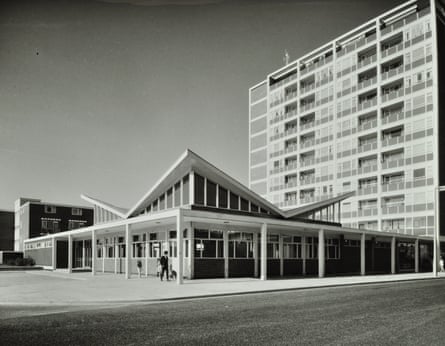
For an idea of how these places transformed lives, Warren recommends watching the beautiful short film about Lewisham’s Grove Park Youth Club, which was created by the London county council architecture team under Sir Hubert Bennett (and a team also responsible for the Hayward Gallery, Queen Elizabeth Hall and Crystal Palace National Recreation Centre).
Of course, the cultural landscape now is very different from these halcyon days. Warren says that recent research found that half of the UK’s young people spend most of their free time in their room.
“People talk about youth workers getting kids off the streets, but it strikes me that a lot of youth work now is about getting kids out of their bedrooms,” she says. “Parents need to understand that having their young people isolated from their peers is deeply unsafe.”
Larry Botchway is the co-founding director of the award-winning design practice POoR Collective, which focuses on architecture and education for young people. He says: “Safe, free places outside the home are essential for connection and growth. Dedicated spaces show that young people are valued members of the community, not a problem to be managed.”
While buildings like Preston’s Vault give a powerful signal, not every community has the finance or land to create such impressive monuments for the next generation. That isn’t always a negative thing. Tower Hamlets in London is one of the areas picked as a pilot for the new youth strategy.
Like the others, it was chosen due to high measures of antisocial behaviour and knife crime. But Tower Hamlets was focused on the needs of its young population before the government’s intervention. The borough has the youngest median age of any area in the country, with one in two children living in low-income families – and the council has been working to open a youth space in every ward over the last two years. After discovering that users of the centre were 70% male, they opened a girls-only club last month as a priority.
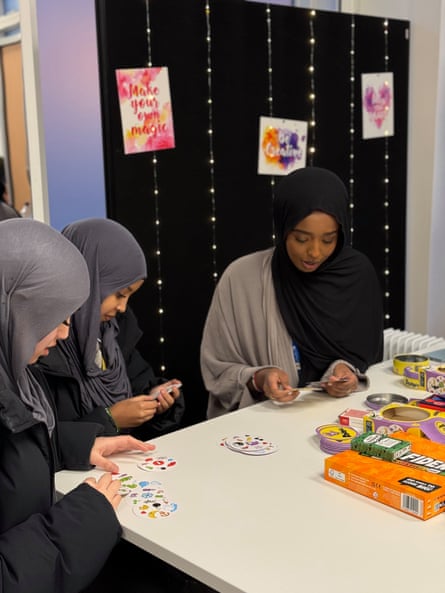
The girls’ centre is simple – a suite of rooms in a modern high-street community centre – but local girls made all the decisions here. Through a survey, they chose how it was furnished, what activities are on offer and even the centre’s name. On opening night in January, the centre had the pastel colour scheme they asked for and a sofa with cushions and fairy lights in a gaming area.
Some of the girls get selfies with Lutfur Rahman, the executive mayor, as he tours the facility to officially open the club – bringing with him an enormous celebration cake decorated with the logo for Young Tower Hamlets. Rahmansays that this is the only time he’ll be allowed in.
Fourteen-year-old Amaira Katyal, deputy young mayor of Tower Hamlets, took the survey which informed the youth club’s design and said she had a real throwback moment when she walked into the centre. “I remember filling out the form in June last year and now it’s finally come true. Spaces for young women have been overlooked, and it feels amazing to have this place where they can come and just be.”
The idea of safe spaces for young people comes up constantly in reports and conversation. Maium Talukdar, who is deputy mayor of Tower Hamlets and lead cabinet member for education, youth and lifelong learning, says that is because it’s a recurring request from young people.
“But a safe space means very different things to different people,” says Warren. “An example I talk about in my book is the 1970s group the London Gay Teenage Group. They used to hang out with and feel protected by some ferocious punks; that felt safe to them. I think to adults or some institutional actors, safe is often conflated with safeguarding. That has its role, but it also has limits. My guess is safety is somewhere where you’re well supported, where you feel less anxious, and where you might even have a laugh.”
Caspar Rodgers is director of Alma-Nac architects, the studio behind 68 Erith Hub, a new community centre in Greater London. Rodgers’ concern with the government’s policy is the expectation that spaces promote social outcomes.
“Design can make community spaces more likely to be adopted, but it can’t solve issues on its own. The YF hubs have the potential to be critically needed additions to their communities. On first read, they sound like highly managed provisions which, while potentially brilliant, does tie success to the quality and funding of its management. I hope the designs focus equally on creating great places for young people to simply spend time together as much as on their agenda of crime reduction and volunteering opportunities.”
For some areas, any provision will be an improvement. Puttick’s next youth centre is in Tilbury, Essex, where he grew up. “There’s basically nothing to do there, it’s a very tough environment; delivering a building there will make a huge difference.”
Of the six people interviewed for this feature, at least four attended youth centres as kids and have continued to support that system as grownups.
Warren not only attended a club as a kid but is a volunteer youth worker now. She thinks these experiences do make a difference. “I imagine a lot of people with structural power didn’t go to a youth club because their parents paid for their leisure activities. They missed out on those connective effects – and on all the jokes.”
Mayor Rahman is someone who is in on the joke. In his short speech before handing the new centre over to the young women of Tower Hamlets he describes his experience.
“I grew up round here in an overcrowded household with no space to do my homework, so I’d go to a youth centre. It helped me so much – I worked hard but I got to spend time with my friends and play at the same time.” He looks admiringly down at the vast sheet cake in front of him. “We, though, never had this kind of big cake.”