3 months ago
67
3 months ago
67
India celebrates 80 years of independence from the UK in August 2027. At about that same moment, “early versions of true super intelligence” could emerge, Sam Altman, the co-founder of OpenAI, said this week.
It’s a looming coincidence that raised a charged question at the AI Impact summit in Delhi, hosted by India’s prime minister, Narendra Modi: can India avoid returning to the status of a vassal state when it imports AI to raise the prospects of its 1.4 billion people?
Modi’s hunger to harness AI’s capability is great. He compared it on Thursday to a turning point that resets the direction of civilisation, such as “when the first sparks were struck from stone”. The most common analogy heard among the thousands of visitors to the summit was the dawn of electricity, but Modi was talking about fire.
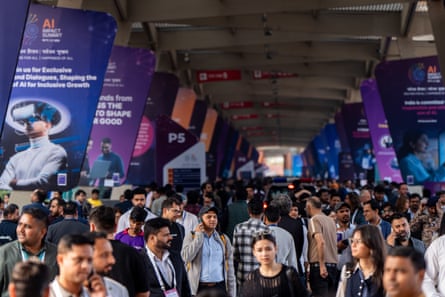
His desire to use AI to supercharge Indian economic growth is matched by that of the big US tech companies. OpenAI, Google and Anthropic all played prominent roles at the summit, announcing deals to get ChatGPT, Gemini and Claude AIs into more people’s hands.
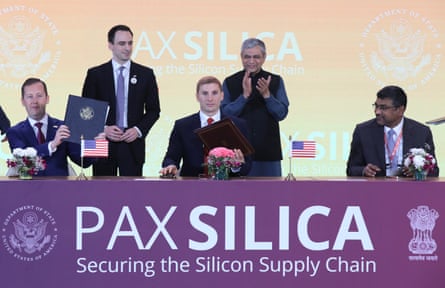
The Trump administration, seeing AI as central to its battle for supremacy with China, was clearing the path for the three AI companies. The US government signed the Pax Silica, a technology agreement that binds India closer to US tech and away from Beijing.
At the signing, Jacob Helberg, the US under secretary of state for economic affairs, emphasised the threat from China if India should even think about looking elsewhere for its AI. “We have seen the lights of a great Indian city extinguished by a keystroke,” he said, in an apparent reference to a suspected Chinese cyber-attack on Mumbai in 2020.
India lacks the semiconductors, power plants and vast gigawatt datacentres to go it alone. In common with most other countries, it faces a choice between US and Chinese AI models. Which they choose could have profound consequences for who controls India’s future, because if AI’s power emerges as predicted, it will not only tweak economic and social structures, but become their new bedrock.
Stuart Russell, a professor of artificial intelligence at the University of California, Berkeley, who closely follows India’s progress, said: “If we get to AGI [artificial general intelligence], AI is going to be producing 80% of the global economy. All manufacturing, most agriculture, all services will be just done; managed by AI, produced by AI.”
Imagine, he said, an Indian village priced out of having a health centre. In the future, AI could design the hospital and “along comes a bunch of giant quad copters carrying the materials, and a bunch of robots come and assemble everything. Two weeks later, you’ve got a hospital.”
In this scenario, technology becomes integral to a country’s wellbeing. Elements of sovereignty can be fought over, but how successful that will be remains to be seen. AI’s power is such that its controller gains enormous leverage.
Anthropic’s chief executive, Dario Amodei, told the summit: “It may sound absurd, but AI can even help India achieve a standout 25% economic growth.” If that were to happen, it would take India to a per-capita GDP in a decade that is equivalent to Greece today. How could a leader resist?
Modi’s tech secretary, Shri Krishnan, said India realised it must ally with like-minded countries to ensure it did not become “enslaved”. It is a high-stakes decision.
India appears unlikely to turn to China, for now. It has the AI models, but there are tensions on the Himalayan border, and Chinese companies and leaders were scarce at the summit.
Will India thrive with US AI? Silicon Valley companies talk of cooperation not control. Chris Lehane, OpenAI’s head of global policy, said: “We don’t see India as a customer, we see it as a strategic partner.”
US officials framed the deal with India as an alliance of two nations that “broke centuries of colonial rule”, and as “two great democracies saying we will build together”.
The Guardian asked Michael Kratsios, Donald Trump’s science and technology adviser, if India risked being controlled by the US under a form of digital colonialism.
“I would say it is actually the opposite,” he said. “Any country that builds on top of the American AI stack will have the most open, independently controlled, secured stack the world has to offer. And that is why we are soon keen to share it with so many countries that are prioritising their AI sovereignty.”
Russell sees another possibility. “I think the American companies want to get in at that high-school and middle-school level to create basically a bunch of AI addicts who can’t tie their shoelaces without the help of AI,” he said. “Silicon Valley has always been about eyeballs. You monetise later and it works. Google and Facebook generate vast amounts of money.”
Could India build its own AI? It is investing billions in datacentres and semiconductor capacity, but it takes years to come online.
Altman was asked on Thursday how Indian entrepreneurs could build their own AI and his response was blunt. “Look, the way this works is we’re going to tell you it’s totally hopeless to compete with us on training foundation and you shouldn’t even try, and it’s your job to try anyway and I believe both of those things.”
India can press US tech companies to adapt their AIs to its kaleidoscope of languages and cultures, and attempt to insist on guardrails. There is much at stake. As the summit came to a close, Joanna Shields, a former Facebook and Google executive and a UK minister for internet safety, warned: “If we have a world where we are accepting models from just the global north, we will lose so much of our cultural diversity, our uniqueness as people, wherever we come from … We don’t want to develop a monoculture based on a handful of models that everybody uses around the world and we lose that richness of who we are, what makes us human.”