3 months ago
62
3 months ago
62
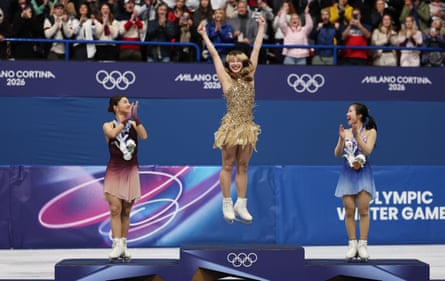
Alysa Liu made her way through a mixed zone teeming with hundreds of reporters at a quarter past midnight early Friday morning, an Olympic gold medal draped around her neck, the sequins in her color-coordinated dress glimmering beneath the klieg lights and crush of television cameras. The 20-year-old from West Oakland had just become the first American woman to win figure skating’s biggest prize in 24 years, drilling seven clean triples to leapfrog a pair of Japanese rivals from third place after Tuesday’s short program and gatecrash her sport’s most rarefied air. But to hear Liu tell it, her second gold in 12 days was merely a passing footnote in a Milan fortnight she doesn’t want to end.
Liu’s carefree mindset should and will be studied in the weeks, months and years after these Olympics – especially these Olympics – as a counterpoint to the results-obsessed mindsets that have shattered the mental wellbeing of so many athletes thrust into the pressure-cooker of the world’s biggest sporting event. She spoke candidly and insightfully on how her unique journey from child prodigy to burnout case to second-act skater gave rise to an indifference to scores or placements. All she wanted in the end was a chance to make the US team and share her artistry on the world stage.
Only a few meters away stood Kaori Sakamoto, the silver medalist and one of the most joyful people ever to skate on Olympic ice, dabbing away a steady stream of tears with a wrinkled tissue, brought down by the cold arithmetic and brutal reckoning of this unforgiving sport. The 25-year-old from Kobe, who is retiring after this season, had won a shock bronze medal four years ago at the Beijing Olympics only when a nailed-on favorite who’d never lost a competition at the senior level went to pieces in the free skate. She’d backed up that breakthrough with a run of three world championships in the years since. But a couple of faint mistakes on Friday night – a wobbly landing on a triple flip, a missed triple toe in a combination – left her short of Liu’s marker and lamenting the storybook ending that might have been. Sometimes third can feel like first. Other times second can feel like nothing at all.
Liu’s journey since Beijing, where she’d finished sixth on her Olympic debut, was different. She’d vanished from the sport only months after the 2022 Games citing mental fatigue, making it Instagram-official before anyone could talk her out of it. She started school at UCLA and studied psychology. She went hiking in the Himalayas with friends. She discovered herself outside a sport where she said she’d felt boxed in since winning US nationals at the age of 13, when her 4ft 6in frame left her too short to reach the top of the podium without a hand from the other medalists.
“I really hated skating when I quit. Like, I really didn’t like it,” Liu said in the run-up to Milan. “I didn’t care about competitions. I didn’t care about places. I didn’t care about skaters. I didn’t care about my programs. I just wanted to, like, get away. I wanted nothing to do with that. I hated fame. I hated social media. I didn’t like interviews. Like, I hated all of it.”
But a chance reconnection with her love for movement while gliding down the mountain during a Lake Tahoe ski trip led her back to the ice. Gradually at first, once a week at public sessions at the Toyota Sports Performance Center in El Segundo, where she found the complex jumps that had propelled her rise had not completely abandoned her. Over time she rediscovered a love for skating not as a competitive pursuit but a vehicle for self-expression. She soon fixed her sights on a comeback, but only under certain conditions. Her father, Arthur, who had poured untold sums into molding his daughter into the next Michelle Kwan – another Chinese-American skating icon from California – would no longer be part of the team. Alysa Liu would be the CEO of Alysa Liu Inc, having final say over everything from her costumes to her music to her diet to her training schedule. Most importantly, the results wouldn’t matter.
Enter Alysa 2.0: a term she dislikes, but an accurate shorthand for the complete reinvention of a skater on her own terms. Sporting an eye-catching frenulum piercing and a bleached tree-ring hairstyle that has required years to cultivate, she has embraced a nonconformist streak that’s made her a darling of outsiders everywhere. But the transformation runs far deeper than aesthetics.
“Protecting my identity is my main goal,” she said in Thursday’s aftermath. “I know exactly what it’s like to not have that. My experience with it before has taught me how I should guard myself. I don’t go online that much. I hang out with my friends and family as much as possible. Being grounded is really what keeps me. I love exploring other hobbies, doing side-quests and what not. It keeps me curious and I’m protecting that.”
Liu first signaled her comeback was for real at last year’s world championships in Boston, when she became the first American to win figure skating’s biggest competition outside the Olympics since Kimmie Meissner in 2006. The bumps in the road since then have ranged from the prosaic to the macabre. There were music rights headaches. Dress issues. Her planned short program music for the Olympic season was scrapped when the artist was found at the center of a police investigation after the remains of a teenage girl were discovered in the trunk of his impounded car. (Regular figure skating things.)
To hear Phillip DiGuglielmo put it, the Olympic gold was a “kind of taboo” subject and didn’t even enter open conversation until November. One half of the thrice-fired, thrice-rehired coaching duo – along with Massimo Scali – that have been with Liu from the start, DiGuglielmo reflected on how Liu’s reframed expectations have rubbed off on the team. Stress management ahead of Thursday’s free skate, for instance, meant two glasses of Pol Roger champagne before their walk over to the rink.
“We did a little pre-celebratory thing, like we learned from her,” he said. “Third place or fourth place would have still been an incredible accomplishment. I can’t sit here and say she has to win. That doesn’t jibe with her values. And as a coach you have to amplify the values of the athlete.”
He added: “Her goal was about showing her art. We get a lot of flak. Pretty hair and pretty dresses and sequins. It’s a sport. It’s a hard sport. It’s a split-second timing sport. You get a little bit of adrenaline and it changes your timing. Her internal clock is just ticking along. Her goal was to just make the Olympic team. That was really the big deal for her.”
DiGuglielmo, who was initially skeptical of the comeback and tried to talk her out of it, had stood alongside Liu through her dizzying, unfulfilling first chapter, giving him a unique perspective for how far she has come.
“When she was younger, she has no memories of any of the places she went to, or any of the competitions she did,” he said. “She was so not happy that she wound up compartmentalizing. She does not remember that she went to junior worlds, or that she went to the junior Grand Prix final. She doesn’t remember any of that. So last year’s tagline was making memories. If we’re in Japan, we’re getting ramen. We wanted to say, ‘Here we are, this is what we’re doing.’”
That odyssey culminated on Thursday night, when an arena once headlined by Whitney Houston and Lady Gaga gave rise to a new American original, an unthinkable outcome two years ago when Liu was off the grid roving the trails around Mount Everest with skating firmly in the rear view. Liu is now the reigning world and Olympic champion, flying home from Italy after Saturday’s exhibition gala with two golds after last week’s team event as the face of US figure skating, if not the sport itself. But more importantly she’s offered proof that joy, not pressure, can prove the sharper edge.
“My story is more important than anything to me, and that’s what I will hold dear,” Liu said. “This journey has been incredible. I have no complaints, and I’m so grateful for everything. It’s just how my life has gone. Everything in general has led me to this point.”