3 months ago
65
3 months ago
65
A 29-year-old tennis coach from Sydney won the inaugural One Point Slam at the Australian Open and its A$1m prize on Wednesday, after upstaging a field which included Jannik Sinner, Carlos Alcaraz, Iga Swiatek and Coco Gauff.
It is Tennis Australia, however, which won the jackpot, after the new concept – despite its near three-hour duration, often confusing format and awkward exchanges between players – attracted a full house to Rod Laver Arena during opening week as organisers look at non-traditional ways to attract fans to Melbourne Park.
It was a knockout tournament with a difference, one in which each tie was determined by a single point. To assist the amateurs, the professionals in the field were given only a single serve. And to decide the server, a game of rock-paper-scissors was held before each point.
The victory of the amateur Jordan Smith, a former US college player with a career-high ATP rank of 1,141 who now works at his family’s tennis academy, cut through much of the promotional spin. His family and girlfriend, who politely asked for half the prize money midway through the evening, gave the proceedings a human touch and imbued them with jeopardy.
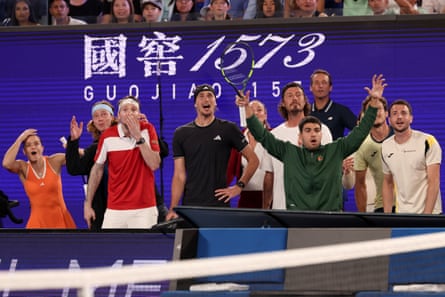
A clearly overwhelmed Smith, wearing a fixed grin for much of the evening – including after beating Sinner in the third round – said at the end of the night: “I can’t even speak, it’s unbelievable,” pledging to use the money to invest or buy a house in Sydney’s inflated property market. He had been more realistic earlier in the evening when he admitted it might have to be an apartment, or “half a house”. The contrast was stark when Donna Vekic was asked what she might do with a million dollars. “I like diamonds,” she replied.
The Smiths ended up relegating even the leading lights of tennis to background props for this modern fairytale. The superstar names were largely eliminated early, and those that remained shared stilted exchanges with the on-court MC, which needlessly dragged out the evening past 10pm.
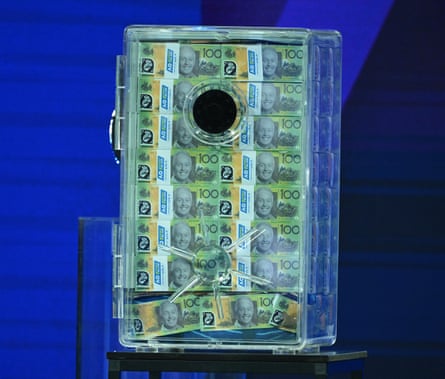
A trial of the new one-point knockout was run last year, but the decision by Tennis Australia to award a $1m prize this year – almost a quarter of the cheque for the men’s and women’s singles winners – built anticipation for the concept.
In the field, there was a breakfast television host, a former jockey, and Nick Kyrgios. There was a video-game influencer with more than five million YouTube subscribers. The biggest star, however, was the Taiwanese entertainer-businessman Jay Chou, reportedly worth more than $100m. He had promised he would donate the $1m prize to charity if he won, but lost in the first round to an ace.
Half of the 48-player field were current professionals, headlined by Alcaraz and Gauff, while the remainder were local celebrities and qualifiers. There were regional qualifiers, including one 37-year-old from Adelaide who represented India at the Davis Cup in 2013, and Smith who had qualified via the Sydney bracket.
The rough edges of the novel format – akin to a TikTokification of tennis – were obvious. A quarter of the matches in the first round ended with faults, and the commentators using them as another chance to talk about pressure wasn’t making the spectacle any better. Players who won the choice to receive, were also given another advantage by naming the side of the court they preferred. And the whole evening was one long made-for-TV spectacular, full of commercial breaks that had players pacing impatiently and spectators losing interest. By the time of the final, close to a quarter of the arena was vacant.
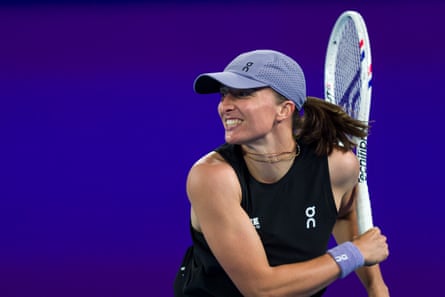
The concept also showed its potential. Rather than the stale Battle of the Sexes format, the One Point Slam gave women no apparent advantages. Mastering the mental side of the game helped six women to the quarter-finals, and a point between Swiatek and Flavio Cobolli – won by the Pole – offered the best tennis of the night.
Though none went home with the big prize, the professional players were supportive of the format, which has been used for years in community tennis but never on the game’s biggest stage. Alexander Zverev said it was a “brilliant” thing to try “before it gets serious” at Melbourne Park, while Elena Rybakina said it was “unbelievable how many people came”.
Most clowned their way through proceedings, but it meant more to others. The Spanish world No 71, Pedro Martínez, who fell to Smith in the semi-finals, immediately rushed to the exit afterwards in frustration.
The field was only finalised on Tuesday with a set of qualifiers in Melbourne. One player to book their place, the Taiwanese world No 117, Joanna Garland – who won a WTA125 tournament in Canberra on the weekend but lost in the Australian Open qualifiers earlier in the week – ended up losing the final.
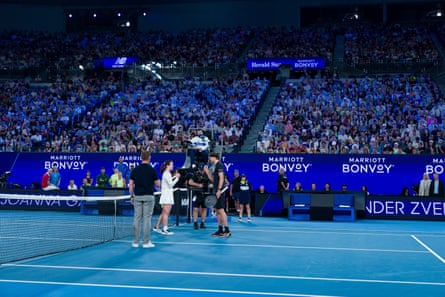
By then, however, she had won over the crowd, who appeared to initially think the softly spoken 24-year-old was an amateur. Her line given to the MC before the final with Smith – “there are three winners here tonight: one is tennis, the others are me and him” – was too sweet to bear. But the crowd lapped up the schmaltz, and cooed when Smith’s father said he was proud of his son, “win, lose or draw”.
Of course there were no draws and the players quickly saw an advantage in choosing to receive, heaping pressure on the server. Most approached the serve as if it were their second, making many points looping baseline rallies. The exception was Arthur Rinderknech who, after faulting with a powerful serve against Amanda Anisimova, gave the line of the night: “Go big or go home,” he said in his French accent, before walking out of the arena. “I go home.”