3 months ago
64
3 months ago
64
Venezuela’s rulers have deployed armed militias to patrol streets, operate checkpoints and check people’s phones in a crackdown to consolidate authority after the US attack on Caracas.
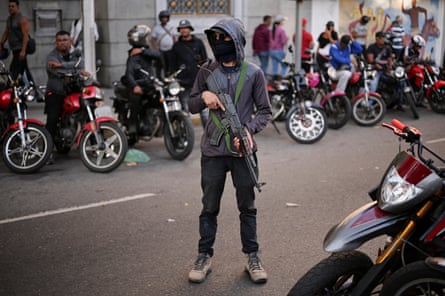
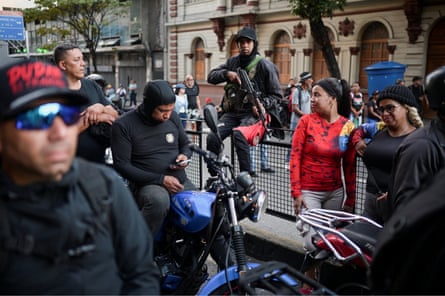
Paramilitary groups known as colectivos criss-crossed the capital with motorbikes and assault rifles on Tuesday in a show of force to stifle any dissent or perception of a power vacuum.
The patrols stopped and searched cars and demanded access to people’s phones to check their contacts, messages and social media posts in a stark demonstration to the population that the regime remained in charge despite the abduction of president Nicolás Maduro.
Anyone who was suspected of supporting Saturday’s US raid was liable for arrest, said Mirelvis Escalona, 40, a resident in the western Caracas neighbourhood of Catia. “There’s fear. There are armed civilians here. You never know what might happen, they might attack people.”
A semblance of normality returned to much of the city, with shops and bakeries reopening and people going to work – but uncertainty over what will happen next created a febrile mood.
The interim president, Delcy Rodríguez, has sought to project a sense of calm and control since being sworn in on Monday but there was no disguising the government’s shock and jitteriness.
In addition to the humiliation of Maduro’s appearance in a New York court on narco-trafficking charges, the authorities face the risk of a fresh US attack, economic collapse, internal regime fracture and the return of overseas-based opposition leaders.
Gunfire erupted on Monday night when security forces shot at unauthorised drones which reportedly were mistaken for another US operation. “There was no confrontation, the entire country remains completely calm,” Simon Arrechider, the deputy information minister, told reporters.
But it is a tense calm.
On Monday at least 14 journalists and media employees, including 13 members of international media organisations, were detained in Caracas. All but one were later released.
An emergency decree has sought to stamp out any public celebration of Maduro’s ouster and ordered police to seek and detain “everyone involved in the promotion or support for the armed attack by the United States”.
Footage posted on social media showed colectivos – some wearing masks – blocking highways, roving pro-opposition neighbourhoods and questioning residents, prompting people to warn friends and family via WhatsApp and other platforms to leave phones at home or to scrub them of political content.
The interior minister, Diosdado Cabello, posted a photo of himself posing with police who cradled weapons and chanted “always loyal, never traitors”.
Jeaneth Fuentes, 53, a doctor at a private clinic in Caracas, said the presence of armed groups – some in uniform, others in civilian clothes – made her commute to and from work feel like a gamble. “It’s frightening, terrifying.”
The gunfire on Monday night compounded the sense that anything might happen, she said. “I can’t plan, it’s living each minute at a time.” She leaves home only for work, and never after 6pm.
Fuentes expressed hope the current turmoil might lead to the end of rule by chavismo, the movement Hugo Chávez brought to power in 1999. “If something was built over so many years, it can’t be torn down in a day.”
Government supporters, in contrast, condemned the abduction of Maduro and said they would defend Venezuela’s sovereignty. “There is a fighting spirit inherent in the Venezuelan people,” said Willmer Flores, a finance ministry employee. “We are the liberators of America, and we are not intimidated by anything.” He pledged solidarity with Maduro.
With the Trump administration warning of potential fresh military strikes, and a blockade on oil exports squeezing revenues, there is speculation about divisions within the regime over how to accommodate Trump while retaining anti-imperialist credentials. Unlike Rodríguez, who faces no criminal charges in the US, ministers like Cabello who are accused of narco-trafficking could lose not just their power but their liberty.
Another concern for the government is María Corina Machado, the fugitive opposition leader who mobilised millions of voters last year, slipped to Oslo to collect her Nobel peace price and is now vowing to return.
“I’m planning to go as soon as possible back home,” she told Fox News. “We believe that this transition should move forward,” she told Fox News in an interview. “We won an election by a landslide under fraudulent conditions. In free and fair elections, we will win over 90% of the votes.”
Trump however has publicly dismissed Machado, saying she lacks support in Venezuela, and tacitly endorsed continued chavista rule under Rodríguez – on condition she meets US demands, including favoured access for US oil companies.