3 months ago
84
3 months ago
84
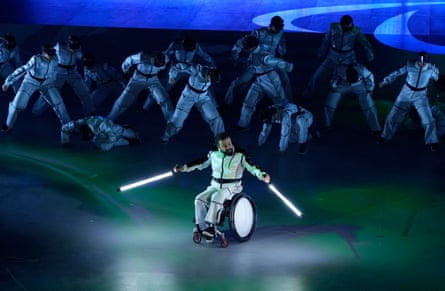
The theme of the closing ceremony of the Winter Paralympics, held at the Olympic curling arena in Cortina D’Ampezzo, was “Italian Souvenir”. It followed, through dance and music, the ambitions of a young girl, played by Sofia Tansella who has spinal muscular atrophy, to see her dreams represented in the world. It was of course a metaphor for the Paralympic movement more broadly, a movement that has been boosted by a successful two weeks in Milano Cortina.
The International Paralympic Committee has been able to boast a number of striking milestones at these Games, on the 50th anniversary of the first. Milano Cortina has had the most countries in competition, 55, and the most to win medals, 27. The number of countries winning gold medals, 18, is the joint-highest in history. Although gender imbalance remains a genuine problem, there were more female competitors than ever before, 160, an 18% increase on four years ago and 26% of the total athlete count of 611, another record.
Just as striking, and of great interest to organisers, has been an apparent boom in audience for the Games. The crowds for the para ice hockey tournament have been the biggest in the history of the sport while the slopes of Cortina have been busy throughout. People in 126 countries were able to watch the games free to air on television, but figures from YouTube have been astronomical. With every event streamed live on the Paralympics channel, there have been some 414m views of video content on the platform, a total 67% higher than the entirety of 2024, which includes the Paris summer Paralympic Games.
This audience growth is surely related to the quality of the actual sport on display. One further striking statistic is that no world records have been broken at these Games. This in part is a reflection of the conditions, which were often suboptimal even when snow did arrive in Cortina on the final day (and brought thick fog with it). But it also speaks to a high level of competition across the piece, with few athletes dominating their field. There were exceptions, however, with the US’s para snowboard star Oksana Masters and cross-country skier Jake Adicoff, alongside the Austrian alpine skier Veronika Aigner, each winning four gold medals.
Aigner’s brother Johannes also won two golds in his back and forth contest with the home nation favourite Giacomo Bertagnolli – who won five medals in five races – in the visually impaired men’s alpine. The president of the IPC, Andrew Parsons, joked that if the Aigners had been a nation they would have finished fifth. “When we let the athletes stop on the field of play, this is when the Paralympic movement shines the brightest. And I think we allow that to happen here,” he said.
Parsons was overseeing his final Games as president, and for the second consecutive winter event he did so during the outbreak of war. The decision by the IPC committee to allow Russia to compete at these Games also created an undoubted tension, not least with the Ukrainian team who clearly felt abandoned by a movement of which they have been a consistent part for three decades. Ukraine boycotted the closing ceremony and a number of other central and eastern European countries stayed away too. Russia, meanwhile, finished third in the medal table and their anthem was heard frequently as they won eight gold medals between their six invited athletes.
Parsons sought to separate the state from the sport as he spoke at the end of competition, but also pushed back against the suggestion that Russian inclusion had created a sense of impunity. “I think sport should be a movement, [where] everyone is welcome, everyone is invited, and no one has to explain or have to pay for the acts of others,” he said. “When we bring politics into that, we [limit our ability to] show a different way of doing things. It’s the way of sport, which is based on values, it’s based on fair play. I think we give a very good example to world leaders. That being said, I also respect different views.”
Asked specifically about Russia’s place in these Games, he asked to check the medal table: “I see the top five is China, USA, Russia, Italy and Austria. Russia is not the only country in this top five to be involved in a war at the moment. That’s my answer.”
Parsons steps down from his role in 2029 and says he hopes to bring new sports into the winter programme, currently limited to six, which sometimes felt too few across the far-flung venues that made up Milano Cortina’s three clusters. Para bobsleigh is one, skating another, but Parsons says a priority must be the introduction of women’s ice hockey, after only one female athlete was included in this year’s mixed team event, Fukunishi Akari of Japan. “We will push really hard,” Parsons said. “One thing is clear. If not in 2030, for sure in 2034.”