2 months ago
58
2 months ago
58
On the outskirts of Cartagena – far from the brightly coloured facades of the old city and the 500-year-old fortress walls overlooking the Caribbean – a crowd of about 300 people erupted into a roar. Given Colombians’ passion for football, it could have been the celebration of a goal.
But the cheers followed the bloody climax of bout in a cockfighting ring whose white padded walls were now splattered with blood.

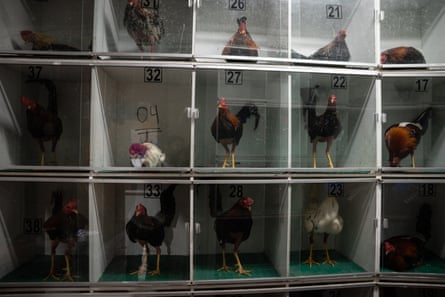
As the mostly male bettors clinked cold drinks from ice buckets and collected their winnings, handlers carried off the body of the defeated bird, while a worker quickly swept up feathers and wiped away blood, preparing the ring for the next of what would be more than 100 fights that evening.
Cockfighting was introduced by Spanish colonisers and is still highly popular in Colombia, but its days are numbered.

It was banned by a constitutional court ruling in September, which nonetheless established a three-year “transition” period, during which the government must provide alternative livelihoods for the tens of thousands of people who rely on the practice.
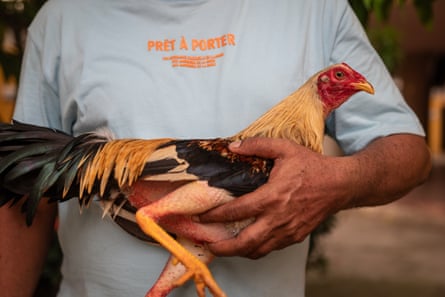
“I was horrified by the court’s ruling,” said Alí Viveros, 38, who breeds about 50 fighting cocks and owns a shop selling specialised supplies for other breeders, known as galleros, such as vitamins, carrying cases and cages.
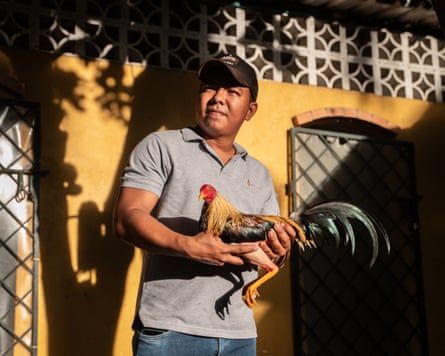
“Cockfighting is a tradition, it’s part of our culture,” he added.
In Gabriel García Márquez’s One Hundred Years of Solitude, an insult exchanged at a cockfight sparks a duel that ultimately leads to the founding of the fictional town of Macondo, where the story unfolds.
“A lot of families depend on it,” said Viveros, adding: “It’s not just the galleros, but people who sell food and drink on fight days, the doormen, the judges, the cleaners, the people who make the cages, and so on.”
The national cockfighting federation, which is still seeking to overturn the ban, estimates that there are nearly 10,000 fighting arenas nationwide and that between 270,000 and 290,000 families depend on the activity.

Animal rights organisations and activists dispute those figures, arguing that the activity’s informality leaves a lack of reliable data – one reason the court also ordered the government to survey to establish exactly how many people are involved.
“We have waged a long and intense struggle against activities labelled as cultural, but that are cruel,” said Andrea Padilla, a senator who is one of the leading figures behind the ban.
“Until recently, child marriage was also considered an acceptable cultural practice in Colombia. [But] the fact that something is deeply rooted in a society does not mean it’s morally valid,” she said.
In the same ruling the court upheld a 2024 ban on bullfights and also prohibited coleo – in which a bull is brought down by its tail – and corralejas, in which amateur matadors, often drunk, taunt bulls in an open ring.
A rightwing senator introduced a bill in January to roll back the ban, including on cockfighting, claiming they were cultural activities and part of the nation’s heritage. The proposal is still at a very early stage in the legislative process.
The central justification for the supreme court bans was that cultural tradition cannot be used as a pretext to legitimise violence, suffering or the deliberate killing of sentient beings.
“And what about the chickens and cattle we kill to eat – aren’t they sentient too?” said Fabián Montes, 60, one of the country’s leading cock breeders, who keeps about 1,000 birds.

Montes, a dentist who said cock breeding was not his primary source of income, said that the animals are not mistreated. They fight only because it is their “natural condition”, he added.
“You can release 10 brothers into the same yard and let them roam freely, and until they are about five and a half months old they can coexist. After that, even if they were raised together, they will inevitably fight and kill each other,” said Montes.
Scientific research has shown that some breeds have developed a predisposition to combat as a result of centuries of human-driven artificial selection. Even so, once a chick is identified as a “fighter”, it begins to be “trained” with exercises such as simulated bouts or a breeder chasing it around a confined space to build aerobic capacity.


“Nobody induces them to fight,” said Montes, adding that ideally the government should “regulate” the practice, rather than ban it.
At a recent cockfight, the Guardian witnessed at least one bout in which, the birds did not attack each other. The judges repeatedly pushed the birds toward one another until, on the third attempt, they began pecking and clawing. One of them died at the end.
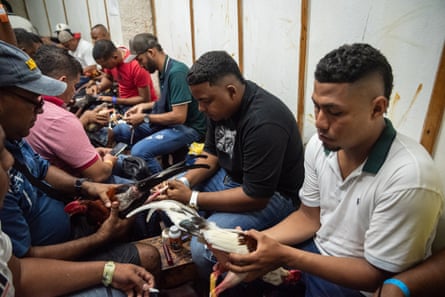
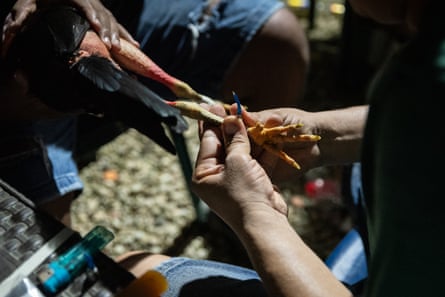
The animals also have their combs and wattles cut, and their leg and chest feathers trimmed. Because natural spurs are not lethal enough, they are filed down and replaced with artificial spurs made of metal, resin or bone, which are then fixed with hot wax and tape.
Breeders claim that fewer than 20% of cocks die during fights, though animal rights advocates such as Senator Padilla say the figure is far higher.
“The objective is always for one to die,” she said.
Despite pushing for the ban, Padilla said the government is still not moving as it should to find alternative livelihoods for the galleros and other cock-adjacent workers, warning that this could create a new problem when the ban takes effect in 2028. The government did not respond to the Guardian’s request for comment.
“I’m absolutely certain that what is coming is rampant clandestinity, because staging a cockfight is very easy – all it takes is a small space where people can gather, place bets and put two cocks to fight,” she said.
“To think that a law can simply erase a cultural practice is absurd. Laws do not perform miracles,” added Padilla.