4 hours ago
4
4 hours ago
4
A baby boy who was found with twine looped and knotted round his neck and wrapped in a 116-year-old newspaper was unlawfully killed, a coroner has concluded.
Crispin Oliver on Thursday said the child, known only as Baby Auckland, had been garotted by an unknown person.
He said it was an “unusual case, legally and evidentially”. The whole story, he added, was “very sad and singular”.
Oliver said: “Clearly, this was a terrible thing that happened to a defenceless infant. It happened in our community. But it happened over a century ago, and it is heartwarming how the public and individuals in this community have stepped up to do the right thing by Baby Auckland.”
The inquest heard that the skeletal remains of the baby had been found during renovations on the second floor of a late 19th-century house in Bishop Auckland, County Durham, on 29 July 2024.
They were found by the house owner, Peter Moody, while he was laying a new floor. In a statement he said he had made the discovery when he lifted up a floorboard. He contacted the county council, unsure of whether he needed to call the police.
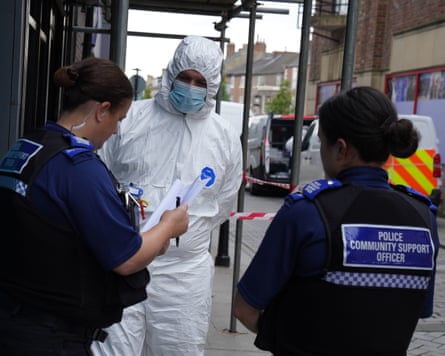
DCI Mel Sutherland told the inquest he had been on duty in Bishop Auckland when he was alerted to the discovery of skeletal remains in a town centre house.
After they were confirmed as human, he supervised the sealing of the house to keep it forensically sterile, while a forensic anthropologist was contacted. That scientist, Dr Micol Zuppello, travelled up that evening and spent two days at the house investigating.
The baby’s skeleton was mostly complete, the inquest in Crook heard, bar a missing toe tip. The remains were partly mummified. Carbon dating could conclusively establish only that the baby died between the 17th century and 1955.
A postmortem of the skeleton was carried out by Zupello and Dr Louise Mulcahy, a Home Office pathologist for north-east England based at the Royal Victoria Infirmary in Newcastle.
Mulcahy said the baby had been 38-40 weeks, with no signs of traumatic injury, and had twine looped around his neck. She said it had been looped around the neck three times, knotted, and then looped again.
It was not possible to say, she added, if it had been tight or loose. The medical cause of death, she said, was “unascertained”.
The skeleton was too old to be able to confirm or refute the presence of natural disease, she said. In the absence of soft tissue it was not possible, the inquest heard, to say if there had been any assault or trauma. Equally, it was not possible to say with any certainty if the baby had been stillborn or not.
Oliver said police had “had to think laterally” during their investigation. He praised Sutherland for “leaving no stone unturned”.
Sutherland described some of the techniques they had used to investigate further, including DNA testing. All were inconclusive.
He said the newspaper was very brown, but articles could be seen. It was called The Umpire and dated June 1910.
Sutherland said that in 1911 census data, the building was described as dining rooms, meaning “a cafe-type establishment”.
A public appeal was made for people who thought they might be related to come forward. Two sisters came forward who believed they were related to a servant at the house, but DNA testing revealed no match.
During the whole investigation, Sutherland said, there had been “very little to go on”.
Oliver asked if the twine might have been used for a religious artefact, but nothing like that had been found, Sutherland said. There was also no evidence to suggest any link to midwifery practices of the time.
A knot specialist could not be used, the inquest heard, because the nearest person was in the Netherlands and would have been too expensive for this type of investigation.
Baby Auckland was laid to rest at Bishop Auckland cemetery in April this year, with professionals involved giving their services for free.
Sutherland said it had been two years of investigating, “challenging and frustrating at times, but heartwarming to see the send-off he got at the end”.