3 hours ago
5
3 hours ago
5
The planet’s atmosphere held more water vapour in August than any other month on record, further increasing the risk of extreme heat and rainfall around the world, according to Europe’s climate change service.
Climate scientists said global heating was a contributor to the record because a warmer atmosphere can hold more water, and the historic El Niño in the Pacific Ocean was also likely pushing water vapour levels up.
According to the Copernicus Climate Change Service (C3S), the amount of water vapour in the atmosphere through August was 27.35 kg per square metre, beating the previous record from July 2024 by 0.04 kg m².
The value describes how much water vapour is in a column of air sitting above a square metre of the Earth’s surface, extending up through the atmosphere.
The 0.04 kg m² increase on the previous record, one climate scientist calculated, was the equivalent of about 20 trillion litres of additional water, or 20 cubes of water, each a kilometre wide, high and deep.
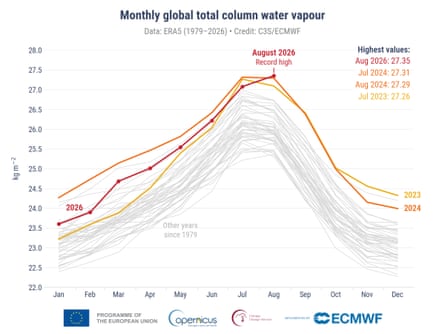
Dr Julien Nicolas, senior scientist at C3S, said water vapour was estimated in its ERA5 dataset by combining humidity measurements from satellites, weather balloons and other sources with a weather model. The water vapour estimates go back to 1979.
August was also the planet’s joint hottest month on the ERA5 dataset going back to 1940, and the hottest according to the US government’s National Oceanic and Atmospheric Administration dataset that starts in 1850.
Nicolas said the water vapour record was “consistent with the record high global temperature in August” and said “warmer air can hold about 7% more water vapour per degree of [global] warming”.
He said the tropical oceans were a major source of the water vapour.
“The exceptionally high sea surface temperatures seen across these regions in August, partly linked to the presence and strengthening of El Niño conditions, increased evaporation and were likely an important contributor to the record-high global water vapour value.”
He said rising water vapour levels could increase the risk of intense rainfall, including from cyclones, and give extra energy to storms “because heat is released when water vapour condenses into cloud droplets, potentially helping to intensify them”.
The current El Niño climate pattern in the tropical Pacific is forecast to be the strongest on record and climate scientists predict it could push global temperatures to record levels next year.
Provisional analysis by Australian scientists has found the expected record peak ocean temperatures in the Pacific that are a marker of the El Niño were being made six times more likely because of global heating.
Dr Andrew Dessler, a climate scientist at Texas A&M University, wrote that it was “unimaginable that any month in the last few thousand years, maybe 100,000 years” had had more water vapour in the atmosphere than August.
“We are, as the proverb says, living in interesting times,” he wrote.
Prof Steven Sherwood, of the University of New South Wales Climate Change Research Centre, said while an extra 0.04 kg m² of water vapour across the planet “does not sound like a lot … when this rise is continuous, it starts to have effects.
“A lot of the impacts of climate change actually happen because of water vapour.
“When you move this water vapour to higher latitudes, it puts heat into the air, and so a lot of extreme heat that’s experienced there is indirectly from the water vapour.
“We know high humidity has effects during heatwaves as it stops night-time cooling, so it gets harder for people to recover from very hot days.”
Prof Jason Evans, also of the UNSW climate centre, calculated the water vapour record had exceeded the previous record by the equivalent of about 20 trillion litres, or about 41 Sydney Harbours’ worth of water.
Dr Kimberley Reid, a climate scientist at the University of Melbourne specialising in water vapour research, said “given August was the hottest month for at least 170 years – this record isn’t too shocking”.
“Temperature and water vapour are closely linked,” she said. “Like the temperatures, we are getting these records because of the emissions from burning fossil fuels and from the El Niño.
“Water vapour is also part of the climate feedback loop – water vapour is a greenhouse gas and so the atmosphere will warm even further, and then take up even more water vapour. The root cause is the extra CO2 and methane.”