3 months ago
62
3 months ago
62
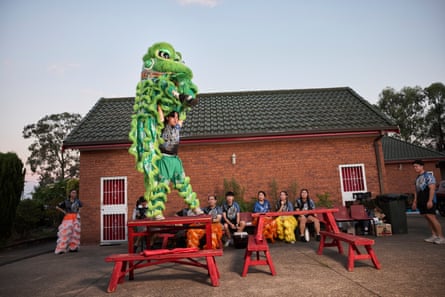
Drums and cymbals echo across Mingyue Lay temple’s sun-baked concrete car park. Lion heads made out of papier-mache are dotted around the lot and pairs of kids are jumping on to poles, tables or each other’s shoulders – all while connected at the hip.
It’s a sticky night in Sydney’s west, but the 33C heat doesn’t faze these lion dancers, who are gearing up for their busiest period: lunar new year. The festivities continue well past the day itself, with more than 100 performances across three weeks. On the eve of lunar new year, the studio will start their performance at the temple in Bonnyrigg at 9pm and finish well past midnight.
Lunar new year is not only a big deal for the studio but for the city – Sydney has one of the largest lunar new year celebrations in the southern hemisphere. It is also the year of the fire horse, a rare pairing that happens once every 60 years.
“Rain, hail or shine, we still train,” says Long Huynh, who has been a lion dancer with the Qing Fong Dragon and Lion dance team for six years.
-
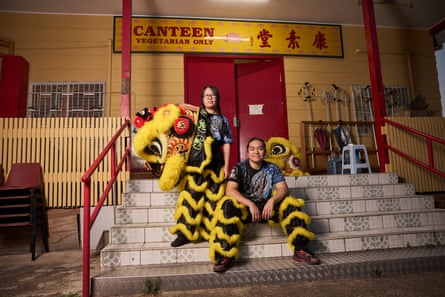
Above: Team instructor Jenny Cao and Long Huynh outside the hall
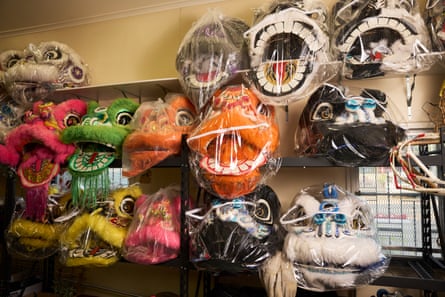
Below: Costumes wait to be put on for dance rehearsals
The newer cohort of students are afforded some relief from the heat, training inside a small air-conditioned hall. Kelvin Tran, a co-founder of Qing Fong and team leader, yells directions over the thumping drum as the younger dancers move their bodies sharply to the rhythm.
Tran’s teaching approach? “I tell my kids to be the lion and to feel the lion through themselves.” This is coupled with intensive training. At Qing Fong, they train at least twice a week for three hours at a time. These sessions begin with conditioning: running laps around the car park, dynamic stretching and circuit exercises.
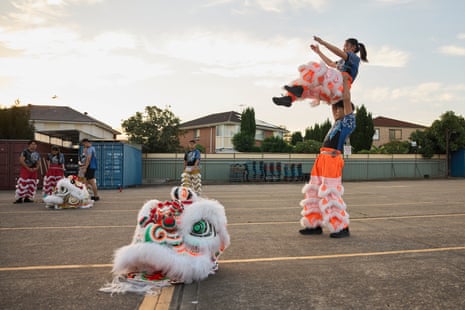
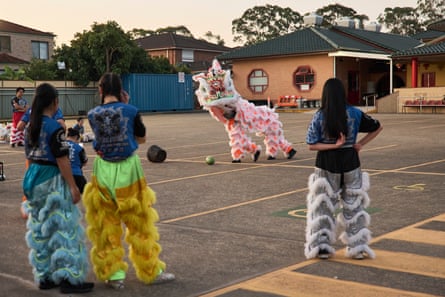
After their warmup, the students split off into groups to practise their routines. Each group comprises six people: four playing drums and cymbals and a pair of lion dancers, in full costume, where one person controls the head and the second controls the tail.
-
Above: The Chinese lion dancers spread out during their acrobatic routine
Below: The troupe’s dressing room filled with costumes
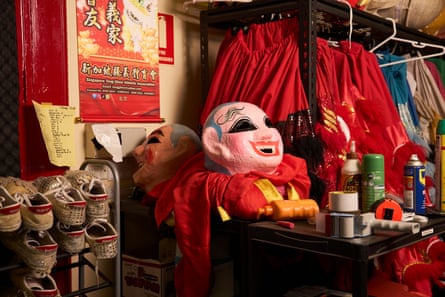
Although the head gets more time in the spotlight, the tail feels the love too. The tails of the group tell me they get “lots of pats on the bum” from audience members. Team instructor Adelene Pham believes “people just see the lion, they don’t see the two people underneath”.
There are a lot of moving parts: dancers need to move the head of the lion and their feet correspondingly, while creating the lion’s facial expressions by opening and closing its jaw and raising its ears using strings inside the head. This is all done in time to the music.
The tail follows the head’s lead, so “if a head has a happy interaction with a crowd member, we tails wag our tails”, Huynh says. Once the costume comes on, “you can’t see what’s around you”. Inside the lion costume, the head and tail have poor vision. The only gap in the lion’s head is the mouth, and the tail is almost always in a squat with their chest facing the floor – unless they’re about to do a shoulder lift. Each dancer needs to know how their other half will move and it is this relationship between partners which brings lions to life.
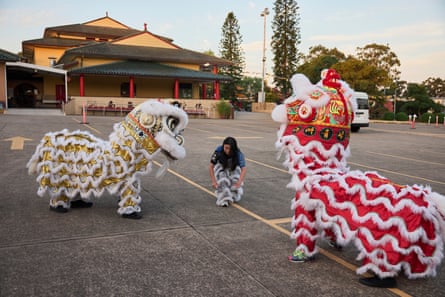
-
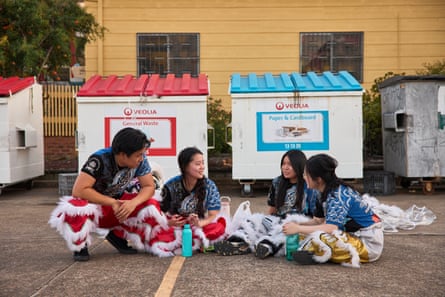
Dancers take a break from the energetic dancing in hot costumes
Tran agrees: “You have to trust each other and you have to rely on each other in order for a performance to actually work out well.”
Perhaps this is why most students in the troupe say their favourite part about dancing is the “family” they have found. Qing Fong has the demographics to match – the youngest member is 12 and the oldest is 40. “You watch each other grow up,” Tran says.
Music is integral to lion dancing too – students are taught to play phrases which correspond to specific movements. According to one student, the music and lion “are synergised”. Nicky Phan, who has been a lion dancer for seven years, says the music represents the “heartbeat of the lion”.
Culturally significant to Chinese communities around the world, lion dance performances are thought to ward off evil spirits, bringing prosperity and good luck for the coming year. Tran says that lion dancing has brought many of his students closer to their heritage.
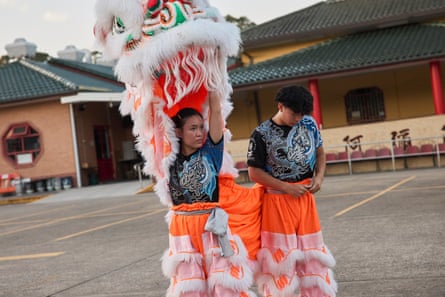
-
Dance team instructor Adelene Pham and Dylan Kha practise their dance routine which culminates in Adelene chopping a watermelon in half with her bare hands
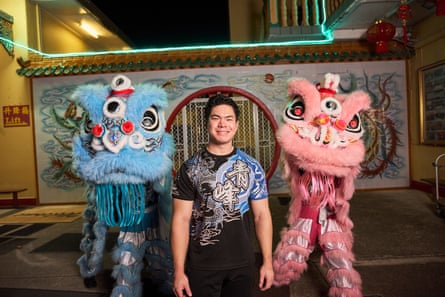
-
Kelvin Tran, co-founder and team leader of Qing Fong Dragon and Lion Dance team
Before Nicky Phan became a lion dancer she describes her relationship to her Vietnamese-Chinese ethnicity as “broken”. But learning the history and significance of lion dancing made her appreciate her family’s history. “Being a lion … brings back something that you feel like you’ve lost for a very long time.”
Though lunar new year is the peak season for the troupe, training continues well after all the red packets have been distributed. The moon festival in September is another busy month, but they also have one or two performances every week for weddings or business openings.
A lot can go wrong in a performance, Tran says. A dancer may miss a move or drop their partner. But after those 12-hour days during lunar new year, the only constant is eating dinner together. “Whether it’s a small performance or a big performance, we always make sure we feed each other,” Pham says.
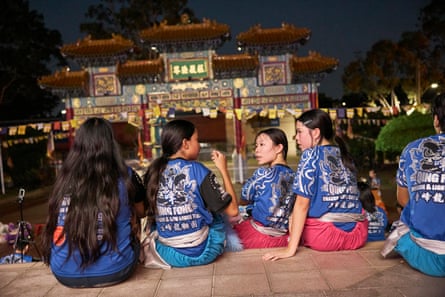
-
Young dancers watch final dance rehearsals outside the temple
Their training session ends with all 30 dancers squeezed into the hall. A box of doughnuts makes its way around the room and there is a frenetic, optimistic energy. For some, this was their first full dress rehearsal before the big lunar new year showcase.
“It has just become a really big part of my life, and a very good part of my life,” Pham says.