2 months ago
54
2 months ago
54
Bulgaria is preparing to adopt the euro in January amid fresh domestic political turbulence and fears that Russia-aligned disinformation is deepening distrust of the new currency.
The Balkan country of 6.5 million people will become the 21st country to join the eurozone on 1 January, as policymakers in Brussels and Sofia hope it will boost the economy of the EU’s poorest nation and cement its pro-western trajectory.
Ursula von der Leyen, the president of the European Commission, has said that “thanks to the euro”, Bulgaria will have more trade, more investment and more “quality jobs and real incomes”.
On a recent visit to Sofia, the economy commissioner, Valdis Dombrovskis said the move was key at a time of Russia’s war with Ukraine, rising geopolitical tensions and global economic uncertainty that “underline the importance of European unity”.
“Most European countries – including Bulgaria – are far too small to shape today’s world on their own. They only stand to gain necessary weight by fully integrating into the European Union’s larger political and economic structures,” he said.
Despite the touted benefits, however, Bulgarians are far from united. A recent survey by the ministry of finance showed that, while 51% of citizens were in favour of joining the single currency, 45% were against it.
A fight broke out in the parliament in June when the euro entry was approved by the European commission, with MPs from the far-right, pro-Russian Revival party blocking the podium.
Petar Ganev, a senior research fellow at the institute of market economics, a thinktank based in Sofia, said the division on the euro was symptomatic of broader political tension.
“This is not surprising. The country is divided on almost everything that you can imagine,” said Ganev. “And after the political instability, we ended up in a very hostile political environment.”
A four-year political crisis marked by seven parliamentary elections and widespread corruption have eroded trust in the government and contributed to the polarised political climate. Last week, the government of the former prime minister Rosen Zhelyazkov resigned after less than a year in office after weeks of mass anti-corruption protests across the country.
Although the political drama is unlikely to hamper the adoption of the euro, many fear prices will spike during the transition and, with an average monthly salary of about £1,100, this is not something many Bulgarians could afford.
Communities in rural areas and elderly are expected to be most vulnerable to inflation and are the most fearful of the transition, even though Brussels has said there is no evidence to suggest inflation will rise.
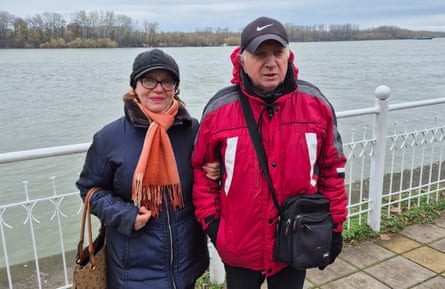
Walking along the Danube, Nencho and Maya Neshev, 67-year-old pensioners from Vidin, a city in north-western Bulgaria, said they were worried about potential inflation and the impact on the family budget.
“The uncertainty is evident and I have concerns because I am retired,” said Maya. “Should I stock up? Does it make sense? How will it happen in January? Is it better to save [old currency] leva during the whole month of January? To continue in leva, and then in February go to the euro? There is a lot of uncertainty.”
Elena Vasileva, 26, an engineer in the food industry from Hisarya, a small town 70 miles east of Sofia, fears that by abandoning the lev, first introduced in 1881, Bulgaria will be losing some of its identity.

“We have some of the brightest people of our country on our money,” she said. “It’s like losing your identity. It’s a pity.”
Victor Papazov, a macro economist and adviser to the anti-EU Revival party that has campaigned against euro membership and is close to Vladimir Putin’s United Russia, claimed Bulgaria was heading for a Greek-style crisis.
“Any person in their right mind would oppose adopting the euro.” said Papazov, in a lengthy written statement. He added: “Joining now will make things worse and faster. In my opinion there is not a single serious positive in adopting the euro.”
The leader of Revival, Kostadin Kostadinov, faced criticism earlier this year when he made the unfounded claim that Bulgarians would lose their savings after joining the euro due to a different exchange rate.
Investigative reports, meanwhile, have found that a network of Russian-linked social media campaigns sought to undermine support for the euro by spreading disinformation.
Asked about alleged Russian influence on public opinion about the euro, Dombrovskis said it was “no secret” Russia was waging a hybrid war against Europe. “It is provocation, acts of sabotage, violation of European airspace, meddling in political processes in the European Union, also in other countries, and it is spreading disinformation,” he said.
Despite the protests and fears about joining, many remain positive. Maria Valentinova, 35, a pharmacist from Sofia, said the euro “will be good for the economy of the country in the long run”. She was glad her six-year-old son would grow up in a country belonging to the eurozone.
Until 31 January, Bulgarians will be able to pay in lev and euro, with only payments in euro being accepted afterwards. Valentinova said she had concerns about this transitional period, describing it as “a bit stressful”, but added: “I think it will be a good thing in the end.”
Ganev said he believed the transition would be smooth and after a few weeks Bulgarians would get used to the new currency. “What will happen to our country and if we are going to be a good example in the eurozone or a bad example … depends entirely on us,” he said.