3 months ago
67
3 months ago
67
Standing inside the temple armed with buckets of rice, the villagers gaze out at police officers armed with riot shields and sticks, the sound of shouting audible over banging drums.
Then the tension erupts. A scuffle breaks out, some villagers throw handfuls of rice at the officers, a traditional custom for dispelling evil, while others hoist religious artefacts onto their shoulders and march away, past groups of police and other officials.
The showdown happened last month, apparently caused by the planned demolition of a small local temple in a village in Lingao county in Hainan, a tropical island province in south China. Underneath a video of the incident posted on Douyin, a video-sharing platform, one commenter wrote: “Oh, even their spiritual solace is gone. In such a vast world, can’t a single temple be spared?”
The protest in itself appears minor, but these scenes of anger are being repeated in one form or another across rural China, and the number of them is soaring. By the end of November this year, China Dissent Monitor, a protest-tracking project run by Freedom House, recorded 661 rural protests in China, a 70% increase on the whole of 2024.
The startling rise in unrest reflects the increasing pressures in China’s economy, particularly on low-paid workers. For decades, people have flocked from China’s countryside to booming cities to chase dreams, opportunities and incomes that could transform their lives and those of their families back home.
But as China’s development enters a new era of slower growth and the country battles “involution” – a downward spiral in the economy that means people have to work longer hours for less pay – many of those internal migrants are giving up on their big city dreams.
The life that then awaits them back in their home towns and villages is often at odds with the promises of prosperity that have secured the Chinese Communist party’s legitimacy since the 1990s.
“When these rural people return, they bring back urban expectations, political awareness, and frustration,” says Chih-Jou Jay Chen, a professor of sociology at Academia Sinica in Taipei. “Many returnees are young; they are not content to retire; they are frustrated by the lack of economic opportunity and are more prone to volatile outbursts,” Chen says, adding that returnees often settle in smaller towns rather than their original home villages.
Debt, land and broken dreams
The Hainan protest was about trying to save a local Taoist temple that was ultimately demolished. But very often the protests are about land.
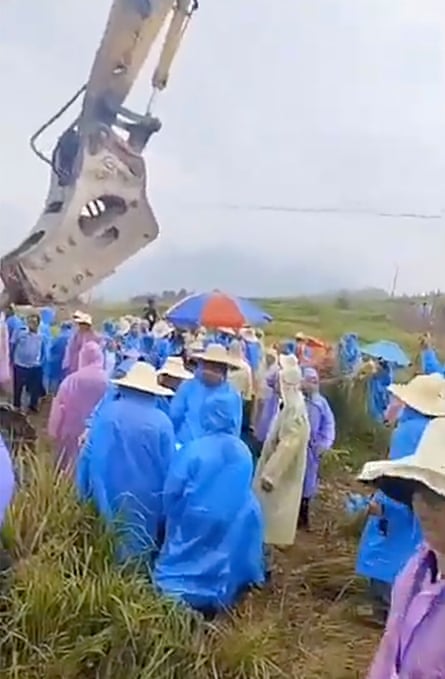
In a video from a village in Hunan province, a protest in September shows dozens of villagers crowding around uniformed officers. Two women are kowtowing, a traditional gesture performed by those seeking justice.
The dispute appears to have arisen from the local authorities seizing farmland in Tongxing village, a mountainous community in south China’s Hunan province, known for its crops of bayberries, a small, prickly, red fruit. A person who uploaded a video of the protest to Douyin, a video-sharing app, accused the local government of hiring “more than 200 thugs to violently assault the villagers”.
“In this [sluggish] economy, they are seizing farmland, sparing no way for villagers to live,” wrote one commenter on Douyin.
The video could not be independently verified, although several videos collected by China Dissent Monitor appear to corroborate the reports. A report published by Chinese media earlier in the summer detailed an ongoing dispute between villagers and a limestone mining company to repurpose their land for a quarry. Several villagers signed a petition opposing the quarry, citing environmental concerns and the impact on their homes. The company could not be reached for comment.
Lingao county in Hainan and Xinhua county in Hunan, where Tongxing village is, were both contacted for comment.
In China’s cities, all land is owned by the state, but in the countryside, land is owned by a rural collective.
However, the state has the power to requisition farmland for commercial development – a right that cash-strapped local authorities often exercise without giving villagers a level of compensation that they feel is fair. Small local protests represent frustration with a system where there is little accountability and few avenues for appeals.
In November, protests erupted in Guizhou province over a directive that deceased people should be cremated rather than buried. After several days of intense clashes, a video emerged of villagers appearing to overpower local officials, forcing them to kneel. The video was posted online by Yesterday, a website run by overseas Chinese dissidents that tracks unrest in China. It could not be independently verified.
There is no evidence that the protests are linked to each other, or are the result of social contagion between different places. Mostly they are a response to a local issue, and are normally quickly brought under control by the authorities, who prize social stability above all else.
But the rapid increase in protests comes at a time of nationwide malaise about the sluggish economy, which may fuel discontent across different locations.
‘No jobs … no land … no place to go’
The pressure comes from two directions.
Firstly, struggling local governments, which collectively are estimated to be saddled with at least 44tn yuan ($6.2tn) of debt, need money for public services and to pay salaries. This incentivises local officials to seize land. Even though the property sector has plummeted the seized land can still be used as collateral to get new loans – despite their eye-watering levels of existing debt.
Meanwhile, many ordinary people feel their livelihoods are under pressure as China’s economic growth remains sluggish by recent standards.
“Many local governments have persistent and significant debt problems, made worse by the economic slowdown. This could lead to a greater need to confiscate and [develop] rural land to generate revenue, resulting in more conflict with residents in these areas,” says Kevin Slaten, research lead for China Dissent Monitor.
“At the same time, people from these areas may be dealing with other consequences of the slowing economy, such as unemployment or difficulty in their small businesses. This generates greater discontent with the state of things, which could make people more willing to engage in public dissent.”
“Land seizures continue to be a major issue because the country is rapidly urbanising,” says Rachel Murphy, a professor of Chinese development and society at the University of Oxford. “Meanwhile, local government coffers continue to rely in large part on converting land use from agricultural to non-farm uses”.
Secondly, another trend that has the potential to foment dissatisfaction in China’s rolling countryside is the return of migrant workers from China’s cities. While there is no official data on this trend, anecdotes abound. Hengyang county in south China’s Hunan province saw around 183,000 workers return home for this year’s Spring Festival, with more than 40,000 of them staying there, according to one recently published paper.
The failure of those people to return to work reflects “the deep-seated contradictions in the current employment situation of migrant workers”, wrote researchers from Hunan Normal University.
Some in China talk of the “three no’s” to describe the situation of rural migrant workers: no jobs to find, no land to cultivate, no place to go”
Building an accurate view of the situation is difficult, because official statistics do not tell the whole picture. Evidence is generally scrubbed from social media, and there is scant independent local reporting inside China, making unrest difficult to track.
Still, some of the rural protest videos have remained online, and there is a community of overseas monitors who work to collect evidence outside China’s internet firewall.
‘Rural contention is becoming harder to handle’
Experts are divided about whether or not the rise in protests represents a serious threat to the Communist party’s grip on power. This year, the government has started rolling out new service centres in rural areas staffed with social workers, legal advisers and even psychological counsellors to mediate disputes before they escalate. There were 2,800 such centres at a county level as of September, according to a government announcement.
“The considerable resources being invested … suggest that the central leaders are taking note of increasing expressions of social unrest,” says Murphy.
Villagers tend to focus their complaints on bad apples in the local government rather than central authorities. But Chen believes the trend is clear: “Rural contention is becoming harder to handle.
“These protests may not threaten the central government directly, but they can overwhelm county and township officials, pile up across regions, and put real pressure on the system,” he says.
Additional research by Lillian Yang