3 months ago
63
3 months ago
63
Introduction
Good morning from Davos, where the final day of the World Economic Forum is underway.
After a week dominated by issues such as the world order, geopolitical tensions, tariffs and artificial intelligence, the health of the global economy will be in focus today.
ECB president Christine Lagarde, IMF head Kristalina Georgieva and WTO director-general Ngozi Okonjo-Iweala will give their views on the Global Economic Outlook.
It’s an outlook that has darkened this week, with warnings from the leaders of Germany and Canada about the rise of great powers, and anxiety over whether AI will create an unemployment crisis.
Speaking here earlier this week, Lagarde warned that President Trump’s escalating threats have undermined trust.
She told CNN, before Trump TACO’d out and dropped his latest tariff threat:
“I think the trust is undermined. When you keep repeating the same pattern of undermining the rule of law, undermining the contracts, undermining what has been agreed between parties, then parties begin questioning, is that for real? Is that going to change again? And that’s when uncertainty looms large.”
She also warned Europe needs to look at its economic strength, and weaknesses., just in case the normal relationship is not restored.
S&P Global Ratings’ global chief economist, Paul Gruenwald, reports that talk about tariffs, and macro-economics has been less prevalent in Davos this year.
“I put this down to the fact that 2025 turned out to be a decent year for the global economy. Part of this was tariff climbdowns combined with resilient consumer spending and labor markets.
And part of this was the offsetting demand from the Al and data center investment boom and its spillovers through the trade channel.”
Actually, it’s more of a half-day, with events due to wrap up by lunchtime. And it feels like many delegates have already fled Davos, perhaps to fight or inflame (YMMV) the world’s problems.
The agenda
-
8.45am Davos / 7.45am GMT: Session on Next Generation Social Movements
-
9am Davos / 8.45am GMT: Session on Geopolitical Risks Outlook for 2026
-
10.15am Davos / 9.15am GMT: Session on the Meaning of Politics
-
11am Davos / 10am GMT: Session on the Global Economic Outlook
Key events Show key events only Please turn on JavaScript to use this feature
Attempts to resolve Donald Trump’s fixation on Greenland has distracted Europe from the urgent task of pushing Russia back in Ukraine, Jane Harman adds.
Davos is now hearing about the geopolitical risks of the year ahead.
Jane Harman, chair of the bipartisan US Commission on the National Defense Strategy, warns that America is leaving a “huge vacuum” around the world, which China is moving into.
She cites the risk of a future unipolar world, made up of command economies controlled by China.
Harman, a former congresswoman, also warns that Congress is not “pulling its weight” within its role of controlling spending and setting budgets.
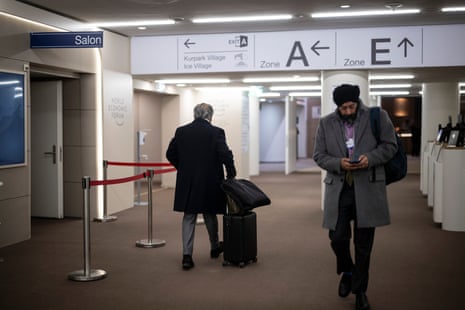
One of the many news stories out of Davos this week was the ‘framework of a future deal’ announced by Donald Trump over Greenland, after meeting Nato chief Mark Rutte on Wednesday.
But it’s still not clear what was hammered out.
French foreign minister Jean-Noel Barrot has told BFM TV this morning that France has no details at this stage on a deal reached Rutte and Trump.
Gold: next stop $5,000?
The precious metals market is giving its own verdict on the stability of the global economy.
Gold has hit yet another record high today, at $4,967 an ounce, pushed up by geopolitical risks, concerns about the independence of America’s central bank, and anxiety that high debt levels may lead to currency debasement.
Kathleen Brooks, research director at XTB, explains:
The weak dollar is helping to push gold to a fresh record high. The gold price is higher by more than 7% this week and is up $20 so far on Friday. There is no stopping the gold price right now, as the $5,000 per ounce level beckons.
Investors may be willing to buy stocks in this environment, but geopolitical risk and an unconventional US President is keeping demand for the yellow metal alive as we move through January.
Introduction
Good morning from Davos, where the final day of the World Economic Forum is underway.
After a week dominated by issues such as the world order, geopolitical tensions, tariffs and artificial intelligence, the health of the global economy will be in focus today.
ECB president Christine Lagarde, IMF head Kristalina Georgieva and WTO director-general Ngozi Okonjo-Iweala will give their views on the Global Economic Outlook.
It’s an outlook that has darkened this week, with warnings from the leaders of Germany and Canada about the rise of great powers, and anxiety over whether AI will create an unemployment crisis.
Speaking here earlier this week, Lagarde warned that President Trump’s escalating threats have undermined trust.
She told CNN, before Trump TACO’d out and dropped his latest tariff threat:
“I think the trust is undermined. When you keep repeating the same pattern of undermining the rule of law, undermining the contracts, undermining what has been agreed between parties, then parties begin questioning, is that for real? Is that going to change again? And that’s when uncertainty looms large.”
She also warned Europe needs to look at its economic strength, and weaknesses., just in case the normal relationship is not restored.
S&P Global Ratings’ global chief economist, Paul Gruenwald, reports that talk about tariffs, and macro-economics has been less prevalent in Davos this year.
“I put this down to the fact that 2025 turned out to be a decent year for the global economy. Part of this was tariff climbdowns combined with resilient consumer spending and labor markets.
And part of this was the offsetting demand from the Al and data center investment boom and its spillovers through the trade channel.”
Actually, it’s more of a half-day, with events due to wrap up by lunchtime. And it feels like many delegates have already fled Davos, perhaps to fight or inflame (YMMV) the world’s problems.
The agenda
-
8.45am Davos / 7.45am GMT: Session on Next Generation Social Movements
-
9am Davos / 8.45am GMT: Session on Geopolitical Risks Outlook for 2026
-
10.15am Davos / 9.15am GMT: Session on the Meaning of Politics
-
11am Davos / 10am GMT: Session on the Global Economic Outlook