7 hours ago
21
7 hours ago
21
From 2017 onwards, Rehan Ahmed styled himself as a savvy business owner. But behind the facade of a successful entrepreneur lurked one stark fact: his empire was built on fakery.
On Friday, the man behind the biggest-ever UK case of producing fraudulent vinyl, who sold counterfeit copies of records by some of the world’s biggest artists including Taylor Swift, Coldplay and Kendrick Lamar, was jailed.
Ahmed, a 40-year-old father of three from Southall, west London, pleaded guilty to two charges of breach of artists’ copyright, and acquiring and using criminal property. On the first count, Judge Darren Reed sentenced him to two years and eight months in prison, while the more serious second charge led to a custodial penalty of three and a half years. The sentences will be served concurrently, meaning that the second will dictate the time Ahmed spends in prison.
In a sentencing hearing at Inner London crown court on Friday, the judge highlighted the “sophisticated and planned nature of the enterprise”, and the fact that Ahmed had caused “wider harm to the music industry”.
Operating under the company names Phoenix of Vinyl and Paragon Music, Ahmed produced counterfeit vinyl albums that he supplied to record shops or sold directly to consumers through online platforms such as Discogs and eBay. In 2025, eBay removed about 7.9m potentially counterfeit or prohibited items from the platform.
A spokesperson said: “Counterfeits are strictly prohibited on eBay. Where listings violate eBay policies, we act swiftly to remove them and may take action against the seller’s account.” Discogs did not respond to a request for comment.
Phoenix of Vinyl was no minor operation. When police raided Ahmed’s factory, they found 15,000 records. His previous business endeavours, around which there is no suggestion of criminality, had focused on takeaway food and bodybuilding supplements. But the booming vinyl industry appears to have lured him into the illicit market.
In 2025, UK vinyl sales increased by 13.3% to 7.6m units, maintaining 18 years of constant growth. Led by Swift’s 2025 release of The Life of a Showgirl, the total retail value of vinyl in the US that year reached over $1bn for the first time in four decades.
Rising prices of records inevitably followed this increased demand: some high-profile albums, particularly in “limited edition” versions, are now regularly priced at about £40.
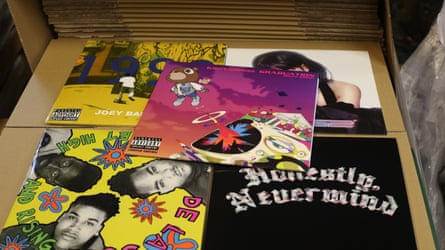
While “bootlegs” of rare and unreleased material have long been part of the music landscape – originally on vinyl and now largely eclipsed by the internet – Ahmed was part of a growing underground industry making counterfeit copies of officially released albums. Over the last two years, the music business umbrella organisation the British Phonographic Industry (BPI) says it has been involved in the execution of 43 search warrants centred on illegal counterfeit vinyl and CDs, and seized about 600,000 items estimated to have a street value of up to £8m.
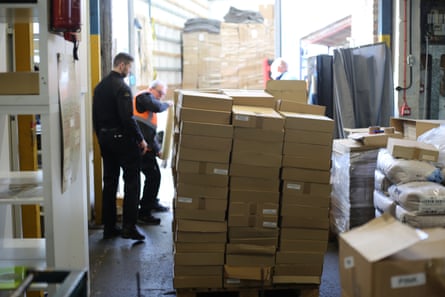
The fakes can be easily spotted when it comes to particular artists. The American star Frank Ocean, for example, digitally released his Grammy-winning debut Channel Orange in 2012, but only put out a vinyl edition in 2025, leaving a huge gap for the counterfeiters to fill. In my experience reporting on counterfeit vinyl, Ocean’s work is ubiquitous in impounded batches and the stash found at Ahmed’s HQ was no exception.
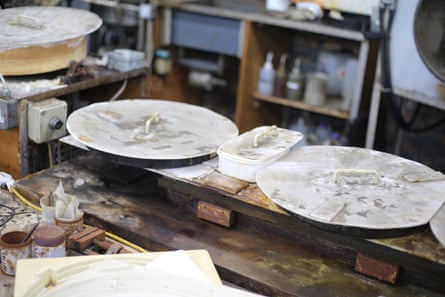
Ahmed employed “three or four” people at his factory, which operated exclusively at night. When officers from the Police Intellectual Property Crime Unit (Pipcu), a national taskforce based within the City of London force, raided the premises, they found a squalid mess, with chemicals stored in fridges next to cans of lager. Machinery, some of which was believed to be at least 70 years old, and stock were haphazardly arranged over three floors, suggesting little quality control. Receipts and order documents were found randomly scattered around.
In footage of the raid viewed by the Guardian, a framed silver disc apparently presented to Ahmed by “the God of Vinyl” is visible. A representative from the BPI can be heard expressing surprise at the absence of a cutting lathe, the very expensive piece of machinery that commences record manufacturing by producing the “master” disc, from which everything else is copied, which indicated Ahmed’s “masters” were existing records.
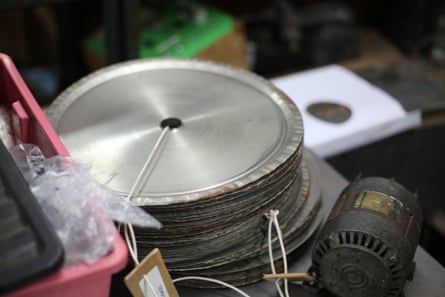
Amid the chaos, officers, assisted by vinyl experts from the BPI, found albums with a street value of about £1m alongside production equipment that is considered a relative rarity among illegal British record specialists, who tend to outsource manufacturing. The only things Ahmed did not produce himself were labels and sleeves, which he had printed by a factory in Gravesend, Kent.
I was led to Ahmed while reporting on what appeared to be a sprawling counterfeit vinyl trade across the UK. In summer 2024, I was writing a feature about the case of Richard Hutter, a Hampshire-based rogue trader who avoided a spell in prison, despite having been found to have made £1.2m from selling illicit records by artists including Amy Winehouse and the US metal band Tool under the company name Vinyl Groove UK.
While researching his case, I was told about a Midlands-based inquiry called Operation Typhoon, which had come to life with the seizure of 529 counterfeit vinyl records from a shop in Stoke-on-Trent.
Then there was an enticing new development. The Stoke discovery was followed by a new police inquiry called Operation Imatra, which had started with forced entry into “a three-storey industrial unit in west London”.
after newsletter promotion
Ten days before Ahmed was sentenced, I met DC Daryl Fryatt, who led the investigation. A relative newcomer to the byzantine world of vinyl, he was clearly fascinated by his new line of work. Midway through the investigation, he bought his first turntable, which he used to indulge his love of modern country music.
Phoenix of Vinyl, he explained, had already been issued with a legal cease and desist order in 2017, but blithely carried on its activities for another seven years – something Fryatt put down to the fact that systems designed to detect counterfeits were new, allowing Ahmed’s records to slip through the net.
By the time raids took place on Ahmed’s business and family home – a pebble-dashed semi in nearby Southall – at 6am on 20 February 2024, Fryatt and his team still hadn’t grasped the scale of his operation. “Then we searched the premises and we seized a huge amount of records. We found all the production equipment there. And clearly, the factory did the whole lot: made the vinyl, distributed it. Everything,” Fryatt said.
Police and BPI experts faced an arduous task before they were able to bring charges. They needed to contact 108 record labels or artists’ legal representatives to formally confirm that copyright had been breached.
It took until 5 February this year for Ahmed, along with his brother and sister, to be charged with copyright infringement and acquiring, using or possessing criminal property. At a hearing a month later at Westminster magistrates’ court, Ahmed’s siblings pleaded not guilty and the charges against them were later dropped.
When Ahmed was first interviewed under caution by the police in May 2024, he painted an illusory picture of his operation, identifying a number of supposed business partners and presenting the police with packs of their supposed ID documents.
“One of them didn’t exist,” said Fryatt. “One was a heroin addict who struggled with life and the other one was a guy in America that may or may not have been involved, but there were no records on any phone to show he was. So we discredited his account, basically.”
In a second police interview, Fryatt recalled that Ahmed “decided to give us another version: ‘Forget all that: it’s my business, I’m the mastermind behind it all and I’ll take the punishment.’”
Between the first and second interview, Fryatt said, “his demeanour was completely different: he started out confident and cocky, but in interview two he was kind of crushed.” He said he would now plead guilty.
Fryatt believes Ahmed’s motivation for his crime was simple: “Money, getting rich quick … There was no kind of siphoning it off and investing it. It was all just spent.”
Peter Ratcliffe, the BPI’s new director of content protection, appointed nine months after Ahmed’s operation was raided, said there were “absolute shockers” among the seized stock. “They were warped: there were bumps in them. The sound was dreadful. The printing quality was awful.”
The ex-Pipcu officer, himself a vinyl enthusiast – the last album he bought was The Cure’s Songs of a Lost World – is ambivalent about the soaring cost of records, viewing his role as more about protecting quality and ensuring money made from counterfeit records isn’t used to fund other serious crime.
On 22 April, thanks to information provided by BPI vinyl specialists who were present at the subsequent raid, officers from Pipcu forced their way into a warehouse in Luton, where they found counterfeit albums estimated to be worth £260,000, by artists including The Beatles, Queen and David Bowie.
Ratcliffe said that at least 10 other counterfeit vinyl investigations are also taking place. “We’re going to find more,” he said, “and I think we’re going to have bigger finds as well. Just the industrial scale now and the increased popularity of vinyl … It’s all going to lead to very big seizures.”