4 hours ago
22
4 hours ago
22
As mayor of New York City, Zohran Mamdani has frequently demonstrated impressive media savvy, but arguably nothing has proved his genius for in-the-know promo more than a video, released in April, with the documentarian John Wilson.
The spot, in support of the mayor’s plan to reduce the presence of the city’s ubiquitous sidewalk sheds, suggested that either he or someone on his team was a fan of How To With John Wilson, the film-maker’s cult-beloved HBO series that remains a taste signifier for alt-humorous New Yorkers. And for good reason: over three near-perfect seasons, Wilson, armed with his ever-present camera and diffident, memoiristic narration, explored the city’s disintegrating streets with a singular eye for the weird and unintentionally hilarious, turning the most mundane of NYC preoccupations – public restrooms, parking spots, scaffolding – into profound meditations on the glories, indignities and absurdities of modern life.
It was because of that scaffolding episode, released in October 2020, that I, like some smart Mamdani staffers, began to perceive the sidewalk shed shadowing my block not as an inevitable fixed entity but an obtrusive, if well-intentioned, symptom of neglect. Shortly after the mayor’s video, said scaffolding miraculously came down – revealing, to my shock, a three square-wide swath of concrete that had not seen the sun in six years.
When I credit Wilson for this upgrade, in person at a film office in Manhattan, he reacts with a modest “I’ll take it,” as dry as the dusty footprints of the recently departed metal poles. Fitting, for though that newly revealed concrete, speckled with old gum and anonymous residue, is certainly better, if not exactly beautiful, perhaps only Wilson could see it as cinematic. His debut feature film, The History of Concrete, takes on the granddaddy of all urban materials, tugging wry insights on our terminal human condition out of the crumbling facades of New York’s most pervasive substance.
Concrete is many things: a mixture of cement, water, sand and crushed stone; arguably ancient Rome’s greatest invention; the second-most used substance on earth, behind water; the foundation of buildings and bridges and “everything I’ve done before” Wilson says, a “Marvel supervillain origin story” to How To’s many bricolages of unfortunately named streets (“Titman Road”) and sidewalk characters. But it is not what one might call a marketable idea. The general response on pitch calls was crickets – “an absolute emotional flatline,” Wilson tells me during a break from signing film posters featuring a single giant cinderblock.
It didn’t help that Wilson, languishing in a post-How To malaise and without the structure of an HBO contract nor writer’s room, didn’t have much of an idea what it would be about, beyond realizing, through a poor DIY attempt to fix the cracked foundation of his Queens apartment, how strange it is to know so little about the dominant element of your visual environment. Wilson initially tried pitching it as an environmental doc, a new riff on the enshittification of American infrastructure. The response was, roughly, “I don’t want to think about this,” he laughs. “And it’s hard to say that I don’t want to make that movie I just told you about either. I want to try, and then experiment and get lost along the way as I usually do.” A strike-era Writer’s Guild of America workshop on how to make a Hallmark movie offered salient advice – “trauma is FINE, if it ends on a high note” – and a pressing question: if Hallmark could make movies about property developers, why not concrete?
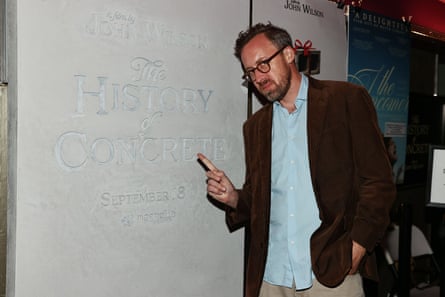
So goes the 100-minute film, which plays like an extended episode of How To and, in true Wilson fashion, is as much about the difficulty of figuring out your next thing, let alone making and selling it, as it is about the composite material (though he does visit one science lab and, naturally, a corporate meet-up for “the women of concrete”). The film finds Wilson in a strange place after the high of How To’s 2023 – directionless, anxious, famous enough to be the $2,000 Jeopardy question no one gets but not to secure financing for his dream of a feature-length documentary.
“I was having a lot of strange thoughts, crazy problems with self-esteem, especially when nobody wanted to take a chance with something like this, at least at first,” he recalls in the same halting, nasally speech of both his How To narration and, as seen in the film, someone’s AI-generated ad to sell gutters on TikTok (“I would’ve done it for free, if they asked,” he deadpans). The pressure to follow but not repeat the show was creatively dead-ending. “There was a lot of frustration when I started to pitch this idea because everyone seemed to want something different than How To, and that just felt like an arbitrary requirement to me,” he explains. The show’s digressive style “wasn’t a shtick. This is how I think. I just think this is the right way to do things. I like essay films, I like shooting things from my perspective.”
Resistant to do something different for difference’s sake and in the absence of financing, Wilson went back to basics: pick up camera, leave house. “I just started to do things the way that I always did, and that was the most fluid way to get myself out of the house and, like, have anything to do and work on, because I was depressed,” he recalls. “For some reason, I need to keep reminding myself of the same basic idea, that you should not wait for anyone else to make the thing that you want. You just need to do it.”
“I was just caught in this trap again, of thinking that I needed permission,” he continues, eyes grazing the cinderblock poster. So I just went out to try to make it, and then I decided to incorporate all of these voices that were trying to get me to change and do whatever the market would reward.”
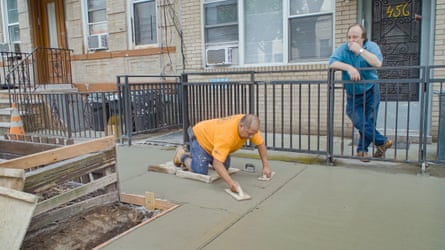
Said advice includes: make it sexy (he attends a brick-laying competition, where the winner receives a very sleek blue truck); make it a rock-umentary (he meets and follows an aging rocker at a liquor store); make it topical (expert testimony will leave you wary of driving under the crumbling Brooklyn Queens Expressway); make it celeb-adjacent (Wilson is among the few documentarians less comfortable in a room with Kim Kardashian than with a man preserving tattooed human skin). As with any Wilson project, the narrative wanders far away from the initial premise; Wilson wanders from Rome to the Sri Chinmoy Self-Transcendence race in which runners loop around a single block in Queens for a month, from an Ohio driver’s ed class to the set of Marty Supreme (whose director, Josh Safdie, served as an executive producer of Wilson’s doc).
All become avenues for Wilson’s sly explorations of far less solid material, from the struggle to find motivation to cyclical self-doubt, our desire to at once move forward and make something last. “I’m thankful for the resistance that I got, because the very thing that you are resisting, or that’s resisting you, ends up becoming the skeletal system or the spine of your work in certain ways, if you let it,” he says, slipping into the show and film’s standard second-person voice.
Such challenges could cause you to give up, to quit the project of your dreams for something else, to abandon the sly attempts to convince people to pay more attention to the ever weirder world around them. “There might be a kind of sickness in shooting things this way,” he tells me, reflecting on the uphill climb to a concrete movie. “But it’s the kind of imagery that I want to see, because I don’t see it anywhere else.”
-
The History of Concrete is out in select US cinemas now and will premiere at the London film festival next month with an Australian release planned for 9 October