2 months ago
58
2 months ago
58
Morning opening: Denmark 'slightly more optimistic' about resolving US Greenland interest

Jakub Krupa
Danish foreign minister Lars Løkke Rasmussen revealed he had “constructive” talks with the US over Greenland last night, saying that he is “slightly more optimistic today than a week ago” that a solution can be found.
No wonder: it’s a week since US president Donald Trump delivered that rambling Davos speech in which he repeatedly stated he needed to take control of Greenland.
Confirming hints from US state secretary Marco Rubio last night (Europe Live yesterday), Rasmussen said the pair met in Washington for further talks, putting them back on track with the process they agreed on two weeks ago.
“After that, there was a major detour, things were escalating, but now we are back on track,” he said.
Rubio told the US Congress last night that the low-profile format hoped to avoid “a media circus” around the talks – with more to come.
Rasmussen didn’t answer specific questions about what was covered in talks, sticking to the line that they focused on what can be done to meet US security interests without violating Denmark’s red lines on territory and sovereignty.
He will no doubt offer a bit more detail behind the closed doors as EU foreign ministers meet in Brussels this morning to go through a busy agenda covering the world on fire in Greenland, Ukraine, the Middle East, and other parts of the world.
I will keep an eye on what others ministers will say arriving for talks.
Separately, German chancellor Friedrich Merz is delivering a major foreign policy speech in the Bundestag this morning. I will bring you the key lines here, too.
I will also look at the latest on Ukraine and Russia, including a rare late night violation of Polish airspace by weather balloons from Belarus.
Lots for us to cover.
It’s Thursday, 29 January 2026, it’s Jakub Krupa here, and this is Europe Live.
Good morning.
Key events Show key events only Please turn on JavaScript to use this feature
Germany's Merz warns against 'rough winds' as he urges Europe to reassert itself to face challenges
Meanwhile over in Berlin, German chancellor Friedrich Merz warned about “rough winds blowing in the world” as the international rules-based world order is under strain, as he urged Europe to reassert itself as a global superpower, but without undermining its longstanding partnership and alliances, including with the US.
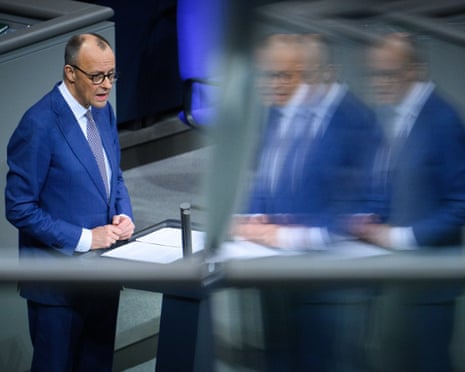
Merz said that with the rise of imperialism and autocracy, the EU has become a more attractive partner for new global alliances.
He said that in recent weeks he felt, “perhaps for the first time,” that Europe “can be a [global] power” when it focuses on defending its values.
He said that Europe needed to step up its defence and technological capabilities to “reduce dependencies” built over the last few decades. “Europe has always grown when it has been under pressure,” he said.
Merz also called for unity on the European side in the face of growing pressures, pointedly saying it proved to be effective in keeping the US on side on Ukraine before Christmas, and forcing Washington to U-turn on tariffs and Greenland early this year.
He said that the EU’s response over Greenland showed that “we would not be intimidated by tariff threats again,” showing to “everyone” (he means Donald Trump) that “we are ready and able to defend ourselves.”
He also pointedly said that leaders “should not recklessly jeopardise established alliances,” as he demanded US respect for German troops in Afghanistan after recent Trump comments.
Reminding lawmakers that 59 German soldiers died in Afghanistan and well over 100 were seriously injured, he said – to loud applause – that “we will not allow for this effort … to be scorned and disparaged today.”
But he also stressed the continuing importance of Nato, saying “we, Europeans, want to preserve NATO in order to strengthen it from Europe and in Europe.”
Merz also separately talked about the need to push for a greater reform of the EU to remove red tape and simplify existing regulations to kickstart European economies, a topic expected to be raised during next month’s informal EU leaders’ retreat.
Russia 'trying to bomb and freeze' Ukrainians into submission, EU's foreign policy chief warns
Arriving for the EU foreign ministers meeting in Brussels, the bloc’s foreign policy chief Kaja Kallas said they had a “very package agenda” for today, as “the international rules-based order [remains] under … strain.”
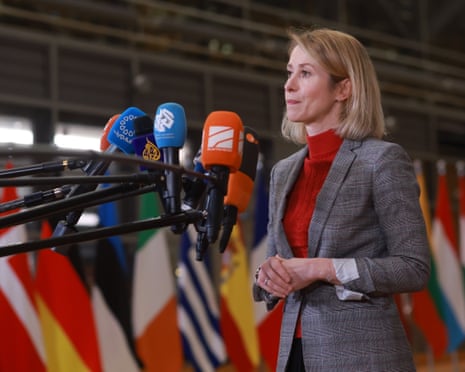
She said the ministers will discuss the evolving EU-US relationship, Russia’s war in Ukraine, and the Middle East, among others.
On Ukraine specifically, she said that the Russian delegation in the UAE talks continued to represent only military personnel, with “no mandate to agree on anything,” questioning whether Russia is genuinely committed to the peace process.
“They are bombing Ukrainians, trying to bomb and freeze them to surrender, and that’s why we are also discussing the energy support that we can give them, because it’s very hard winter and Ukrainians are really suffering. There is a humanitarian catastrophe coming there,” she said.
She added:
“My worry is that we have seen a lot of concessions also on the Ukrainian side, but that is blurring the picture, because Ukraine is not the one who is doing the aggression. It’s Russia who is doing this. So we should put more pressure on Russia so that we would see concessions on the Russian side.”
She also played down the idea of “a European army,” saying that it remained to be a domain for national authorities and hierarchies.
“In military you have to have a very straight and understandable chain of command, so that whenever something happens, it’s clear who gives orders to whom. If we create parallel structures, then it’s just going to blur the picture,” she said.
On the Middle East, the main topic is the situation in Iran, with a discussion on listing the Iran Revolutionary Guard on the EU’s terrorism list, “putting them on the same footing with Al Qaeda, Hamas, Daesh.”
“If you act as a terrorist, you should also be treated as terrorists,” she said.
The Washington meeting took place just hours after the US embassy in Copenhagen angered Danish veterans by removing national flags put up in front of the mission to honour Danish soldiers killed in Afghanistan.
Days after US president Donald Trump angered some allies by downplaying the role of non-US Nato troops in the Afghanistan war, 44 flags, which carried the names of the 44 Danish soldiers killed in Afghanistan, were put up on Tuesday in flower beds outside the US embassy in Copenhagen, AFP reported.
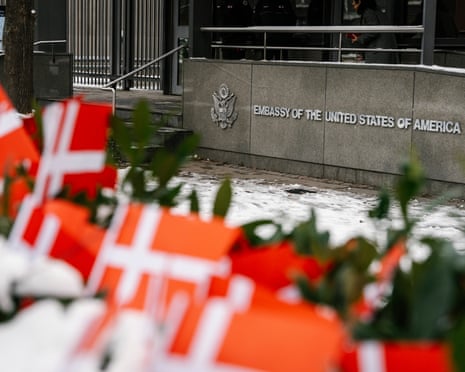
The embassy originally told Danish media that it had removed the flags because they had been put up without coordination with the embassy, prompting angry reaction from locals and veteran associations.
The embassy later backtracked, and a US State Department spokesperson told AFP that “until an outlet reached out, we were unaware of why the flags were placed in planters outside the Embassy.”
Following the news of the removal, new flags were put up on Wednesday.
By Wednesday afternoon, hundreds of small Danish flags had been put up in the flowerbeds, TV2 reported.

The embassy told AFP that “additional flags subsequently placed are currently in place and will remain so”.
Morning opening: Denmark 'slightly more optimistic' about resolving US Greenland interest
Jakub Krupa
Danish foreign minister Lars Løkke Rasmussen revealed he had “constructive” talks with the US over Greenland last night, saying that he is “slightly more optimistic today than a week ago” that a solution can be found.
No wonder: it’s a week since US president Donald Trump delivered that rambling Davos speech in which he repeatedly stated he needed to take control of Greenland.
Confirming hints from US state secretary Marco Rubio last night (Europe Live yesterday), Rasmussen said the pair met in Washington for further talks, putting them back on track with the process they agreed on two weeks ago.
“After that, there was a major detour, things were escalating, but now we are back on track,” he said.
Rubio told the US Congress last night that the low-profile format hoped to avoid “a media circus” around the talks – with more to come.
Rasmussen didn’t answer specific questions about what was covered in talks, sticking to the line that they focused on what can be done to meet US security interests without violating Denmark’s red lines on territory and sovereignty.
He will no doubt offer a bit more detail behind the closed doors as EU foreign ministers meet in Brussels this morning to go through a busy agenda covering the world on fire in Greenland, Ukraine, the Middle East, and other parts of the world.
I will keep an eye on what others ministers will say arriving for talks.
Separately, German chancellor Friedrich Merz is delivering a major foreign policy speech in the Bundestag this morning. I will bring you the key lines here, too.
I will also look at the latest on Ukraine and Russia, including a rare late night violation of Polish airspace by weather balloons from Belarus.
Lots for us to cover.
It’s Thursday, 29 January 2026, it’s Jakub Krupa here, and this is Europe Live.
Good morning.