2 months ago
54
2 months ago
54
Few people have seen as much horror as Don McCullin. The feted photographer, now 90, witnessed major conflicts and disasters up close for decades. You can only imagine, through his widely published black and white pictures, how that might have affected him.
McCullin’s latest exhibition, Broken Beauty at the Holburne Museum in Bath, begins with four recent pictures of ruined Roman sculptures. These images – the white ruins photographed against black backgrounds so they float – are reminiscent at first of museum postcards, representations of representations that refer to ancient history and myths of fatal ambition, desire and domination. There’s a crouching Venus, her arms missing and head half-shattered. A hermaphrodite struggles to get away from a lascivious satyr. A headless Amazon and the Roman emperor Commodus, known for his uninhibited cruelty, are fighting on horseback. Their pockmarked surfaces and broken limbs suggest the collapse of the great empires, the fragility of ideals that are obliterated by time, like marble.
McCullin seems to search for continuity in these sculptures, an acknowledgment that we’ve always been like this – and always will be. And perhaps also, they are a justification for his own role, in representing it, something he has devoted his life to. Will his images of horror have the same kind of beauty, with the distance of centuries?
McCullin stopped going to wars in the mid-1980s. He has since photographed landscapes in Somerset, where he lives, looking for solace and healing. But his pictures of the countryside are hardly anodyne: he makes a pond look like a pool of blood, spindly trees scratching the sky like torn limbs. His moribund visions turn open spaces into oppressive, brooding environments stalked by ghosts. If there’s beauty in this darkness, McCullin makes it hard to see.
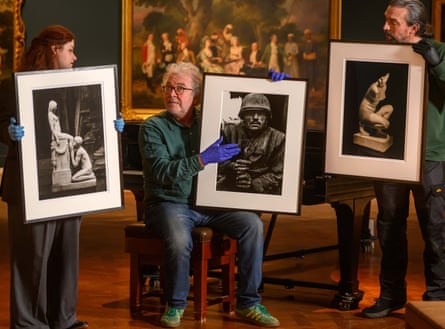
This small exhibition spans more than 60 years of work, from his first published picture of a notorious gang in Finsbury Park, London, that kickstarted his career in 1958, to iconic images from the Biafran war and the Aids crisis. The presentation is unfussy and straightforward, but all the drama is in McCullin’s photographs, glimpses of some of the bleakest moments in living memory. Many of the most harrowing images here focus on young men – their abhorrent propensity for violence but also their resilience and grief.
The picture of a group of young Christian Phalangists mocking the dead body of a teenage Palestinian girl who lies on the floor in front of them as they serenade her with sickly smiles and a stolen mandolin, still makes my stomach turn, though I have seen it many times. You think, too, of McCullin standing there, looking at the scene. In another picture, a 15-year-old boy stares right at you, his face glossy with tears. He is at his father’s funeral, having lost him to Aids. Young landmine victims waiting for medical aid, young Palestinian soldiers, topless and carrying guns. A shellshocked young marine’s vacant stare – a reflection of the horror of what they have seen, fighter and photographer. These young men, who once held the optimism of the future, are now ruined bodies among wrecked homes.
There are also several pictures from McCullin’s extensive body of UK work, of industrial landscapes and workers, homeless people and poverty on the peripheries. A homeless man in Shoreditch, London, sleeps standing up. McCullin is drawn to these liminal states, somewhere between life and death, past and present.
The conflict pictures have a sense of speed that McCullin’s work since could never have. It’s hard to believe he was able to take the pictures in real time. A triptych made in Belfast in 1971 shows riot police edging around the corner of a building, ready for the attack of a man in a suit armed with a plank who advances from the other side, catching the moment he hurls his weapon, blindly, towards their shields.
The landscapes can never hold the same immediacy and urgency as photographs like these. They are the “blunt side of the knife”, as McCullin has said, unable to pierce or wound us in the same way. Alongside the ancient ruin photographs and the still lifes McCullin makes in his garden shed, these landscapes are intended, perhaps, as a reprieve for the viewer, and for McCullin himself.
His interest in landscapes and still lifes is derived from the spectral presence of his previous subjects. McCullin has talked of the “twisted smiles of corpses” he sees everywhere. This show is a very brief introduction to McCullin’s immense contribution to photojournalism. But it shows that it is in proximity to devastation and death that McCullin’s work feels most alive.