3 months ago
79
3 months ago
79
The Six Nations is kicking off on a Thursday this year to avoid a direct clash with the Winter Olympics opening ceremony. In at least one key respect, even so, the two events are perfectly aligned: one early stumble for France or Ireland and a potentially painful descent awaits.
Despite the possibility of first‑night nerves and some Parisian drizzle it should still make for more intriguing viewing on ITV1 than the alternative of Dragons’ Den and The Apprentice on BBC One. Unless, of course, France are so far out of sight inside 40 minutes that they cannot be caught and the audience are free to switch over in good time to watch Sir Alan Sugar say: “You’re fired!”
That was pretty much Wales’s fate at this stage 12 months ago. By half-time in the 2025 tournament’s opening fixture, France were 28-0 ahead and cruising. The final score was 43-0 and, by the middle of March, Les Bleus were hoisting aloft the trophy. Only a narrow away defeat by England, in a game Fabien Galthié’s side could and should have won, prevented a French grand slam.
A potential case of deja vu this time? Ireland would much prefer to rewind to 2024 when this fixture, because of the looming summer Olympic Games in Paris, was shifted to Marseille. France saw Paul Willemse shown a red card after half an hour before going down 38-17. And guess who emerged as champions the following month? None other than Andy Farrell’s Ireland.
Plenty hinges on being able to seize the tournament initiative and send an early message to every other rival. And no one studying this week’s French team sheet could possibly say the hosts lack the ingredients to do that. While plenty of column inches have been given over to the absence of Damian Penaud, Gaël Fickou, the unavailable Thibaud Flament and the now retired Uini Atonio, rather fewer words have been devoted to the rich promise of Oscar Jégou, Matthieu Jalibert, Nicolas Depoortère, Théo Attissogbe and the ridiculously prolific Louis Bielle-Biarrey.
Then on the bench there is the 20‑year-old Kalvin Gourgues, the exciting Toulouse centre who has had to overcome serious health concerns to pursue his burgeoning career. Last year Gourgues was forced to undergo surgery to replace an artery in his left foot with one from his thigh to solve a blood-clotting problem that might otherwise have required the amputation of his lower leg.
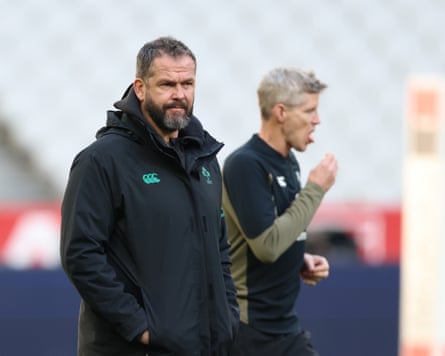
Roll it all up together and if France click the results could be spectacular. Jalibert has been in majestic form for Bordeaux, offering a sharp running threat in addition to his other playmaking talents. Some insist that he and Antoine Dupont, back after a 10‑month absence following the cruciate ligament injury he sustained against Ireland last March, are not an ideal half-back pairing because both prefer to run the show. Which is a perfectly valid stance if you ignore how attuned Jalibert and Bielle-Biarrey seem to be at club level, let alone Dupont and his Toulouse confrère Thomas Ramos.
It leaves a much-changed Ireland with umpteen tricky questions to answer and a few reputations at stake. Front-row injuries have presented Munster’s Jeremy Loughman with his first Test cap for two years, the 30-year-old slotting in at loosehead prop in the absence of Andrew Porter, Paddy McCarthy and Jack Boyle. Thomas Clarkson starts at tighthead with Tadhg Furlong not deemed to have recovered fully from a calf injury.
With no Hugo Keenan, Robbie Henshaw, Jordan Larmour, Mack Hansen, James Lowe or the suspended Bundee Aki, there is a similarly reshuffled feel to the backline. While Farrell has dubbed it “a fantastic opportunity” for some less familiar names to impress, he will also be aware that Ireland’s foundations are less stable than is usually the case.
It makes for a subtly different mental challenge, too, with Brian O’Driscoll suggesting last week that Ireland would benefit from adjusting their sights anyway. Ireland have paid a price previously, O’Driscoll reckons, for obsessing over Six Nations titles at the expense of prioritising exactly how best to deliver longer‑term World Cup success. He was speaking in a noisy room in Edinburgh but his message was clear enough: to reach the last four of a World Cup, Ireland need to prepare more strategically and give more big-match experience to fringe squad members en route.
That scenario has arrived. It is a colossal night, in particular, for the Prendergast brothers – 22-year-old fly-half Sam and 25-year-old flanker Cian – picked to start a Test together for the first time. As Farrell observed: “You can tell they try to keep it on the down low in front of all their teammates but I’m sure behind the scenes, along with their parents, they’re as proud as punch.”
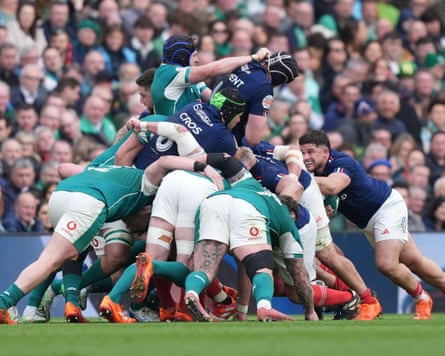
This will also be Jacob Stockdale’s first Six Nations appearance in five years, the Ulsterman having been crowned the player of the tournament as far back as 2018. For this Ireland side collectively, though, this feels like uncharted territory, even if Farrell is unfazed by the bookmakers giving France a 13-point start. “It’s obvious who are the favourites and all of that but it really doesn’t matter,” the victorious British & Irish Lions head coach of last year insisted.
There will also be some new silverware on offer, with the two teams playing for the inaugural Solidarity Trophy, which will now be awarded annually to the victors. And if the opening night story turns out to be a crushing Irish defeat, brace yourself for the “Thursday Murder Club” headlines.