2 months ago
63
2 months ago
63
A question about the death of Ayatollah Ali Khamenei to the head coach of the Iran women’s team before the Asian Cup was quickly, and unsurprisingly, shut down by officials in Australia. It is hard to know what Marziyeh Jafari could have said with events back home moving at an almost unimaginable pace. The former leader of Iran cast a large shadow over all walks of life and football was no different, though apparently he was not a fan.
But like many dictators he understood and was wary of the power of the country’s most popular sport, and the passions it provoked, especially when thousands of people came together. When times were tense, games were played behind closed doors. The heroes of Melbourne, who came from behind to win a playoff in Australia to qualify for the 1998 World Cup, were told not to come straight home to Tehran as the city celebrated. At that tournament there was more public joy after the famous 2-1 win against USAbut Khamenei’s statement was not the most sporting. “Tonight again the strong and arrogant opponents felt the bitter taste of defeat at your hands,” he told the team. “Be happy that you have made the Iranian nation happy.”
Throughout the Ayatollah’s time, players – heroes to millions – had to be careful what they said. Vital games have taken place amid protests at home, such as the 2010 World Cup qualifier in Seoul when several players donned green armbands, the colour of the opposition candidate in a presidential election many thought was rigged (the incumbent president and Khamenei’s man was Mahmoud Ahmadinejad – also reportedly killed in Saturday’s strikes – who really was a fan. He would turn up at national team training, give advice, and in 2009 lent the presidential plane to get the players back from a qualifier in North Korea for a game in Tehran four days later).
During the 2022 World Cup, there were more protests at home and players refused to sing the national anthem. There was something similar with the under-23 team this year when the regime was killing protestrs, and this week the women’s team stayed silent during the anthem before their game against South Korea.
Under the Ayatollah’s leadership women struggled for years to get into stadiums to watch football. This changed somewhat in 2019 but entry remains limited. There has been a lack of investment in football infrastructure and grassroots, the league has fallen behind regional rivals and the fact that the national team qualify for World Cups is testament to the talent that Iran still manages to produce.
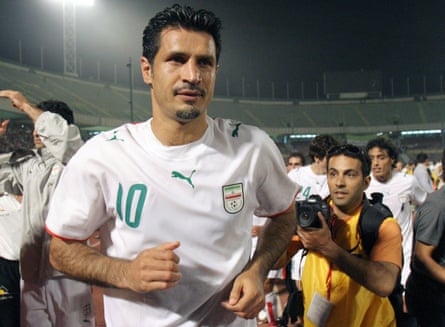
Khamenei was involved at times. It was rumoured that, in 2008, he made it known to Ahmadinejad that the striker Ali Daei should become national team coach. Coaching seemed to be a theme. In 2019, he lamented the quality of foreign managers in Iranian football. Three years later, he posted on social media to congratulate the Iranian team on reaching the Volleyball Nations League finals with the title: “Happy success with an Iranian coach.” A day later the Iranian football federation dismissed Dragan Skocic, who had qualified for the 2022 World Cup. The Croatian coach was reinstated within days but fired for good within weeks.
The current coach of Iran is Amir Ghalenoei, regarded as an uninspiring appointment, who took Team Melli to a fourth successive World Cup where they will meet New Zealand, Belgium and Egypt in Group G. Two of those matches are scheduled to take place in Los Angeles, nicknamed “Tehrangeles” owing to the large Iranian community that settled there after escaping the Islamic Revolution.
It could be an interesting atmosphere but, then again, maybe it won’t happen at all after, just over 100 days out from the biggest sporting competition, one of the co-hosts attacked one of the participants. “What is certain is that after this attack we cannot be expected to look forward to the World Cup with hope,” the Iranian Football Federation president, Mehdi Taj, reportedly said as bombs and missiles started to rain down.
Donald Trump is nothing if not unpredictable so anything could happen but there is genuine doubt as to whether Iran, confident of getting out of the group for the first time at the seventh attempt, will go, be allowed to go by Tehran or be allowed to enter by the US. There are no clear rules to govern what would happen if Iran do not participate but it is likely another Asian team would step in. It makes sense that this would be Iraq if they lose their playoff this month against Bolivia or Suriname. If Iraq win then the UAE, who finished third in the qualification group from which Iran and Uzbekistan took the two automatic spots, could well step in.
There’s more. This week the four AFC Champions League Elite’s last-16 first legs due to take place in west Asia have been postponed. The quarter-finals are not due to take place until April in the Saudi Arabian city of Jeddah, which for the second successive year has been chosen to host matches in the last eight. But Trump has said the US campaign has been projected to last four to five weeks and could “go far longer than that”. Even in his best-case scenario, alternatives will have to be found. There is plenty of uncertainty in Asian football and not just about whether Iran will go to the World Cup.